
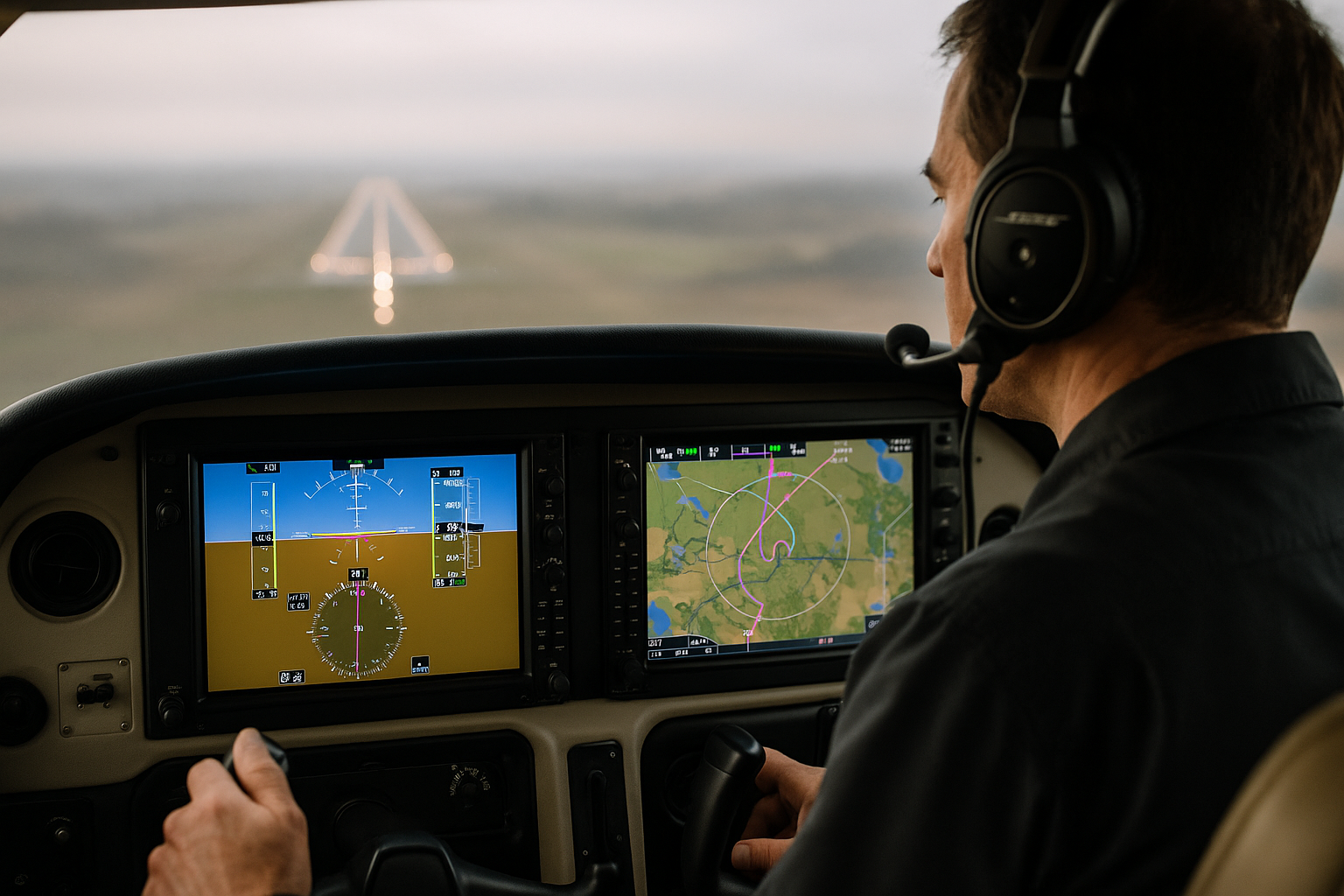
Advanced IFR approaches are a set of instrument procedures and technologies that give pilots more precise lateral and vertical guidance during instrument meteorological conditions. For pilots, student pilots, and flight instructors, understanding how to select, fly, and manage these approaches improves safety and supports better in-flight decisions.
This article explains the most operationally useful advanced IFR approaches, why they matter in real-world flying, how pilots should interpret the procedures in the cockpit, common misunderstandings that lead to risk, an example scenario demonstrating practical application, and clear best practices you can incorporate into training and operations. The guidance emphasizes pilot judgment, stabilized approach concepts, and system limitations rather than regulatory minutiae.
What We Mean by Advanced IFR Approaches
In operations language, advanced IFR approaches are procedures that provide enhanced navigation guidance or performance-based features beyond the most basic nonprecision procedures. Examples include approaches with precise lateral guidance, electronic vertical guidance, curved or radius-to-fix legs, and procedures that require navigation performance authorization. These capabilities are delivered through technologies such as GPS-based RNAV, satellite-based augmentation systems, and modern flight management systems with sophisticated lateral navigation and vertical navigation computations.
Defining an approach as advanced focuses on three practical attributes: precision of path guidance, complexity of the procedure design, and the need for additional pilot training or operational authorization. Precision reduces pilot workload and exposure in the final stages of an approach. Complexity and special authorization mean pilots and operators must add training and procedural discipline to fly the approach safely.
Why This Matters in Real-World Aviation
Advanced IFR approaches matter because they change operational risk characteristics in both positive and challenging ways. Enhanced vertical guidance, for example, can lower pilot workload and reduce the probability of an unstabilized approach in reduced visibility. Curved RNAV legs allow procedures to avoid terrain, noise-sensitive areas, or airspace constraints while maintaining a stabilized descent path aligned to the runway. When used correctly, these features improve safety margins and access to airports in marginal weather.
However, advanced approaches also introduce new failure modes and human factors considerations. Pilots must manage complex avionics, ensure database currency, confirm navigation performance, and maintain situational awareness when flying nonstraight-in segments. Autopilot coupling, VNAV logic, and flight director behavior during vertical transitions require explicit understanding during training and operational checks. Without that understanding, pilots can misinterpret indications, apply inappropriate automation modes, or mismanage a missed approach.
Core Types of Advanced IFR Approaches
The procedures pilots encounter most often fall into a few practical categories. Each has cockpit, training, and operational implications you should know.
LPV and APV Approaches
Localizer Performance with Vertical guidance (LPV) and other approaches that provide advisory vertical guidance offer descent path information similar to an instrument landing system without the ground-based localizer or glideslope. LPV minima are typically lower than traditional nonprecision minima because of the vertical guidance, which helps stabilize the final descent. In the cockpit, pilots should verify the required navigation receiver status, ensure the approach database contains the procedure, and confirm that vertical guidance is valid before relying on it for descent.
RNAV (GPS) Approaches with Radius-to-Fix and Fly-Over Legs
RNAV approaches can include advanced leg types such as radius-to-fix (RF) and fly-over waypoints. These features allow procedure designers to shape approach paths precisely around terrain or airspace but demand pilot familiarity with how the flight management system displays and navigates those legs. RF legs often involve bank angles and guidance that the autopilot and flight director will manage differently than straight segments, so brief the path and anticipated bank angles during an approach briefing.
RNP Approaches and Authorization Requirements
Required Navigation Performance (RNP) approaches are RNAV procedures that include a requirement for maintained navigation accuracy and, in some cases, special operational authorization. RNP approaches may allow lower minima and can include curved final approaches. The operational implication is twofold: pilots must understand the navigation performance capability of their aircraft and, where required, ensure their operation meets authorization or training requirements before flying RNP approaches.
Approaches with Advisory Vertical Path (VNAV) from FMS
Modern flight management systems compute advisory vertical guidance, often called VNAV, which pilots can use to fly an efficient descent profile. VNAV modes vary widely across manufacturers and models. Some VNAV functions provide guidance down to decision altitude, while others are advisory only and require the pilot to cross-check altitudes and descent rates. Knowing how your aircraft behaves during altitude capture, level-offs, and small flight path corrections is essential for maintaining a stabilized descent.
How Pilots Should Understand Advanced IFR Approaches
Operational understanding centers on the interaction between procedure design, avionics behavior, and human decision-making. Practice and preflight briefing convert procedural complexity into predictable cockpit behavior.
Start with the charted procedure. Identify whether the approach provides vertical guidance and what minima apply. Confirm that your navigation database is current and that the aircraft and avionics are certified for the approach type you plan to fly. During the approach briefing, call out the final approach course, descent path type, missed approach point, go-around routing, and any special segments such as RF legs or altitude constraints.
In the cockpit, cross-check automation modes. Many incidents occur because pilots assume the autopilot is in a particular mode when it is not. Verify lateral navigation mode, vertical mode, and what the NAV source is. For example, when flying an LPV, confirm the approach is loaded and the GPS indicates LPV vertical guidance is available before using it to descend below circling minima.
Understand what a stabilized approach looks like for instrument operations. Stabilized does not only relate to speed and descent rate. It includes being on the correct lateral and vertical path, having engines and systems configured for landing, owning the approach segment mentally, and being able to execute a missed approach immediately without disorientation. If the approach becomes unstable, execute the missed approach early rather than attempting to salvage it close to the runway.
Common Mistakes and Misunderstandings
Pilots and instructors often underestimate how advanced approaches change cockpit workflows. Common mistakes include overreliance on automation, misinterpreting advisory guidance as mandatory guidance, and inadequate briefings for complex procedure segments.
Misunderstanding automation modes is a frequent problem. For example, pilots may expect VNAV to manage descent to the runway threshold but the system is programmed to level off at a step-down altitude or to follow a flight director that requires mode transitions at specific waypoints. Ambiguous annunciations or unfamiliar flight director behavior can produce altitude busts or unstabilized profiles if not managed proactively.
Another common issue is database or receiver status. Flying an LPV or RNP procedure without verifying the navigation source and database currency undermines the safety benefit of the approach. If the system cannot provide the required navigation performance, the pilot must revert to an alternative method or approach.
Finally, pilots may underestimate the human factors involved during high workload segments. Complex procedure geometry, radio calls, approach lighting conditions, and last-minute runway changes add cognitive load. Training should simulate those stresses so pilots build the decision-making routines needed to reject unstable approaches and execute missed approaches cleanly.
Practical Example: A Realistic IFR Arrival and Approach
Consider a commercial operator flying a medium twin from cruise to a busy metropolitan airport in instrument conditions. The clearance assigns an RNAV approach with an LPV minimum; a curved RF final aligns the aircraft with a runway that is offset from the initial arrival track. The crew receives a late notice of a ground delay that will increase traffic and requires careful spacing on final.
The captain briefs the approach: lateral path includes an RF leg requiring an anticipated bank of approximately 20 degrees, vertical guidance will be LPV if available, missed approach routing climbs to 3,000 feet and then turns to a holding fix. The PM loads the approach, verifies database cycle, confirms the GPS indicates LPV capability, and cross-checks nav radios. The autopilot is coupled and set to follow LNAV/VNAV or LPV as appropriate.
During descent, the crew monitors the VNAV path and speed. At the initial approach fix the flight director shows path capture, but a headwind increase produces a higher descent rate than planned. The PM calls an early stabilization check. The approach remains stable because the crew adjusts thrust and uses flight director cues to maintain target descent rate and speed. If the vertical guidance were lost or the approach became unstable because of turbulence or an abrupt go-around instruction, the crew had already briefed the missed approach and could execute it without confusion.
This example demonstrates the interplay of briefing, automation management, workload management, and clear decision points. The advanced features of the approach reduce exposure in IMC, but only when the crew validates the system state and maintains disciplined crew resource management.
Best Practices for Pilots
Implement the following operational habits to get the most safety value from advanced IFR approaches.
- Brief with intent. Your briefing should identify how the approach will be flown, what automation modes will be used, where mode transitions occur, and the exact missed approach plan.
- Validate navigation status early. Confirm database currency, GPS integrity flags, and published minima applicability before descending below the initial approach altitude.
- Verify vertical guidance availability. If the procedure has advisory vertical guidance, make sure it is active and annunciated. If it drops out, revert to a prepared plan.
- Manage automation modes explicitly. Use callouts for autopilot and flight director mode changes. If you hand-fly any segment, brief who will fly and how mode changes will be announced.
- Maintain stabilized approach criteria. Set and enforce stabilized approach criteria that include lateral path, vertical path, speed, and configuration. If criteria are not met by a specified point, go missed early.
- Practice missed approach execution. Train missed approaches from both coupled and manual flight. Include scenarios where vertical guidance is lost and where RF legs complicate the initial turn.
- Train for degraded scenarios. Simulate database errors, GNSS outages, and ambiguous mode annunciations in training to build resilience in real operations.
Training and Proficiency Considerations
Advanced IFR approaches call for structured training that integrates avionics knowledge, procedural briefings, and scenario practice. Flight instructors should include scenario-based training that forces the pilot to manage automation failures and make timely decisions to go missed. Recurrent training should cover approach selection, onboard database management, and manual flying techniques for RNAV procedure segments with curved legs.
Proficiency includes the ability to interpret and confirm lateral and vertical guidance, understanding how your specific avionics present RF legs or fly-over waypoints, and managing the transition from instrument flight to visual references if they appear late in the approach. Regular practice in a simulator or a high-fidelity flight trainer accelerates this learning without exposing the aircraft and crew to unnecessary operational risk.
When to Prefer Simpler Alternatives
Advanced approaches offer operational advantages, but simplicity has its own safety value. In circumstances where automation is degraded, database status is uncertain, environmental conditions are highly dynamic, or the crew is fatigued, consider approaches that are straightforward to fly manually. A stable nonprecision approach flown accurately often has better outcome probability than a complex procedure flown poorly. This is not an argument against advanced approaches; it is a reminder that approach selection must consider system health, pilot proficiency, and operational context.
Common Scenarios That Challenge Advanced Approaches
Several real-world scenarios repeatedly test pilots flying advanced approaches. Anticipating these helps create robust responses.
- Automation mode ambiguity. Pilots become confused about whether the autopilot is following the lateral or vertical path. Explicit cross-checks and callouts reduce the risk.
- Loss of vertical guidance near minima. Systems may revert from advisory vertical guidance to advisory-only or to step-down modes. A clear plan for immediate stabilization or a missed approach is essential.
- Procedure complexity with traffic pressure. Busy airspace and ATC vectors increase workload during complex final segments. Briefing the timing and expected interactions with ATC mitigates last-minute surprises.
Frequently Asked Questions
Are advanced IFR approaches always safer than conventional approaches?
Not automatically. Advanced approaches can reduce workload and provide precise paths, which improves safety when systems are functioning and pilots are proficient. However, they introduce new dependencies on avionics and databases. When those supporting elements fail or when crews lack training, the complexity can increase risk. Approach selection should weigh the aircraft and crew capability against the operational conditions.
How should a single-pilot operator manage advanced RNAV approaches?
Single-pilot operations require conservative decision-making. Prioritize approaches that match your avionics capability and your personal proficiency. Perform a thorough briefing, configure the avionics early, and use simpler missed approach procedures if the approach geometry or traffic pressure increases workload. If you are not comfortable with an advanced segment, request a vector to a simpler final or an alternate approach.
What should I do if vertical guidance disappears during final approach?
If advisory vertical guidance fails near minima, immediately assess whether the approach can remain stabilized using raw data and visual cues if available. If not stabilized or if you cannot confidently fly to the runway visually, execute the missed approach. A prebriefed missed approach reduces confusion under stress.
Do I need special authorization to fly RNP approaches?
Certain RNP procedures include operational authorization requirements and associated training. Verify that your operation meets any authorization or training needs for the specific RNP approach before accepting the clearance. If you are unsure, treat the approach as unavailable and request an alternate procedure.
How often should I practice advanced approach maneuvers in training?
Regular practice is vital. Include advanced approach scenarios in initial and recurrent training cycles. Frequency should match operational exposure: crews who fly advanced approaches regularly should train on them more often. Simulators and procedure trainers are efficient ways to build and maintain these skills.
Common Mistakes and How to Fix Them
Understanding common errors helps frame specific, teachable corrections.
- Assuming vertical guidance is guaranteed. Fix: Always verify annunciated guidance and have a contingency plan if it fails.
- Not briefing RF or curved segments in detail. Fix: Include expected bank angles and autopilot coupling behavior in the briefing.
- Letting automation mask situational awareness. Fix: Cross-check raw instruments and outside references when they become available; use mode callouts.
- Delaying the missed approach decision. Fix: Define a go/no-go point and be disciplined about executing the missed approach if criteria are not met.
Key Takeaways
- Practical takeaway: Advanced IFR approaches give precise guidance that can reduce workload and improve stabilized approaches when systems and training support their use.
- Safety takeaway: Always validate navigation and vertical guidance status and be ready to execute a missed approach early if the approach becomes unstable.
- Training and decision-making takeaway: Integrate scenario-based training for automation failures, RF legs, and database issues to build competence and confidence.
Final Operational Guidance
Adopt a conservative, systems-aware mindset. Advanced IFR approaches are tools that extend capability when used correctly. Emphasize thorough briefings, explicit mode management, and disciplined execution of stabilized approach criteria. Use simulators to rehearse failure modes and missed approach profiles so that in real operations the crew reacts decisively and safely.
By blending technical knowledge of approach features, rigorous briefings, and recurrent scenario-based practice, pilots and instructors can turn the advantages of advanced IFR approaches into consistent operational safety gains.