
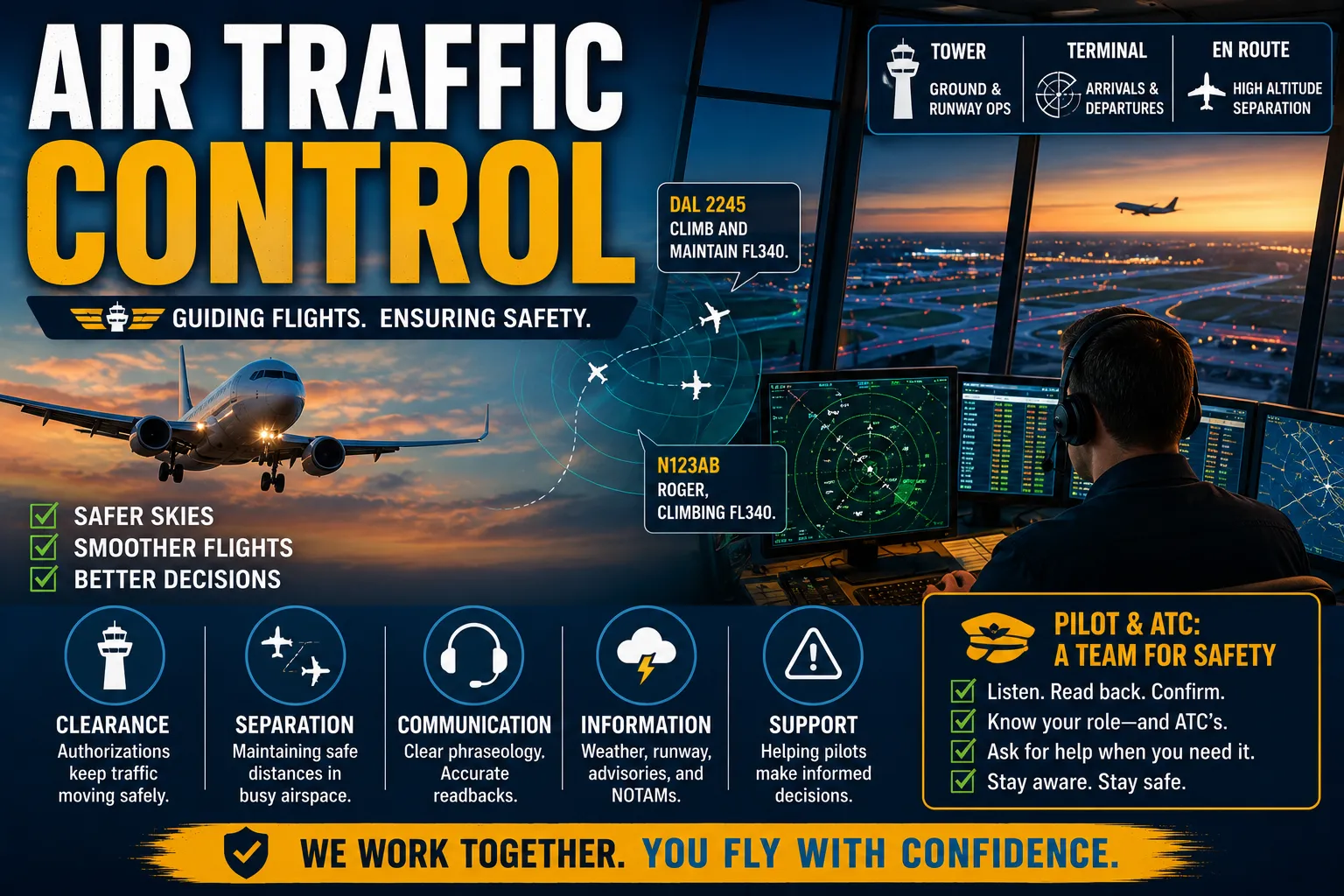
Air traffic control plays a central role in keeping the skies safe for pilots, passengers, and aviation professionals. Whether you fly light singles, teach students, or operate commercial aircraft, understanding how air traffic control manages traffic, communicates risk, and supports pilot decision-making improves safety and operational effectiveness.
This article explains the core functions of air traffic control, how controllers maintain safe separation and situational awareness, and what pilots should know to work smoothly with ATC. Practical takeaways, common misunderstandings, and a realistic scenario are included to help flight instructors and pilots apply these concepts in training and everyday flying.
How Air Traffic Control Works
Air traffic control coordinates the movement of aircraft to prevent collisions, expedite traffic flow, and provide information essential to safe operations. Controllers operate in a layered system that includes tower, terminal, and en route facilities. Each facility has defined responsibilities tied to phases of flight: ground and runway operations at towers, arrival and departure sequencing at terminal facilities, and en route traffic separation in high-altitude centers.
Controllers rely on several tools and practices: radar and multilateration surveillance, automated flight data systems, aeronautical charts, standard instrument procedures, and clear radio communications. They apply local procedures and established separation methods to manage interactions between aircraft in controlled airspace. When automation and surveillance are not available, ATC uses procedural control methods that depend on timing, routing, and pilot position reports.
Why This Matters in Real-World Aviation
For pilots and instructors, ATC is more than a source of vectors and clearance; it is a safety partner. Timely and accurate clearances reduce pilot workload during critical phases like approach and departure. Reliable ATC services help manage traffic flows around busy airports, reduce go-arounds, and support contingency handling in rapidly changing weather. Understanding ATC responsibilities and limitations improves crew coordination and decision-making, especially when operating near busy airspace or under instrument conditions.
ATC also serves as an information conduit. Controllers provide traffic advisories, runway condition updates, and guidance on airspace restrictions. Pilots who understand what ATC can and cannot do are better positioned to request services such as flight following, preferred routing, or assistance when experiencing an emergency.
How Pilots Should Understand Air Traffic Control
Pilots should view ATC as a system of shared responsibilities. Controllers provide separation and traffic information within the scope of their authority and the constraints of surveillance and traffic volume. Pilots retain responsibility for safe operation of the aircraft, including compliance with clearances and self-separation when operating under visual meteorological conditions or when ATC services are limited.
Effective pilot-ATC interaction rests on concise, standardized phraseology and clear readbacks. When a clearance is received, a correct readback confirms mutual understanding. If a clearance is ambiguous, incomplete, or conflicts with the pilot's safe operation of the aircraft, the pilot must ask for clarification or amendment. Proactive communication helps prevent misunderstandings that can lead to traffic conflicts or airspace deviations.
Common Mistakes or Misunderstandings
Several recurring errors appear in pilot-ATC interactions. One is assuming ATC will provide tactical separation or advisories without explicitly requesting them. For example, pilots operating under visual flight rules should not expect traffic advisories unless they have flight following or are in a service that includes traffic information.
Another common misunderstanding is failing to monitor assigned frequencies during handoffs. Missing a frequency change or delay in establishing contact can lead to lost communication and missed traffic information. Also, pilots sometimes accept clearances that place them outside the aircraft's performance or the pilot's situational comfort; immediate coordination is necessary to adjust such clearances.
Finally, overreliance on automation and surveillance can create blind spots. Surveillance coverage varies with terrain and equipment, and outages or degraded radar performance can occur. Pilots should not assume ATC has definitive situational awareness of every aircraft at all times.
Practical Example
Imagine a commercial single-pilot operator flying a regional route to a busy terminal airport. During descent, ATC issues a sequence to follow another aircraft on final approach and provides a crossing restriction. The pilot verifies the traffic visually and reads back the crossing restriction. Weather begins to deteriorate below published minima for the visual segment. The pilot communicates an inability to accept the visual sequence and requests an instrument approach. ATC responds by reassigning spacing and vectors to sequence the aircraft for the instrument approach. The pilot completes the instrument approach using the cleared procedure and conducts a stabilized landing.
This example shows several practical points: timely communication of the pilot's limitations, the controller's role in resequencing traffic, and the importance of readbacks and situational awareness. It also demonstrates that ATC can provide flexible support but that pilots must clearly state their needs when conditions change.
Best Practices for Pilots
Adopt the following habits to strengthen pilot-ATC coordination and safety.
- Listen actively before responding. Briefly confirm the intent of an instruction before readback when workload allows.
- Use standard phraseology and precise readbacks to reduce ambiguity. When you cannot comply with a clearance, state why and request amendments.
- If surveillance or ATC services are critical to your operation, verify coverage before relying on it. Ask for radar advisories, traffic information, or flight following when appropriate.
- Plan for contingencies including lost comms, surveillance outages, and sudden weather changes. Know the applicable lost communication procedures and missed approach or go-around actions.
- Maintain visual scanning even when ATC provides traffic advisories. Do not substitute ATC traffic calls for your see-and-avoid responsibilities.
Frequently Asked Questions
What is the difference between tower, terminal, and en route ATC?
Tower controllers manage ground movement and runway operations at airports. Terminal (approach and departure) controllers handle arrival and departure sequencing within a terminal area. En route or center controllers manage traffic at higher altitudes between terminal areas, providing separation and routing over broader regions. Each facility focuses on distinct phases of flight and hands aircraft off to the next facility as the flight progresses.
Can ATC give pilots instructions that conflict with published procedures?
Controllers can issue clearances that differ from published procedures when traffic or operational considerations demand it. Pilots are expected to comply unless the clearance is unsafe or the aircraft cannot meet the clearance. If a clearance conflicts with aircraft performance, regulations, or safety, the pilot should immediately request clarification or an amended clearance.
How should a pilot handle lost communications with ATC?
If two-way radio communication is lost, follow applicable lost communication procedures for your airspace and flight rules. Attempt to reestablish communications on known frequencies, squawk the lost comms code if applicable, and use transponder and navigation resources to continue safely. Notify ATC of the situation when communications are reestablished or follow expected routing and altitudes specified in published guidance.
Does ATC provide traffic separation for VFR flights?
Services vary by airspace and facility. In many cases, ATC provides Traffic Advisories or Flight Following to VFR aircraft upon request when capacity and surveillance permit. However, VFR pilots retain responsibility for see-and-avoid separation, and flight following is not a substitute for visual vigilance.
When should a pilot ask ATC for assistance?
Request ATC assistance whenever you need traffic advisories, radar vectors, weather updates, rerouting, or help with unexpected situations such as in-flight system failures. Be explicit about the type of assistance required, for example requesting vectors for traffic separation or declaring an emergency if needed.
Key Takeaways
- Keep communication clear: use standard phraseology and accurate readbacks to prevent misunderstandings.
- Safety depends on shared responsibility: ATC manages separation within its scope; pilots remain responsible for safe aircraft operation and situational awareness.
- Train for contingencies: practice lost comms, missed approaches, and coordination with ATC during instrument and visual operations.