
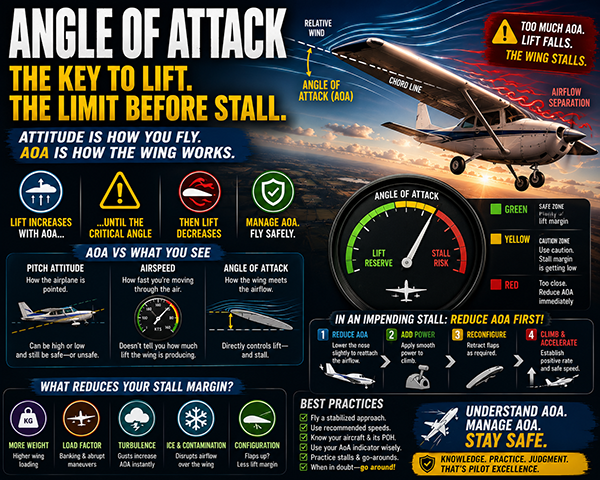
Angle of Attack is a core aerodynamic concept pilots must understand to fly safely and confidently. Angle of Attack, often shortened to AoA, describes the angle between the wing's chord line and the relative wind. It directly controls the wing's ability to produce lift and is the primary variable that determines when a wing will stall.
This article explains Angle of Attack in practical terms for pilots, student pilots, flight instructors, and aviation professionals. You will learn how AoA differs from pitch and airspeed, how aircraft configuration and maneuvering affect stall margins, and how to apply this knowledge during approaches, maneuvers, and upset recovery. Practical examples, common mistakes, and useful best practices are included to improve in-flight decision-making.
What Angle of Attack Is and How It Works
Angle of Attack is the geometric angle formed between the wing chord line and the oncoming relative wind. As AoA increases, lift produced by the wing increases up to a point. Beyond a critical angle the airflow separates from the upper surface of the wing and lift decreases rapidly. That sudden loss of lift is what pilots call a stall.
Lift varies with the coefficient of lift, which is a function of AoA, air density, wing area, and airspeed. Two important consequences follow: first, a wing can stall at any airspeed if its AoA exceeds the critical value; second, changes in weight, load factor, or wing configuration can change how close an aircraft is to its stall AoA even when indicated airspeed remains constant.
Why This Matters in Real-World Aviation
Understanding AoA matters because it helps pilots prioritize energy management and control inputs over mere reliance on airspeed or pitch attitude. A common accident chain involves high AoA close to the ground during approach or maneuvering, where limited altitude removes recovery options. Training that emphasizes AoA awareness improves recognition of impending stall conditions and supports safer go-around and recovery decisions.
Aircraft manufacturers publish performance data and stall speeds for specific configurations in the pilot operating handbook. Those values are useful, but they apply to a particular aircraft at a particular weight and configuration. Real-world conditions such as turbulence, ice accumulation, flap settings, or abrupt control inputs change the stall margin by altering AoA or load factor.
How Pilots Should Understand and Use AoA
Pilots should treat Angle of Attack as the aerodynamic variable that directly controls stall onset. Practically speaking, that means:
- Recognize that pitch attitude and airspeed are indicators, not direct measures, of how close you are to the critical AoA.
- Develop a mental model where lift is controlled primarily by AoA and secondarily by airspeed and configuration.
- When recovering from an approaching stall, reduce AoA first to restore attached flow, then manage power and configuration to regain airspeed and altitude.
Some aircraft are equipped with Angle of Attack indicators or lift reserve displays. These devices present information about how close the wing is to its critical AoA, often in a simple, pilot-friendly format. When available and properly calibrated, AoA indicators help with stabilized approaches, cross-checking reference speeds, and detecting marginal margins in gusty conditions.
Common Mistakes or Misunderstandings
Pilots frequently make operational errors related to AoA because it is not always obvious from the cockpit instruments. Common mistakes include:
- Relying solely on indicated airspeed. Airspeed does not directly tell you the wing's current AoA, especially when the aircraft is maneuvering or loaded differently than when published stall speeds were determined.
- Confusing pitch attitude with Angle of Attack. Pitch attitude is the aircraft's orientation relative to the horizon. AoA is the wing's angle relative to the relative wind; pitch can be high while AoA is low and vice versa.
- Allowing excessive load factor. Increasing bank angle or abrupt control inputs raise wing loading and increase the AoA required to maintain altitude, reducing the margin to stall.
- Misinterpreting AoA indicators. Different aircraft use different scales and color bands. Pilots must know how the installed indicator presents information for that airframe and configuration.
Practical Example: Stabilized Approach and Go-Around
Imagine you are on short final in a light single. The approach feels slower than normal because of a tailwind component and a gusty crosswind. You notice the airplane feels mushy and the sink rate increases. Pitch attitude looks high compared to previous approaches, but the airspeed indicator still reads near the published approach speed.
In this situation, AoA awareness helps you prioritize actions. The combination of gusts and higher pitch can increase instantaneous AoA, reducing your stall margin even though indicated airspeed appears acceptable. Rather than tightening controls to maintain the airspeed needle, a stabilized-approach mindset and early decision to go around preserve safety: reduce angle of attack to reattach the flow, add power smoothly, and reconfigure as necessary to climb away on a stabilized climb-out. Recognize that trimming for a lower pitch or adding power without reducing AoA first can delay recovery.
Best Practices for Pilots
Understanding AoA is partly conceptual and partly procedural. The following practices help convert knowledge into safer flying.
- Train deliberately on AoA recognition and recovery. Practice stall recognition, approach-to-stall scenarios, and go-arounds in the airplane or a flight simulator under an instructor's supervision.
- Know your aircraft's POH/AFM performance and how configuration changes stall margins. Use recommended approach speeds and adjust for gusts, weight, and density altitude per manufacturer guidance.
- Use an AoA indicator if available and understand its specific indications and any limitations for your aircraft and configuration.
- Prioritize reducing AoA immediately during a stall or impending stall. Once the wing is flying again, smoothly add power and adjust configuration to accelerate to a safe climb speed.
- Brief and practice go-arounds so the maneuver becomes an automatic, safe response to an unstable approach rather than a last-minute, high-AoA scramble.
- Avoid abrupt high-angle maneuvers at low altitude, and apply coordinated rudder and aileron inputs to prevent asymmetric stalls or spins.
Frequently Asked Questions
What is the difference between Angle of Attack and pitch attitude?
Pitch attitude is the airplane's orientation relative to the horizon. Angle of Attack is the wing's angle relative to the relative wind. Pitch can be a useful cross-check, but only AoA determines when the wing will stall. A high pitch attitude does not always mean a high AoA, and a low pitch attitude does not always mean a safe AoA.
Will an AoA indicator prevent stalls?
An AoA indicator provides direct information about the wing's current angle relative to the airflow. It improves situational awareness and approach stabilization when used correctly. However, like any instrument, it must be interpreted in context of configuration, airspeed, and pilot technique. It is a tool that supports, but does not replace, proper training and sound judgment.
When should I practice AoA-related maneuvers?
Practice AoA recognition and recovery as part of your regular training syllabus under an instructor's supervision. Incorporate maneuvers such as power-on and power-off stalls, approach-to-stall drills, and go-arounds. These exercises help build the instinct to reduce AoA first and recover in a coordinated manner.
Key Takeaways
- Practical takeaway: Angle of Attack controls lift and determines stall; learn to recognize and manage AoA, not just airspeed or pitch.
- Safety takeaway: In an impending stall, reduce AoA first to restore attached flow, then add power and reconfigure to regain safe flight.
- Training takeaway: Practice AoA recognition and go-arounds under instruction and understand any AoA indicator specific to your aircraft.