
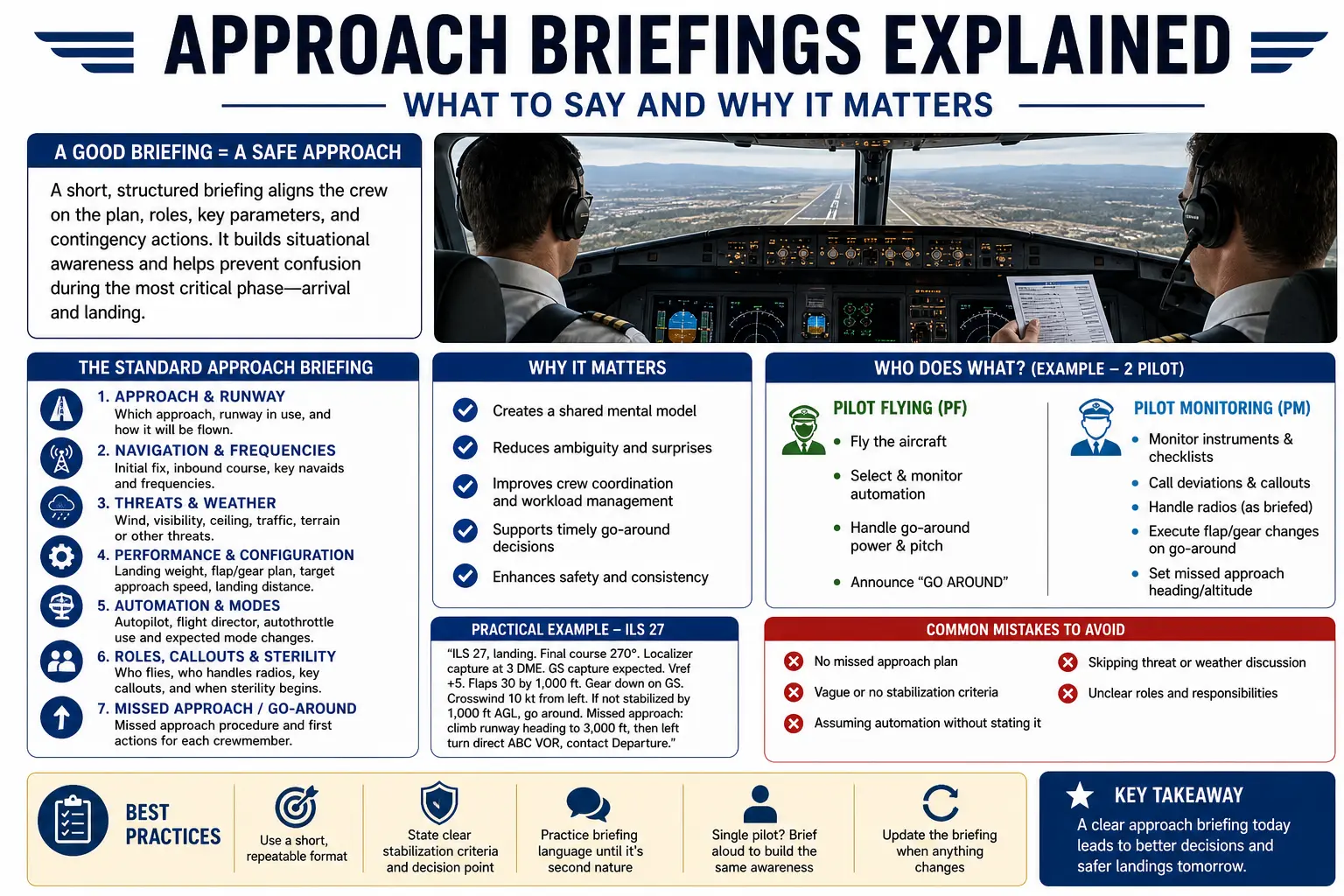
Approach briefings are a short, structured exchange that sets expectations for the arrival and landing phase of flight. Whether you fly single‑engine trainers, business jets, or large airliners, a clear approach briefing aligns the pilot(s) on the plan, roles, key parameters, and contingency actions. The primary keyword "approach briefings" appears naturally in this introduction because mastering what to say, and why, directly improves situational awareness and reduces the chances of confusion during one of the most time‑critical phases of flight.
This article explains the standard briefing structure, highlights differences between airline and general aviation practice, and shows how concise briefings improve safety. You will find practical guidance for pilots, instructors, and operators, plus a realistic example, common mistakes to avoid, and best practices that you can apply during training and everyday operations.
What an approach briefing is and the standard structure
An approach briefing is a focused, verbal summary of the essential elements of the arrival and landing. It creates a shared mental model so every crewmember understands the plan and the triggers for alternate actions. While organizations vary in wording and detail, a standard briefing structure typically covers these core elements:
- Type of approach and runway: which approach procedure, runway in use, and whether the approach will be flown as published, stabilized, or visual.
- Navigation and frequencies: expected initial fix, inbound course, and key frequencies or navaids to be used.
- Threats and weather considerations: wind, visibility, ceiling, known nearby traffic, or terrain concerns that could affect the approach.
- Landing performance and configuration: expected landing weight, landing distance considerations, flap and gear timing, and target approach speed or airspeed profile.
- Automation and modes: how autopilot, flight director, and autothrottle will be used and what mode changes to expect.
- Callouts, role assignments, and sterility: who will fly, who will handle radios, who performs final checks, and when normal cockpit sterility begins.
- Missed approach and go‑around: the initial missed approach procedure or go‑around plan and first actions for each crewmember.
That order helps pilots establish the expected tactical picture, then identify what to do if the approach becomes unstable or a diversion is required. The briefing should be concise, explicit about responsibilities, and repeated as necessary when conditions change.
Why approach briefings matter in real‑world aviation
Arrivals and landings are high workload, high risk, and often time compressed. Briefings matter because they reduce ambiguity, improve shared situational awareness, and make error detection and recovery faster. In multi‑crew environments, a briefing reinforces crew resource management by aligning pilot actions and callouts. In single‑pilot settings, the briefing functions as a deliberate cognitive rehearsal of the approach and contingencies, often spoken aloud or documented in the flight log.
Good briefings also support decision making: when pilots have already discussed the go‑around criteria, required approach speed, and landing conditions, they are more likely to execute timely go‑arounds rather than continuing unstabilized approaches. Briefings become especially important when operating into unfamiliar airports, in marginal weather, or during complex approaches that require mode changes and precise spacing.
How pilots should understand approach briefings in practice
Think of the briefing as a compact narrative that answers three questions: what are we doing, how will we do it, and what will we do if it goes wrong. The tone should be procedural, not conversational: concise language, confirmed roles, and explicit thresholds for action. In practical terms:
- Keep it short. A full briefing rarely needs more than 60 to 90 seconds for routine approaches; allow more time for complex or non‑standard situations.
- Make it relevant. Focus on elements that could change the outcome of the approach: weather, NOTAMS, runway contamination, terrain, or competing traffic.
- State decision criteria. Say the stabilization criteria and the point at which you will go around if not met. For example, specify an airspeed tolerance, descent rate limit, or required visual references at specified altitudes.
- Assign roles. In two‑pilot operations, say who will call deviations and who flies the missed approach. In single‑pilot operations, verbalize your plan to air traffic or a safety pilot if present.
Using standardized phrases reduces confusion. Many operators maintain short briefing cards or checklists to ensure consistency. When flying with unfamiliar crewmembers, err on the side of more explicit language rather than brevity that sacrifices clarity.
Airline versus general aviation differences
Both airline and general aviation pilots perform approach briefings, but there are practical differences driven by crew size, organizational procedures, and avionics capability.
Airline and corporate multi‑crew operations typically follow formal standard operating procedures. Briefings are structured, often support challenge‑and‑response checks, and include explicit callouts for automation modes, threat items, and contingency routes. Airlines emphasize CRM, sterility of the cockpit during critical phases, and cross‑monitoring responsibilities. Briefings are used to coordinate complex aircraft systems and to confirm company or dispatch fuel and diversion plans.
In general aviation, particularly single‑pilot flights, briefings are usually more compact and mindset‑oriented. The pilot often uses a standard flow and verbalizes the approach plan aloud to create a mental checklist. When flying with a safety pilot or passenger who helps with radios, briefings should clarify who talks to ATC and who performs visual monitoring. Light GA aircraft frequently operate without the redundancy of multiple trained crew, so briefings emphasize immediate, actionable items that the single pilot can manage without extra support.
Across both sectors, the same principles apply: clarity, responsibilities, and explicit missed approach criteria. The difference lies in the level of formalization and the degree of role separation.
Common mistakes and misunderstandings
Poor approach briefings often look like rushed monologues, omission of critical information, or assumptions that others know the plan. Common mistakes include:
- Overlooking contingencies. Failing to state a missed approach or diversion plan leaves the crew scrambling if the approach fails.
- Vague stabilization criteria. Saying "we will be stabilized" without defining tolerances for speed, vertical speed, or configuration is ineffective.
- Assuming automation behavior. Not explicitly stating which autopilot or flight director modes will be used can lead to unexpected mode changes and confusion.
- Skipping weather threats. Downplaying wind shear, tailwind, or runway contamination leads to surprises during flare and landing rollout.
- Not confirming who flies the aircraft. Role ambiguity, especially during high workload, increases the probability of control or communication errors.
Address these by using short, repeatable phrasing and by confirming the plan aloud when conditions change.
Practical example: two‑pilot ILS approach briefing
Scenario: An ILS approach to runway 27 in light rain with a 10‑knot crosswind. The crew is established on vectors to final at 3,000 feet.
Briefing (concise format): "ILS 27, landing. Final approach course 270 degrees. Autopilot coupled to FAF inbound, localizer capture expected at 3 DME. Target approach speed Vref plus 5 knots, flaps 30 by 1,000 feet, gear down at glideslope capture. Crosswind correction left rudder as required; maximum crosswind for landing is per company limits. Missed approach: fly runway heading, climb to 3,000, then contact departure; pilot flying will call go‑around and advance power, pilot monitoring will call flaps and gear up and set missed approach heading. If unstable below 1,000 feet AGL, go around."
That briefing identifies the approach type, configuration points, automation plan, stabilization decision point, and the missed approach procedure. Each pilot understands who will fly and who will support. It also sets a clear go‑around altitude and immediate actions, reducing hesitation at a critical moment.
Best practices for pilots
Adopt these habits to make approach briefings effective:
- Use a short, repeatable format tailored to your operation. Keep the sequence consistent so items are not skipped.
- Include explicit stabilization criteria and a clear missed approach decision point. Say exact numbers where helpful.
- Practice briefing language during training so it becomes natural under pressure.
- When flying single pilot, verbalize the briefing to yourself or to available support to create the same cognitive benefits as a two‑crew briefing.
- Update the briefing when ATC issues changes, weather deteriorates, or runway conditions differ from expectations.
Frequently asked questions
How long should an approach briefing take?
An effective approach briefing is concise: typically under two minutes for routine approaches. More complex approaches or single‑pilot flights into unfamiliar fields may require more detail and extra time. The goal is clarity, not length.
What if ATC changes the approach shortly before final?
If the approach changes, briefly restate the new plan and any altered roles or decision points. If the change increases workload or complexity, consider requesting additional vectors or time to rebrief and configure the aircraft.
Should single‑pilot GA flyers do a briefing every time?
Yes. Even a short, verbalized plan improves situational awareness. Instructors should teach a compact briefing flow that students can use in training and solo operations.
How do I train approach briefings during lessons?
Include practice briefings before every approach in the lesson. Start with a written or carded format, then progress to spontaneous briefings under simulated distractions so students learn to be concise and clear under pressure.
What belongs in the missed approach portion of the briefing?
State the initial missed approach maneuver, climb profile, heading, and who calls and flies it. Include how automation will be handled and any ATC expectations if known.
Key Takeaways
- Practical takeaway: Use a short, repeatable briefing structure that states the approach, configuration points, automation modes, and explicit stabilization criteria.
- Safety takeaway: Clear assignment of roles and a predefined missed approach decision reduce hesitation and improve error recovery.
- Training and decision takeaway: Practice briefings regularly during training to turn them into reliable decision aids under pressure.