
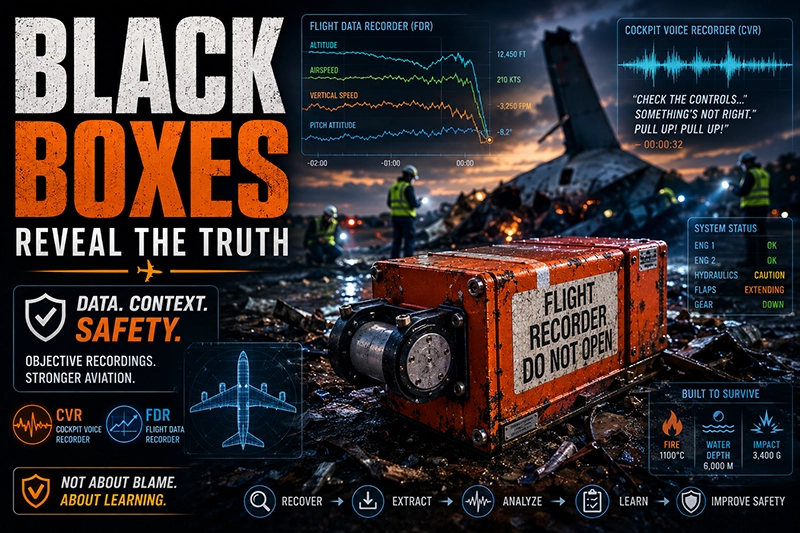
Black boxes play a central role in modern accident investigation. For pilots, instructors, maintenance technicians, and safety managers, understanding what flight recorders capture and their limitations is essential. Recorders do not assign blame, but they provide objective data that helps investigators reconstruct the sequence of events, identify system or human performance issues, and recommend changes that improve safety for everyone in aviation.
This article explains how flight data recorders and cockpit voice recorders function, what investigators typically recover from them, common misunderstandings about their capabilities, and practical actions pilots and operators can take to support investigations. The goal is practical: help aviation professionals use recorders' lessons to improve training, operations, and decision making.
What flight recorders are and how they work
The term "black box" is informal. It usually refers to two distinct devices: the flight data recorder, or FDR, and the cockpit voice recorder, or CVR. The flight data recorder logs measurable aircraft states and control inputs. The cockpit voice recorder records cockpit audio, including pilot conversations, radio transmissions, and ambient sounds. Together, they provide complementary streams of evidence—quantitative system data and human performance context.
Flight data recorders collect parameters such as airspeed, altitude, attitude, heading, engine performance indicators, control surface positions, and system annunciators. Cockpit voice recorders capture speech on pilot headsets, ambient noises such as warnings and engine sounds, and can reveal timing and crew communications that clarify pilot intent and situational awareness.
Recorders are designed for survivability. They are mounted in crash-protected enclosures to resist impact, heat, and water exposure. Many recorders also include locator beacons that help search teams find them after an accident. However, survivability is not absolute—damage, fire, or prolonged immersion can complicate data recovery, and physical recovery remains the first step in most investigations.
Why this matters in real-world aviation
Recovered recorder data often forms the backbone of an investigation. Quantitative FDR traces let investigators reconstruct aircraft flight paths and system behavior. CVR audio places those traces into context, showing how the crew perceived and managed the situation. Together, the recorders can expose mechanical failures, maintenance discrepancies, procedural gaps, or human factors issues such as confusion, task saturation, or breakdowns in crew resource management.
For flight training and operations, recorder-derived lessons translate into concrete improvements. Training syllabi evolve to address real-world weaknesses revealed by investigations. Operators refine procedures and checklists. Maintenance programs change inspection priorities to prevent repeat events. In that way, the practical value of black boxes extends beyond any single accident to continuous system-wide safety gains.
How pilots should understand these devices
Pilots do not need to be technical experts on recorder internals, but a practical understanding helps in several ways. First, appreciating what data is captured reinforces disciplined flying and logkeeping. Knowing that certain parameters and crew actions are recorded encourages accurate reporting and thorough post-incident documentation.
Second, pilots should understand the CVR's role in revealing communications and cockpit environment. That awareness does not mean self-censoring routine communications; investigators interpret recordings in context and work to understand human factors. Pilots should continue to use standard phraseology and prioritize safety over concern about recordings.
Third, pilots should be familiar with procedures that protect evidence after an accident or serious incident. Securing the aircraft, preserving documents and electronic logs, and following instructions from investigators all help maximize the value of recorder data.
Common mistakes or misunderstandings
There are several frequent misconceptions about black boxes that can mislead pilots and the public. One is thinking that recorders are infallible truth machines. In reality, recorders can be damaged, can have gaps in captured parameters, or may not include specific sensors unique to a particular aircraft modification. Investigators must corroborate recorder data with physical evidence and witness statements.
Another misunderstanding is that cockpit voice recordings are used to punish normal communication errors. Investigations use CVR material to learn how and why crews made decisions, not simply to assign blame. Human factors analysis often leads to system-level recommendations such as improved training, equipment changes, or procedural updates.
A third mistake is believing that pilots should withhold information from investigators out of fear. Transparent cooperation is vital. Accurate maintenance records, honest pilot reports, and timely access to aircraft data make investigations faster and more effective, which benefits both safety and the aviation community's reputation.
Practical example
Consider a hypothetical scenario that illustrates how recorders help. An aircraft departs on a regional flight and later experiences a loss of control during approach. Investigators recover the FDR and CVR. The FDR shows a rapid descent rate, changes in flap and power settings, and an unexpected roll followed by corrective control inputs. The CVR captures multiple warning tones, ambient engine noise consistent with thrust changes, and a brief exchange between pilots about a "control problem."
Analysts combine these data streams with wreckage distribution and maintenance history to build a timeline. The FDR confirms when control authority changed and which systems were active. The CVR shows how the crew perceived the problem and their immediate actions. If the aircraft's maintenance records reveal recent control surface rigging work, investigators may focus on maintenance procedures or human factors during servicing. The final report might recommend changes to maintenance sign-off practices, augmenter training in abnormal control events, or redundancy checks on specific systems.
This example is illustrative rather than prescriptive. The important point is how data and context work together to generate actionable safety recommendations.
Best practices for pilots
Pilots can take concrete steps that support investigations and improve safety:
- Preserve the scene and evidence when safe to do so. Avoid moving components unless required for safety.
- Provide accurate, timely statements and copies of logs, maintenance entries, and flight records to investigators.
- Continue to use clear, calm communications in abnormal situations to maintain usable CVR context.
- Maintain up-to-date knowledge of aircraft systems and any recording equipment peculiarities for your fleet.
- Participate in post-incident training that reflects recorder-driven findings to close safety gaps.
Frequently Asked Questions
What information do flight data recorders typically capture?
Flight data recorders record measurable aircraft parameters such as airspeed, altitude, attitude, heading, engine outputs, system annunciations, and control surface positions. The specific set of parameters depends on the recorder model, how the aircraft's systems are routed to the recorder, and any modifications specific to the aircraft type.
What does a cockpit voice recorder capture?
Cockpit voice recorders capture audio from the flight deck, including crew conversation, radio transmissions, ambient sounds, and cockpit warnings. These recordings give investigators insight into crew communications, situational awareness, and the timing of events.
Can recorders be damaged or lose data?
Yes. Although recorders are engineered for crashworthiness, they can be physically damaged, exposed to fire, or submerged in difficult recovery environments. Damage can affect data integrity. Investigators use specialized labs and forensic techniques to extract, validate, and interpret data where possible.
Do recorders assign fault to pilots?
No. Recorders provide objective evidence that supports an investigation. The process evaluates mechanical, environmental, and human factors to determine causal and contributing factors. Investigations aim to identify safety improvements rather than simply attribute blame.
How should pilots prepare for the possibility of being part of an investigation?
Avoid speculating about causes, document your recollection as soon as practicable, and cooperate with investigators. Keep accurate logbooks and maintenance documentation current. Regularly review emergency procedures and crew resource management practices so your actions and communications are effective if an abnormal event occurs.
Key Takeaways
- Practical takeaway: Flight data recorders and cockpit voice recorders provide complementary data streams that help reconstruct events and improve training and procedures.
- Safety takeaway: Preserve evidence, cooperate with investigators, and maintain clear cockpit communication to maximize the usefulness of recorder data.
- Training and regulatory takeaway: Use lessons from recorder-based investigations to update training, maintenance practices, and operational procedures.
Black boxes are essential tools for learning from incidents. For pilots and aviation professionals, understanding their function, limitations, and role in the investigative process helps translate technical findings into practical safety improvements. The next time a safety bulletin or procedural change cites recorder data, you will better understand the pathway from raw data to operational change.