
Building flight hours is a practical challenge for student pilots, newly certificated pilots, and even experienced aviators changing tracks. Whether you want to qualify for an advanced certificate, meet hiring expectations, regain currency, or simply become a safer, more capable pilot, knowing how to build flight hours faster and smarter matters. This article explains strategies that increase useful flight time while preserving safety, training value, and regulatory compliance.
Early in a pilot s career the temptation is to chase raw numbers: the quickest route from point A to whatever milestone you need. That approach often produces hollow hours. Instead, prioritize time that improves aeronautical decision-making, cross-country experience, instrument skills, and the kinds of logs that employers care about. This article shows how to plan efficient flights, pick the right training and employer options, use simulators properly, and avoid common mistakes that waste time or create risk.
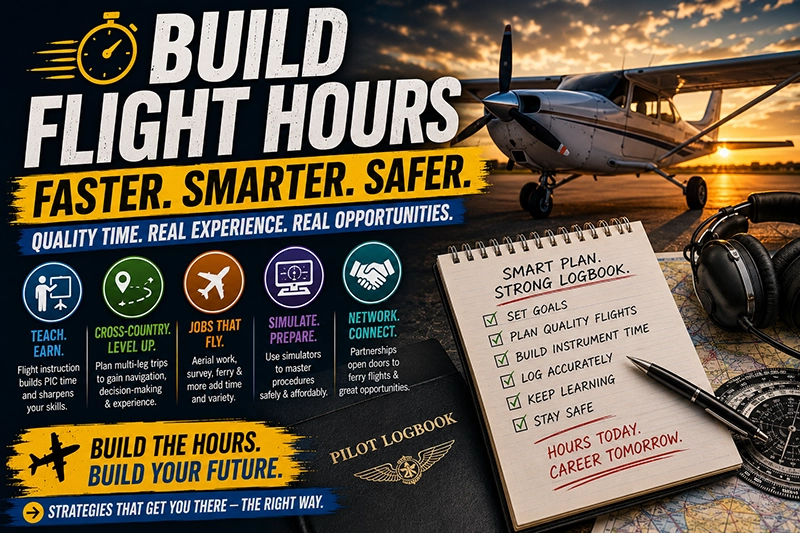
Core strategies to build flight hours faster and smarter
Speed and efficiency are not the same as quality. The right plan combines several strategies designed to increase useful flying time without shortcutting training or safety. Below are the high-level approaches pilots use most effectively.
Flight instruction and teaching. Becoming a certificated flight instructor is one of the most direct ways to build hours that are both legal and relevant. As an instructor you log PIC (pilot in command) time when the operation and safety of the flight are your responsibility. You also get repeated exposure to maneuvers, takeoffs, landings, cross-country navigation, and student-driven emergencies. The value of those hours is high because you learn to analyze and correct errors in real time.
Safety pilot and cross-country partnerships. Flying as a safety pilot while another pilot flies under the hood can be a practical way to build hours, particularly instrument and cross-country time for both pilots. Safety-pilot flights should be planned so the safety pilot remains engaged and practices navigation, communications, and situational awareness rather than counting down minutes until landing.
Structured multi-leg trips. Rather than many short local hops, design multi-leg cross-country trips that combine navigation, flight planning, weather decision-making, and multiple takeoffs and landings. Each leg can generate meaningful cross-country credit and experience in varied airspace, runway environments, and weather.
Part-time flying jobs. Aerial photography, banner towing, pipeline patrol, survey flights, and other local commercial flying opportunities can provide regular flight hours and diverse experience. These jobs often require specialized brief training but can rapidly add PIC and cross-country time while refining low-altitude maneuvering, traffic pattern discipline, and operational planning.
Simulator and flight training devices. Advanced simulators and FAA-approved flight training devices offer a safe and cost-effective way to build instrument proficiency and procedural skills. Use them to practice approach plates, missed approaches, emergency procedures, and cockpit flows before doing them in an airplane. Confirm what time can legally be logged in a simulator for your specific training goals before you rely on it for hour-building.
Networking and ferry partnerships. Connecting with other pilots, flight schools, and operators creates opportunities for positioning or ferry flights. These trips can provide cross-country time and exposure to diverse airports and operating conditions. Always confirm the pilot-in-command status and logging rules before accepting a seat.
Why this matters in real-world aviation
Flight hours are currency and credibility. Employers and advanced training programs evaluate not just the number in your logbook but the character of those hours. Pilots with well-built hours demonstrate consistent decision-making, a variety of leg types, instrument experience, and pattern discipline. They are more likely to manage complex flights safely and transition into professional operations without gaps.
From a safety perspective, hours alone do not prevent accidents; skills and judgment do. Hours gained from repetitive, low-skill tasks provide limited protective value. Conversely, hours spent deliberately practicing cross-country navigation, instrument procedures, emergency handling, and crew resource management translate directly into better outcomes in unexpected situations.
Operationally, building the right kinds of hours makes certification and job transitions easier. Airline and commercial operators look for experience in instrument and cross-country flying, multi-engine operation when applicable, and documented experience with complex aircraft systems. Employers often ask practical questions about the environments you have flown in, not just the totals. Preparing logbook entries and being able to discuss specific experiences matters.
How pilots should understand the concept of useful hours
Useful hours are the intersection of time, training value, and documentation. Time spent should demonstrate skills transferable to higher responsibility. Keep these principles in mind when planning hour-building:
- Relevance: Choose activities that develop instrument competency, cross-country navigation, and night flying if those are the skills you need.
- Documentability: Ensure every flight is logged correctly. Know when you can log PIC, sole manipulator of the controls, SIC, or dual received instruction. When in doubt, discuss with an instructor or check the applicable regulatory guidance.
- Progression: Structure training to compound learning. Follow a curriculum that builds from basic handling to advanced procedures rather than repeating the same tasks.
- Safety margin: Do not accept higher risk to accumulate hours quicker. Decisions that put you near personal minimums or known hazards in pursuit of time are counterproductive.
Common mistakes and misunderstandings
Many pilots unintentionally collect hours that look productive but have little training value. Below are recurring mistakes to avoid.
Logging without learning. Flying circuits for the sake of time often leads to hours that don t improve navigation, weather decision-making, or instrument proficiency. If you fly a repetitive task, pair it with a deliberate learning objective such as improving short-field technique or instrument scan.
Mismatched hour types. Treat various categories of logged time differently. For example, simulated instrument hours, PIC time, and SIC time have different operational and hiring values. Understand which hour types a prospective employer values and plan accordingly.
Poor weather planning. Accepting marginal weather to get a leg in frequently reduces safety and learning value. Pilots sometimes attempt flights in unstable conditions to build cross-country miles; that choice can produce risky situations and less useful experience.
Neglecting logbook accuracy. Incomplete or sloppy logbook entries erode credibility. Include aircraft type, registration, takeoff and landing points, flight conditions, and the role you performed. Be prepared to explain each entry if an employer or examiner asks.
Over-reliance on low-value jobs. Some flying jobs add hours but offer narrow, repetitive tasks. While they are legitimate ways to build time, evaluate whether the experience aligns with your long-term goals and complement them with cross-country and instrument-focused flying.
Practical example: a 6-month plan to build focused hours
Consider a pilot who has recently completed initial certifications and seeks to become a competitive applicant for regional operators or advanced training. Rather than chasing hours indiscriminately, the pilot creates a plan with measurable objectives. The plan includes:
- Obtain a certificated flight instructor rating to qualify for dual instruction jobs and log PIC time while teaching.
- Schedule back-to-back cross-country flights that combine navigation, unfamiliar airports, and night approaches to build diverse experience.
- Reserve time in a flight training device for instrument procedures and complex-system flows, then complete those procedures in the airplane under instructor oversight.
- Accept part-time aerial survey or banner work that offers regular flying, and rotate that work with training flights to avoid monotony.
- Document each flight with detailed logbook entries and debriefs to convert hours into identifiable skill improvements.
This structured approach increases both the quantity and quality of time. The instructor rating offers immediate opportunities to log meaningful PIC time, cross-country flights develop navigational and weather decision-making, and simulator practice reduces risk for complex procedures.
Best practices for pilots building hours
These practical habits reduce wasted time and improve the training value of every flight.
- Plan flights around learning objectives. Before each flight, note one or two skills to practice, then debrief afterwards to capture lessons learned.
- Mix flight types. Alternate instructional flights, cross-country legs, night flying, and multi-leg ferry flights to gain exposure across domains.
- Use simulators deliberately. Rehearse instrument approaches, emergencies, and cockpit flows in a flight training device before risking airplane time.
- Prioritize repeatable, high-value tasks. Devote part of your flying to instrument proficiency, high-density traffic pattern work, and operations into unfamiliar airports.
- Stay current on logging rules. Understand what you can log as PIC, SIC, simulated instrument time, and dual instructions to ensure entries are defensible.
- Maintain currency and proficiency. Regular practice reduces the time needed to regain skills lost during gaps and prevents risky attempts at time building when proficiency is low.
- Keep a clean, searchable logbook. Modern electronic logbooks make it easier to filter entries by aircraft, conditions, and role when an employer asks.
How to use simulators and flight training devices effectively
Simulators are powerful tools when used as part of a planned training pathway. They reduce cost, allow repeated practice of high-risk procedures, and build confidence for real-airplane performance. Use flight training devices to:
- Practice instrument approaches, missed approaches, and unusual attitude recovery until the procedure and scan are second nature.
- Rehearse sterile cockpit flows and cockpit management for complex avionics and autopilot systems.
- Conduct scenario-based training that integrates weather, navigation, and communications tasks so that real flights test higher-level decision-making.
Before counting simulator time in a plan, verify what can be logged and credited toward specific certificates or currency under applicable guidance. Confirm whether an approved device is required for particular logbook credit and record any device session in your logbook with clear notation.
How to approach part-time flying jobs
Part-time commercial flying can be a fast route to hours, but choose assignments that add relevant experience. Evaluate jobs for:
- The type of flying and whether it matches your career aims.
- Scheduling predictability and whether it allows interleaving of instructional or cross-country flights.
- Safety culture and training support from the operator.
- Whether the job requires additional endorsements or training and how that training enhances your résumé.
Many pilots combine a part-time flying job with instructional work to diversify their logbook and develop both operational and teaching skills.
Common logbook and documentation pitfalls to avoid
Good documentation protects you in hiring and checkride situations and turns raw hours into demonstrable competence. Common pitfalls include:
- Vague remarks. Entries like "flew local" are not helpful. Record departure and arrival points, aircraft model, and flight conditions.
- Missing signatures. When receiving training, make sure the instructor signs entries that need endorsements.
- Unclear roles. If multiple pilots are onboard, document who was PIC, who was sole manipulator of the controls, and any safety pilot arrangements.
- Inconsistent format. Use a consistent logbook format, whether paper or electronic, so data is easy to parse during applications or exams.
Common misunderstandings about what counts
Pilots often misunderstand which flights contribute to specific training goals. Clarify these topics for yourself early on:
- Simulated instrument time versus actual instrument time. Know when simulated conditions can be logged and when an actual instrument conditions entry is required.
- PIC versus sole manipulator of the controls. Logging authority varies depending on whether you had command authority or only manipulated the controls.
- Cross-country credit. Definitions for cross-country flying can vary by certificate objective. Know the distances, navigational requirements, and documentation needed for each training milestone.
Frequently asked questions
How can a new pilot build hours without a full-time flying job?
Combine part-time flying work, flight instruction, and structured cross-country trips. Use simulators for instrument practice and network with other pilots and flight schools for ferry or positioning flights. Design each flight with training objectives to ensure you are gaining relevant skills as you accumulate hours.
Is becoming a flight instructor the fastest way to build hours?
Becoming a certificated flight instructor often accelerates hour accumulation because it opens many local employment opportunities and lets you log PIC time while teaching. However, it is not the only pathway. Other avenues, such as aerial work, survey flights, or joining local operators, can also be effective depending on market demand and personal circumstances.
Can simulator time count toward my hours?
Simulators and flight training devices are valuable for building skills and sometimes count toward specific logging or training requirements. Verify the rules that apply to your training goals, as device approval and the type of time that can be logged vary. Record simulator sessions clearly in your logbook so their purpose and device type are evident.
How do I ensure my hours are useful to employers?
Focus on diverse experience: instrument procedures, cross-country navigation, night flying, and operations into different airports. Keep clear logbook records and be prepared to discuss specific flights that demonstrate decision-making, risk management, and operational competence.
What mistakes should I avoid while trying to build hours quickly?
Avoid flying in marginal conditions purely to get time, accepting higher risk for the sake of minutes, and letting your logbook become disorganized. Also avoid jobs that add many hours with little relevance to your long-term goals unless those hours are necessary for short-term objectives.
Key Takeaways
- Include one clear practical takeaway.
- Include one safety or operational takeaway.
- Include one training, regulatory, or decision-making takeaway.
Building flight hours faster and smarter is about combining efficient planning, varied flying experience, and consistent documentation. Choose training and employment options that contribute real skills, avoid shortcuts that compromise safety, and use simulators and structured debriefs to turn raw minutes into lasting competency.