
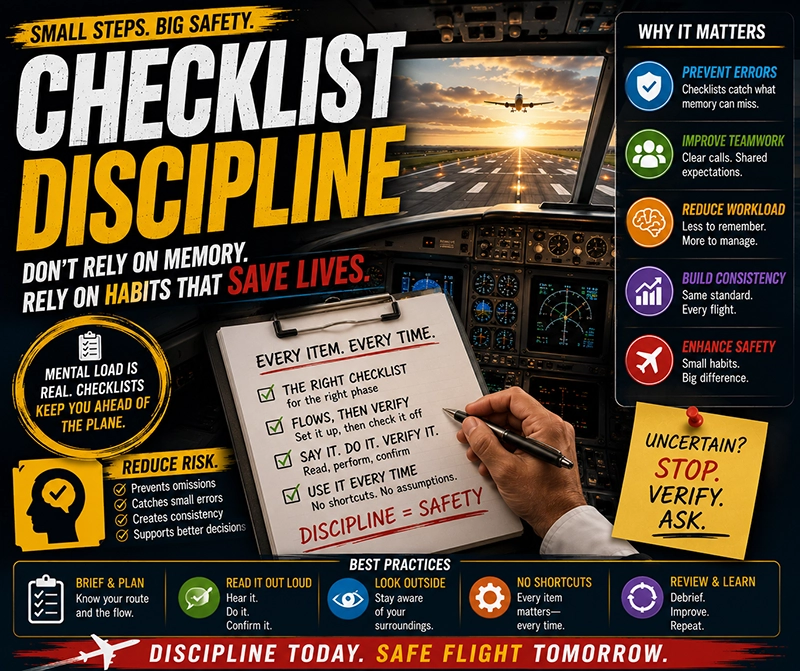
Checklist discipline is a core safety habit that separates routine professionalism from accident-prone behavior in aviation. For pilots, instructors, and operators, disciplined use of checklists reduces omission errors, supports consistent decision-making, and creates a shared expectation among crew members and passengers. This article explains what checklist discipline means in practical terms, why it matters in real-world operations, and how to develop and reinforce it in training and everyday flying.
Understanding and practicing checklist discipline offers immediate operational value. It improves cockpit coordination, reduces cognitive load during high-workload phases of flight, and preserves margin when systems or weather create unexpected complications. Read on for practical guidance that applies to single-pilot operations, multi-crew aircraft, flight training, and flight instructor work.
What Is Checklist Discipline?
Checklist discipline is the consistent, deliberate, and methodical use of written checklists and standard operating procedures to manage aircraft operations. It includes selecting the appropriate checklist for a flight phase, using it at the right time, reading items aloud when appropriate, and verifying actions rather than relying on memory alone. Discipline also covers how and when to deviate from the checklist in time-critical emergencies while ensuring the deviation is deliberate and understood by the flight crew.
Checklists come in many forms: memory items that must be committed to recall for immediate action, flows that help set aircraft configuration in a reliable order, and written checklists used to verify completion. Discipline means applying the right tool for the situation and not substituting convenience or habit for the safeguard that each checklist provides.
Why This Matters in Real-World Aviation
Checklists are a low-technology, high-effectiveness human factors tool. Aviation operations expose crews to frequent interruptions, high workload, and complex system interactions. Human memory is fallible under stress and fatigue. A disciplined checklist practice provides a repeatable method that captures required checks and reduces reliance on short-term memory during critical phases like takeoff, climb, approach, and landing.
From a training perspective, checklist discipline shapes pilot behavior long before advanced avionics or automation are available. For flight instructors, modeling proper use of checklists trains students in cockpit flow, communication, and risk awareness. Operators benefit because consistent checklist use reduces variability between crews and improves predictability for maintenance, dispatch, and air traffic control coordination.
Regulatory guidance and industry best practices consistently emphasize written procedures and standardization. In practice, disciplined checklist use contributes to safer outcomes in many ways: it prevents configuration errors, supports system status awareness, facilitates cross-checking in multi-crew cockpits, and provides a shared language for abnormal and emergency response.
How Pilots Should Understand Checklist Discipline
Checklist discipline is not a rote ritual. It is a structured habit tailored to operational context. Here are the key elements pilots should internalize.
Selection and timing: Use the checklist that matches the flight phase and aircraft state. Resist the temptation to skip items because they ‘‘feel’’ done. The right timing preserves flow and avoids unnecessary interruptions when workload is high.
Flows versus written checks: Many pilots use flows as a sequence of hands-on actions to set up the aircraft. Flows are valuable for tactile confirmation and minimize cockpit head-down time. Follow a flow, then complete the written checklist to verify all items. The flow gets you close to the desired configuration; the written checklist ensures nothing is missing.
Read-and-do versus challenge-response: In single-pilot operations, read-and-do (reading the checklist and performing actions) is common. In multi-crew environments, use a challenge-response format where one pilot reads the item and the other confirms completion. Use clear, unambiguous phrasing and avoid informal language that can be misheard under noise or stress.
Memory items and immediate actions: Some situations require immediate action before a checklist can be consulted, such as an engine failure or imminent fire. These actions are typically memorized and practiced until they are reflexive. Once the immediate hazard is addressed, return to the written checklist to complete the rest of the procedure.
Discipline also covers audibility and confirmation. When possible, speak items aloud, especially in a crewed cockpit. Saying actions out loud helps anchor them in working memory and creates a record that both pilots can hear and verify.
Common Mistakes or Misunderstandings
Even experienced crews can fall into patterns that weaken checklist effectiveness. Recognizing these common pitfalls helps pilots correct them proactively.
Skipping items because they seem obvious: Confidence and complacency can lead pilots to skip checklist items. This often occurs when a pilot has flown a route many times under similar conditions. The result is occasional omission of non-obvious items, such as a certain system mode or a specific circuit breaker state that only becomes critical in certain conditions.
Relying solely on memory: Human memory degrades under stress, fatigue, and distraction. Memory alone cannot reliably substitute for a deliberate checklist, except for a small set of immediate action items that are routinely trained to memory.
Poor timing: Using a checklist at the wrong moment can increase workload and distract from critical flying tasks. For example, starting a long checklist during a short final approach can overload attention. Discipline means placing checklists at natural pauses in workload or using abbreviated checks that do not compromise safety.
Mixing checklist formats incorrectly: Confusion arises when crews mix different checklist formats or non-standard wording. If an operator uses a unique sequence or local modification, make sure everyone understands the change and that it is reflected in training and documentation.
False verification: Saying that an item is complete without verifying it visually or tactilely undermines the checklist’s purpose. This is especially risky for configuration items like landing gear position, flap settings, or fuel selectors.
Practical Example
Consider a single-pilot cross-country flight in a complex piston airplane with retractable gear and variable-pitch propeller. During cruise, a storm cell develops along the planned route and ATC issues a revised clearance with a holding pattern and a descent. The pilot experiences increased workload processing the clearance, navigating around weather, communicating with ATC, and preparing for descent.
Checklist discipline matters in two ways. First, the pilot uses flows to set up the descent: power reduction, prop control, mixture, and initial checklist items for descent. Second, as workload rises during the approach into a busy terminal area, the pilot uses the written descent and approach checklists at appropriate breaks in communication and navigation workload. The written checklist catches an overlooked flap indicator showing partial extension from an earlier test, which the flow missed because of a distraction. Because the pilot used both a flow and a checklist, the partial flap was identified and corrected before reaching a critical phase.
Had the pilot relied only on memory or on flow without the written verification, the partial flap could have led to higher approach speeds, increased landing distance, or a go-around. The disciplined two-step approach reduced risk and preserved safe margins despite disruptions.
Best Practices for Pilots
Adopting disciplined checklist habits is deliberate work. Below are practical steps pilots and instructors can apply immediately.
- Establish flows for tactile setup and always follow them with a written checklist to verify completion.
- Train memory items to a high standard, but limit memorize-only items to those that require immediate action.
- Use standard phraseology and a challenge-response format in multi-crew operations to reduce ambiguity.
- Position checklists within natural workload pauses. If a checklist is long, break it into logical segments that align to flight phases.
- Model disciplined behavior during instruction and mentorship. Instructors should demonstrate both flows and the written checklist every time to reinforce habits in students.
- Include realistic distractions and interruptions in training scenarios so pilots learn to return to the checklist after interruptions.
- Review and update checklists and SOPs regularly to reflect equipment changes and operator procedures. When a checklist changes, brief the crew on modifications and train for them.
- Use cockpit ergonomics to make checklists accessible: place laminated or electronic checklists within easy reach and ensure lighting allows readable presentation at night.
- When deviating from a checklist under time pressure, communicate the deviation clearly to the crew and commit to a follow-up verification when time allows.
Training and Assessment Strategies
Training organizations and flight instructors can reinforce checklist discipline through structured practice and evaluation. Integrating checklist-focused exercises into recurrent training helps convert good intentions into reliable habits.
Scenario-based training is especially effective. Design scenarios that include realistic interruptions: radio congestion, ATC reroutes, system warnings, or passenger disruptions. Evaluate whether pilots resume and complete the appropriate checklist after an interruption. Include both single-pilot and crewed scenarios so trainees experience the difference between read-and-do and challenge-response methods.
Use simulated failures and abnormal procedures so pilots practice memory items, immediate actions, and subsequent checklist completion. After the scenario, debrief specifically on checklist use: timing, accuracy, communication, and verification. Reinforce positive behaviors and correct shortcuts or assumptions.
Operators should include checklist discipline in line checks and proficiency evaluations. Observational audits of cockpit behavior can identify systemic weaknesses, such as inconsistent checklist placement or ambiguous wording. Use collected data to refine checklists and training priorities.
Human Factors and the Psychology Behind Checklists
Checklists work because they offload cognition and reduce reliance on attention during routine tasks. From a human factors perspective, checklists provide external memory aids that compensate for limitations such as inattentional blindness and working memory constraints. Understanding these principles clarifies why discipline is necessary.
Interruptions are a known hazard. When a task is interrupted, resuming correctly depends on external cues. A handwritten or electronic checklist provides those cues. Habit formation and repeated practice build the neural pathways that make checklist actions automatic, but automation does not remove the need for verification and situational awareness.
Crew resource management (CRM) principles align tightly with checklist discipline. Clear communication, assertiveness in pointing out missed items, and a mutual expectation that checklists will be used all reduce the risk that one person’s error becomes an incident. Encourage a culture where any crew member can call out an omitted checklist item without fear of negative repercussions.
Common Misconceptions
Several misconceptions reduce checklist effectiveness when accepted as truth. Addressing them clarifies how discipline should be applied.
Misconception: "I have flown this airplane thousands of hours; I do not need the checklist." Experience improves pattern recognition, but it does not eliminate the possibility of omission under distraction or fatigue. Checklists serve as a last line of defense, even for the experienced pilot.
Misconception: "Checklists slow me down." Properly used, checklists streamline operations by catching errors early, preventing time-consuming recoveries later. Short, well-timed checklists reduce overall workload by decreasing the chance of having to handle an in-flight complication that would consume far more attention.
Misconception: "Electronic checklists are always better." Electronic checklists provide advantages like searchability and standardization, but poor interface design or awkward placement can impede use. Choose a system that is readable, accessible, and integrated into the cockpit workflow.
Implementing Checklist Discipline in Single-Pilot Operations
Single-pilot operations present special challenges because the pilot cannot delegate reading or verification. The core principles remain the same, with additional emphasis on timing and cockpit setup to create natural opportunities for checklist completion.
Use flows aggressively to configure the aircraft with minimal head-down time. Follow flows with a short, written verification step at safe moments. If an interruption occurs, secure the aircraft in a stable attitude, communicate intentions to passengers, and return to the checklist. Practicing abbreviated checks can be useful, but only when the abbreviated list still verifies the items that matter most for the phase of flight.
Checklist Discipline for Flight Instructors and Examining Pilots
Instructors set the tone. Demonstrate how to use checklists under normal and abnormal conditions. Make checklist discipline an observable grading criterion during evaluations. When students or supervised pilots deviate from good practice, provide immediate corrective feedback and a rationale that links behavior to safety outcomes.
Encourage students to verbalize their flows and checklist calls. This practice supports muscle memory and helps instructors identify misunderstandings. During training flights, gradually increase complexity so trainees learn that checklist discipline scales to high-workload situations, not just quiet circuits.
Common Equipment and Organizational Issues That Affect Checklist Use
Checklist discipline can be undermined by equipment or organizational shortcomings. Poorly written checklists, inconsistent procedures between fleets, and inadequate access to checklists in the cockpit all reduce compliance.
Operators should ensure that checklists are clear, concise, and aligned with the aircraft configuration. Avoid long, dense paragraphs. Use action-oriented language and consistent sequencing. Train crews on any variations so they are not surprised by different wording or item order.
Provide physical or electronic access that works across lighting and turbulence conditions. Evaluate whether display brightness, font size, or placement makes a checklist difficult to use and adjust accordingly.
Frequently Asked Questions
How often should I use a checklist during a normal flight?
Use the checklist associated with each flight phase: preflight, before start, before taxi, before takeoff, climb, cruise, descent, approach, and after landing as applicable. Do not treat checklists as optional. Use flows for setup, and complete the written checklist at logical pauses in workload.
When can I rely on memory instead of a written checklist?
Memorize only immediate action items that require rapid response before you can consult a checklist. For everything else, use a written checklist. Memory is fallible, and checklists provide reliable verification, especially after interruptions or under stress.
What should I do if a checklist item cannot be completed?
If an item cannot be completed, determine whether it is critical to flight safety. If it is, transition to an appropriate abnormal or emergency procedure and communicate with ATC and your company or instructor. If safe flight is still possible, note the discrepancy, follow any applicable mitigation steps, and plan for landing or maintenance action as required.
How do I handle checklists during an emergency when time is critical?
Apply memory items and immediate actions first if time is critical. Once the immediate hazard is stabilized, return to the written checklist to complete follow-up items and ensure nothing else has been missed. Communicate clearly with any crew members and passengers about actions being taken.
Are electronic checklists better than paper checklists?
Electronic checklists can be advantageous due to searchability, standardization, and integration with avionics. However, they must be reliable, readable, and ergonomically placed. Poor interface design or device instability can reduce effectiveness. Choose tools that work for your cockpit environment and train with them regularly.
Key Takeaways
- Practical takeaway: Use flows for tactile setup and always verify with a written checklist to reduce omission errors.
- Safety takeaway: Checklist discipline reduces reliance on fallible memory and prevents configuration errors during high-workload phases.
- Training and decision-making takeaway: Teach, model, and assess checklist use in realistic scenarios so habits persist under stress.
Checklist discipline is a simple concept with complex benefits. It reduces human error, supports effective crew coordination, and creates a standard of predictable behavior that improves safety across operations. Developing and maintaining discipline requires deliberate practice, realistic training, and organizational support. For pilots, the investment in disciplined checklist behavior repays itself in avoided incidents, smoother flights, and consistently safer outcomes.