
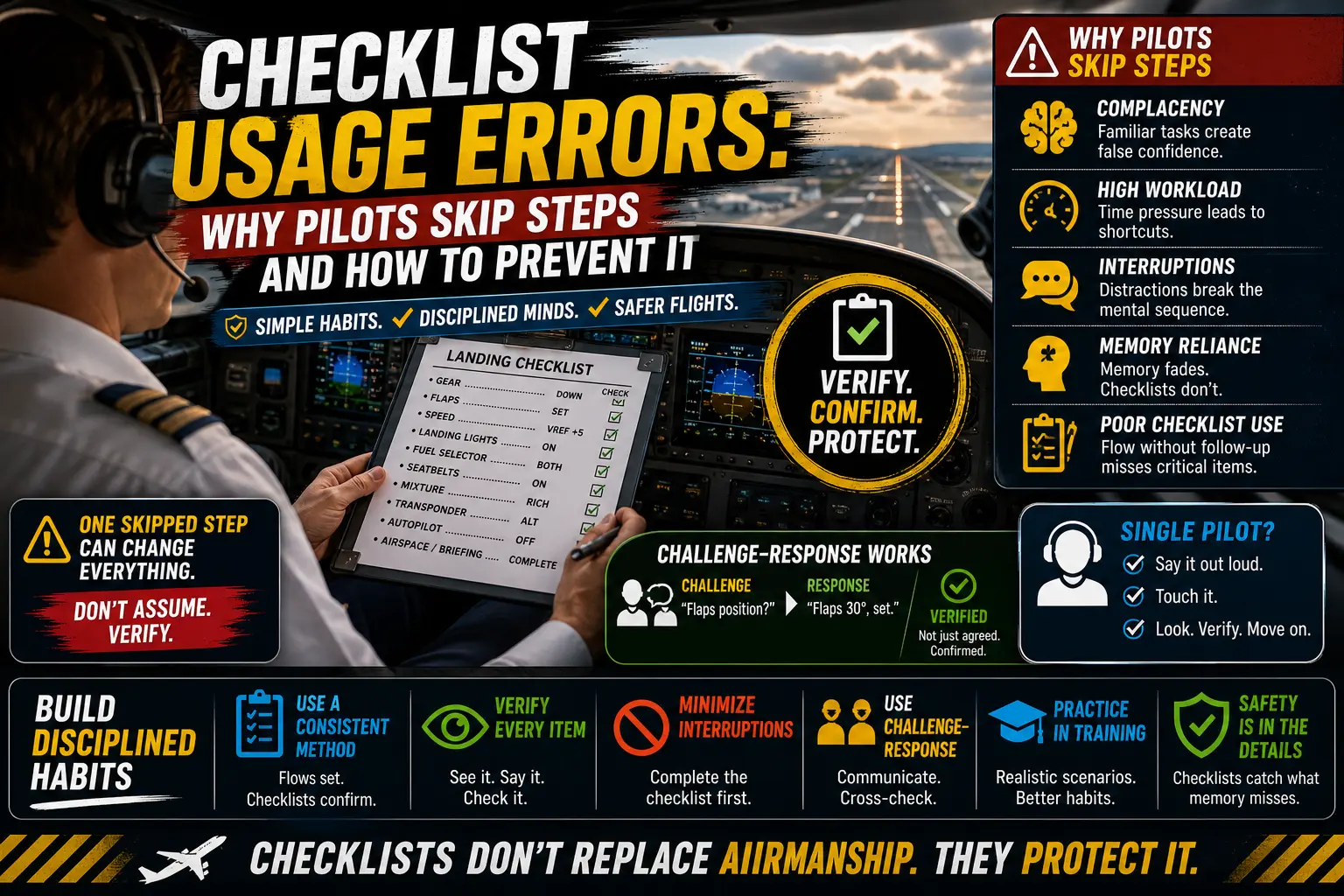
Checklist usage errors are a persistent human-factor concern in aviation. Whether in single-pilot general aviation operations or in multi-crew commercial flights, the tendency to skip steps, rush through items, or rely on partial memory creates a latent risk that can degrade safety. Understanding why pilots skip checklist items and adopting practical countermeasures helps reduce error, improve decision-making, and protect margins when workload is high.
This article explains the human factors behind checklist usage errors, explores the challenge-response method and other proven practices, and offers concrete ways to build disciplined checklist habits. Pilots, instructors, and operators will find practical insights that translate directly into training, cockpit procedures, and everyday flying.
What are Checklist Usage Errors?
Checklist usage errors occur when a required checklist item is omitted, performed incorrectly, or confirmed without verification. Such errors range from minor omissions that have no immediate consequence to missed items that degrade aircraft performance, increase pilot workload, or contribute to incidents. The checklist is a cognitive aid intended to ensure completeness and consistency; errors typically stem from failures in how the checklist is used rather than flaws in the checklist itself.
Why This Matters in Real-World Aviation
In real-world operations, checklists are used during high-workload phases like preflight, takeoff, approach, and landing, as well as during abnormal situations. Workload, time pressure, interruptions, and complacency create conditions where checklist usage errors become likely. For instructors and training programs, teaching not only the items on the checklist but how to use the checklist effectively is essential. For operators, standardized procedures, a strong safety culture, and routine reinforcement of good habits reduce operational risk.
Human Factors That Lead Pilots to Skip Steps
Several human-factor dynamics commonly contribute to checklist usage errors:
- Complacency: Familiarity with routine flights can cause pilots to assume items are already completed.
- Task saturation: High workload during critical phases may force pilots to prioritize perceived immediate tasks over checklist completion.
- Interrupted flow: Interruptions or distractions can break the mental sequence and lead to omissions.
- Memory reliance: Relying on memory instead of using the written checklist increases omission risk, especially when tasks are similar across flights.
- Poor checklist design or misuse: Non-standard formatting, overly complex checklists, or using flow methods without a follow-up checklist can cause items to be missed.
How Pilots Should Understand Checklist Use
Using a checklist is both a procedural act and a behavioral skill. It is not enough to have a checklist available; pilots must integrate it into a disciplined workflow. One useful mental model is to see the checklist as the final verification of a flow-based task sequence. Flows are hand and instrument movements done from memory to set up the aircraft. The checklist confirms those memory actions and ensures no step is overlooked. Proper checklist use balances efficiency with verification.
The Challenge-Response Method Explained
The challenge-response method formalizes verbal exchange between crewmembers during checklist use. One crewmember issues the challenge by calling or reading the checklist item. The other crewmember responds by stating the action has been completed or by reading back the set condition. A clear response should indicate verification, not just agreement. For example, instead of saying "Check flaps," the challenge might be "Flaps position?" with the response "Flaps 15 degrees, set." The method creates a two-step interaction that reduces the chance of confirmation without verification.
In single-pilot operations the challenge-response principle still applies: make a deliberate verbal or tactile confirmation to break the reliance on memory. Saying the item aloud, touching the control, or taking a brief pause to scan the panel transforms a passive review into an active verification.
Common Mistakes or Misunderstandings
Understanding common errors helps pilots recognize and correct unsafe habits:
- Flow without follow-up: Relying solely on a flow pattern and skipping the checklist entirely risks missing non-routine items or items that cannot be set by feel.
- Confirming without seeing: Verbal confirmations given without a visual scan or tactile verification are unreliable.
- Checkbox mentality: Treating the checklist as a routine box-ticking exercise rather than an opportunity for active verification undermines its purpose.
- Over-trust in automation: Assuming automation has configured all systems correctly can lead to missed manual items like fuel selector position, altimeter setting, or transponder code.
- Self-interruption: Poor time management can lead pilots to start a checklist and be pulled away before completing it.
Practical Example
Imagine a single-pilot cross-country flight into a busy uncontrolled airport on a gusty day. The pilot completes a flow to set radios, mixture, and trims, then begins the landing checklist while sequencing traffic. An arriving jet calls on frequency, creating an urgent distraction. The pilot briefly answers and does not return to the checklist's last items before turning final. As a result, the landing light and approach briefing items were not confirmed, increasing workload during final and reducing margin for error.
This situation shows how interruptions, high workload, and reliance on flow without a strict checklist follow-up can combine to produce checklist usage errors. The same scenario, handled with a deliberate pause to complete the checklist or a decision to go around and reconfigure the aircraft, preserves safety margins.
Best Practices for Pilots
Developing disciplined checklist habits is as much about consistent behavior as it is about procedure. The following evidence-based strategies help reduce checklist usage errors:
- Use a consistent method: Decide when to use flow, when to use read-and-do, and when to use challenge-response. Consistency reduces decision fatigue.
- Read-and-do vs do-and-read: In many operations, read-and-do (read the item, then perform it) enforces verification. In low-workload non-critical phases, a do-and-read flow followed by a checklist confirmation can be efficient. Know which method your operation prefers.
- Verbalize critical items: Saying key items aloud forces cognition and creates a record for other crewmembers.
- Minimize interruptions: Use sterile cockpit procedures in critical phases, and defer non-essential communications while completing checklists.
- Use tactile confirmation: Physically moving a control or switching a knob while reading its name helps link action and verification.
- Practice in training: Rehearse checklist discipline during dual instruction with emphasis on the challenge-response method and recovery from interrupted checklists.
- Standardize documentation: Keep checklists clear, concise, and accessible. Non-standard or cluttered checklists increase cognitive load.
- Debrief errors: After flights, discuss any near-misses or omissions and adjust procedures to avoid recurrence.
Training and Habit-Building Techniques
Habits form through repetition and feedback. Instructors can accelerate habit formation by creating realistic high-workload scenarios where students must rely on checklists under pressure. Simulated interruptions, time-compressed tasks, and role-playing multi-crew coordination exercises all reinforce the correct use of challenge-response and read-and-do techniques. Use objective performance criteria during training to measure checklist adherence rather than subjective impressions.
When Checklists and Judgment Intersect
Checklists are tools, not substitutes for airmanship and judgment. There are times when crews must adapt procedures to non-standard conditions, but even then a checklist mindset—explicitly verifying the most critical items—helps maintain control. Use the checklist to structure decision-making: identify memory items that must be acted upon immediately, then return to the checklist as soon as practicable to complete the verification sequence.
Frequently Asked Questions
Should I always read every checklist item aloud?
Reading items aloud is a proven technique for increasing verification, but methods can vary by operation. In multi-crew environments, verbal challenge and response should be used for critical items. In single-pilot operations, verbalizing key items or using tactile confirmation helps reduce omissions. Tailor the approach to workload and operational context.
Is it acceptable to use a flow and skip the written checklist?
Flows are useful for efficient cockpit setup, but they should not replace the checklist. Flows set controls and configure the aircraft from memory; the checklist confirms that the flow covered all required items. Skipping the written checklist leaves gaps that are more likely to be missed, especially when conditions change or interruptions occur.
How do I prevent interruptions from causing missed checklist items?
Adopt a sterile cockpit mindset during critical phases and designate a point of completion before answering non-essential calls. If an interruption occurs, explicitly mark the checklist as interrupted and restart the verification sequence. Crew coordination is key: agree who will manage communications during checklist performance.
What is the best way to train students to avoid checklist errors?
Use scenario-based training that includes realistic workload and interruptions. Emphasize error recognition and recovery, teach challenge-response habits, and debrief with concrete feedback. Measure compliance against objective criteria and practice recovery strategies for interrupted checklists.
Can automation reduce checklist usage errors?
Automation can reduce workload and automate many system settings, but it can also create new failure modes. Pilots should verify automated actions and ensure that items not controlled by automation are completed. Automation should be treated as an aid, not a replacement for checklist discipline.
Key Takeaways
- Practical takeaway: Integrate flows with a deliberate checklist verification method to catch omissions caused by memory or interruption.
- Safety takeaway: Use challenge-response or verbal confirmations for critical items to reduce confirmation without verification.
- Training takeaway: Practice checklist discipline in realistic scenarios and debrief errors to build lasting habits.