
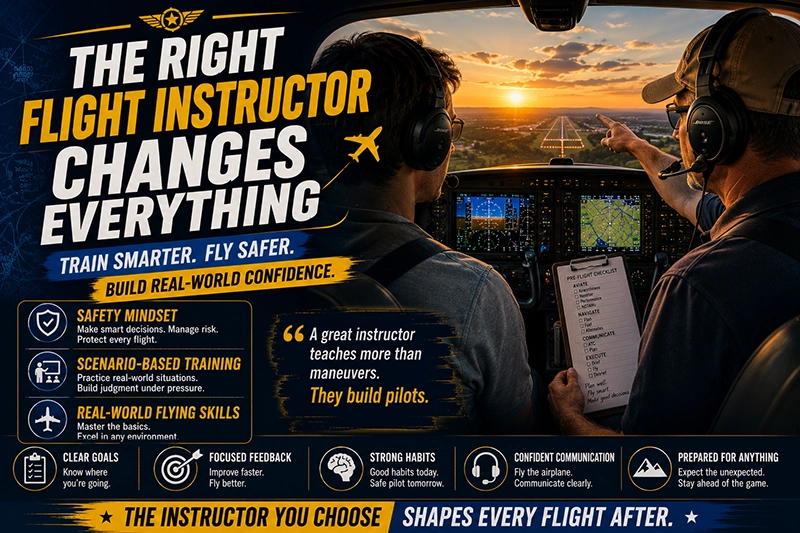
Choosing a flight instructor is one of the most important decisions a pilot or student pilot makes. The right flight instructor shapes your technique, safety mindset, decision-making skills, and long-term progress. Whether you are beginning private pilot training, pursuing advanced ratings, or returning to flight after a break, the instructor you select will influence how efficiently and safely you learn.
This article explains how to evaluate and choose a flight instructor based on teaching ability, technical knowledge, instructional style, and operational experience. The guidance is written for student pilots, certificated pilots seeking additional ratings, flight instructors, and flight school managers who want to make thoughtful, safety-focused choices about instructor selection.
What a Flight Instructor Actually Does
A flight instructor performs more than demonstration flights. A good instructor converts complex aeronautical knowledge into usable skills, builds consistent judgment in crosswinds, emergencies, and unexpected weather, and develops good cockpit habits that reduce workload and risk. Instructors must teach aircraft control, navigation, risk management, radio communications, airspace procedures, and preflight preparedness. They also evaluate student performance and give practical feedback that students can act on the next flight.
Instruction has three overlapping elements: technical training, scenario-based decision making, and assessment. Technical training develops stick-and-rudder skills and systems knowledge. Scenario-based training builds judgment and automation management. Assessment identifies gaps and sets realistic, measurable goals for the next stage of training.
Why This Matters in Real-World Aviation
A training relationship that emphasizes safety, sound aeronautical decision making, and disciplined airmanship reduces the likelihood of errors that lead to incidents. Real-world operations require continuous judgment under changing conditions: weather, traffic, performance limits, and pilot physiology can all affect outcomes. An instructor who stresses practical risk management helps a student build mental models that transfer to real flights, not just checkrides.
Beyond safety, instructor choice affects operational competence. Employers and examiners notice pilots who were trained with emphasis on cockpit work flow, clear communication, and consistent emergency procedures. Conversely, gaps in training—such as inconsistent terminology, poor handover practices, or incomplete system knowledge—often surface later in a pilot's career when higher workload or unusual situations occur.
How Pilots Should Understand the Selection Process
Selecting a flight instructor begins with clarifying your goals. Are you seeking a private pilot certificate, an instrument rating, commercial credentials, or specific type transition training? Are you training for recurrent proficiency or tailored scenario work? Your objective shapes which instructor qualities matter most.
Consider these broad attributes when evaluating candidates.
Technical Competence
Technical competence includes current knowledge of aircraft systems, aerodynamics, navigation, and instrument procedures. It also includes experience in the specific aircraft and equipment you will use. A technically competent instructor can explain the why behind maneuvers, not just the how. They can troubleshoot minor mechanical issues, explain performance calculations, and demonstrate correct scan patterns in instrument work.
Instructional Skill
Not all experienced pilots are effective teachers. Instructional skill includes the ability to break tasks into incremental steps, adapt explanations to a student's learning style, and provide constructive, targeted feedback. Look for instructors who use demonstration, guided practice, and debriefing. An instructor who explains common errors and their causes helps students internalize safer habits.
Communication and Professionalism
Clear, calm communication in the cockpit is essential. The instructor should be concise on the radio, explicit about goals for each flight, and open to questions. Professionalism also includes punctuality, transparent pricing and scheduling, and respectful treatment of students and airport personnel.
Safety Mindset
Assess an instructor's approach to safety by their preflight habits, weather decision-making, and how they handle go/no-go choices. A strong safety mindset manifests in consistent risk management: using briefings, respecting personal minimums, and advocating for alternate plans when conditions change. Instructors who model good decision-making teach students to do the same under pressure.
Compatibility and Teaching Style
Teaching style varies from highly structured, syllabus-driven approaches to more open, scenario-based coaching. Some students prefer firm, directive instruction while others respond better to Socratic questioning that prompts independent problem solving. A productive pairing requires alignment between instructor style and the student's learning preferences.
Practical Steps to Evaluate Instructors
Use these practical steps during the search and interview process. The goal is to assess real teaching practice, not rely solely on reputation or hours logged.
- Ask for a short introductory flight lesson or a discovery lesson. This gives a direct sense of how the instructor structures briefings, demonstrates maneuvers, and provides feedback.
- Request a syllabus or lesson plan for your training goal. A syllabus shows whether the instructor organizes training around measurable objectives and safety scenarios.
- Discuss instructor currency in the specific aircraft and for the operations you plan to fly. Current experience in a make and model matters, especially for complex or higher-performance aircraft.
- Talk about emergency procedures and how the instructor integrates them into routine training. Frequent, realistic practice of emergency flows builds skill retention.
- Check for references from recent students. Talk to former students about pass rates, instructor availability, and whether training translated into operational confidence.
Common Mistakes or Misunderstandings
Several common errors can lead students to a poor instructor choice. Knowing these pitfalls helps you evaluate candidates more critically.
Focusing on Price Alone
Lower hourly rates or package discounts are attractive, but they can mask hidden costs: inefficient training that requires repeated lessons, inadequate preflight briefings, or poor aircraft handling that slows progress. Evaluate cost per successful outcome, not just hourly rate.
Overvaluing Total Flight Hours Without Context
Total flight time is a useful indicator, but not all hours are equal. An instructor with many hours primarily in one environment may lack relevant experience for your training needs. Equally important is recency and diversity of experience.
Assuming a Big Personality Equals Good Instruction
Charismatic instructors can inspire, but if their teaching style is authoritarian or unpredictable, it may hinder learning. Good instruction balances confidence with patience and clear explanations.
Confusing Checkride Readiness with True Competence
An instructor focused only on passing the practical test may use tactics to coach to the standard without building deep situational awareness. Prefer instructors who aim for operational competence beyond the checkride.
Practical Example: Selecting an Instructor for an Instrument Rating
Imagine you are a private pilot ready for an instrument rating. Your priorities include instrument scan technique, precision in attitude flying, knowledge of instrument procedures, and IFR decision-making. Here is how you might evaluate two candidate instructors.
Instructor A is highly experienced with instrument flying in turboprops and glass cockpits. Their teaching emphasizes scenario-based training: approaches in varying weather, diversion planning, and automation management. They use structured debriefs and simulate failures during instrument approaches. Instructor A's lessons consistently include cross-country IFR planning and communication practice with ATC.
Instructor B is a long-time CFI with many hours in piston single-engine trainers. Their instrument instruction focuses on maneuver proficiency and procedure practice. They follow a checklist-oriented lesson plan and are strong on fundamentals like scan and aircraft control but less focused on automation or complex airspace procedures.
If your goal is commercial instrument competence in complex airspace and glass avionics, Instructor A may be a better fit. If you want rock-solid attitude flying and basic IFR skills in legacy avionics, Instructor B could be the right choice. The correct selection depends on your objectives, the avionics you will fly, and the operational environment you expect to encounter.
Best Practices for Pilots Working with an Instructor
Once you select an instructor, certain practices will make training more efficient and safer.
- Set clear goals for each lesson and review progress against those goals at the start and end of flights.
- Keep an honest training log and note areas that need reinforcement. Use those notes to shape the next lesson's focus.
- Practice outside of aircraft time where possible: briefings, simulators, procedural flow drills, and scenario visualization reduce in-air workload and accelerate learning.
- Request debriefs that identify one or two specific, measurable improvements to work on. Actionable feedback beats general praise.
- Establish a communication protocol for when the instructor will take controls and how maneuvers will be graded during a lesson.
How to Verify Qualifications and Experience
Always confirm an instructor's certification status in the regulatory system appropriate to your country and check their endorsements, where applicable. Ask about their recent flight experience in the aircraft and operations you intend to fly. If you are training towards a commercial role, discuss whether the instructor has experience preparing candidates for airline or corporate standards, and whether they can help build a professional logbook with evidence of required tasks.
Also inquire about the instructor's instructional credentials, such as whether they have formal instructor training, use of evidence-based training techniques, or experience in scenario-based instruction. These attributes often correlate with better learning outcomes.
Common Safety Risks and How the Right Instructor Mitigates Them
Poor instruction can leave gaps that become safety risks in advanced or unusual flight conditions. Examples include inadequate transition training to high-performance aircraft, insufficient automation management training that leads to mode confusion, and weak upset recovery instruction that results in improper recovery techniques. A competent instructor integrates failure simulations, cross-check discipline, and scenario-based work to reduce these risks.
Good instructors teach standardized procedures that students can rely on under stress. They also cultivate recognition of task saturation and teach diversion strategies that prioritize safe outcomes over rigid adherence to plans.
Matching Instructor to Aircraft and Mission
Match the instructor's experience to the aircraft and mission. For VFR training in a basic trainer, the most important qualities are teaching clarity and stick-and-rudder proficiency. For complex or multi-engine training, prioritize instructors with demonstrated experience in those aircraft and with consistent use of emergency checklists and systems knowledge. For glass cockpit operations or advanced avionics, seek instructors comfortable instructing in those avionics and capable of teaching automation management.
How to Assess an Instructor During a Trial Lesson
A trial lesson provides direct evidence of teaching approach. Use a brief checklist in your mind when evaluating the lesson's structure:
- Preflight briefing: Were objectives stated and risks discussed?
- Demonstrations: Did the instructor model the maneuver at appropriate speeds and altitudes and explain common errors?
- Feedback: Was feedback timely, specific, and linked to concrete actions?
- Postflight debrief: Did the instructor summarize performance, highlight improvements, and set clear next steps?
If the instructor cannot articulate a plan for how training will progress or is vague about skill benchmarks, consider other options.
When to Change Instructors
Consider changing instructors if progress stalls, if your goals are not being met, or if there is a mismatch in teaching style. Other valid reasons include inconsistent safety standards, frequent rescheduling, or unprofessional behavior. Before switching, discuss concerns candidly; sometimes a short change in lesson structure or a supplemental session with another instructor can resolve gaps.
Hiring an Instructor: Independent vs. Flight School
Independent instructors may offer flexibility and lower rates. Flight schools often provide structured syllabi, integrated aircraft maintenance, and a path for multiple ratings. Evaluate the benefits of either approach in terms of scheduling reliability, instructor oversight, and the school's quality assurance processes. If you choose an independent instructor, confirm their aircraft maintenance arrangements and responsibility for adhering to safety routines.
Common Misunderstandings About Instructor Qualifications
Some students assume that a high number of instructor hours automatically equals excellent teaching. In reality, recent, relevant experience and instructional training often matter more than aggregate hours. Another misconception is that an instructor who repeatedly takes controls quickly is being cautious. While safety is paramount, overly interventionist instruction can deprive students of learning opportunities. The best instructors maintain a balance: intervene when safety is threatened but allow controlled errors for learning when appropriate.
Frequently Asked Questions
How many flights should I expect before I reach checkride standard?
There is no fixed number. Progress depends on prior experience, frequency of lessons, student aptitude, and the quality of instruction. Expect variability and focus on performance goals rather than a specific number of hours or flights.
Should I train with an instructor who is also an active charter or airline pilot?
Active operational experience can be beneficial because those instructors bring current, realistic operational context to training. However, ensure they have recent instructional experience and available time for consistent scheduled lessons. Operational experience enhances scenario-based training but does not replace structured instructional skill.
Is it better to switch instructors if I am not improving quickly?
Not always. Slow progress can result from inconsistent practice, infrequent lessons, or unrealistic expectations. Before switching, discuss specific concerns with your instructor, set measurable short-term goals, and evaluate progress over a few lessons. If there is still a persistent mismatch in communication or instructional approach, consider switching.
How important is it that my instructor is experienced in the exact aircraft I will fly?
Very important for complex or high-performance aircraft, and for type-specific procedures. Familiarity with cockpit layout, performance characteristics, and emergency procedures relevant to the aircraft improves the quality and safety of training.
Can an instructor help me become job-ready for professional flying?
Yes, some instructors specialize in professional pilot development, offering advanced procedures training, multi-crew communication skills, and commercial-level standards. Ask about their experience preparing pilots for airline or corporate operations, and whether they can provide scenario-based training aligned with employer expectations.
Key Takeaways
- Choose an instructor who matches your training goal, teaching style, and the aircraft you will fly.
- Prioritize instructors who model a strong safety mindset, use structured briefings and debriefs, and integrate scenario-based training.
- Verify recent, relevant experience and instructional skills rather than relying solely on total hours or price.
If you are serious about progressing safely and efficiently, invest time in selecting the right flight instructor. The right instructor will accelerate learning, reduce risk, and prepare you for real-world aviation challenges. Make your choice deliberately, evaluate the fit during a trial lesson, and keep an open line of communication to ensure your training remains aligned with your goals.