
Every instrument pilot knows that a filed route is not always the route that gets flown. Weather builds, traffic demand rises, equipment outages appear, and air traffic control may need to move departures away from a constrained part of the National Airspace System. When that happens, a pilot can receive a long amended clearance, wait on the ground while a new route is coordinated, or, in some cases, use a more efficient option: a Coded Departure Route.
Coded Departure Routes, commonly called CDRs, are designed to make rerouting faster and more predictable when normal departure routes are affected by constraints. They are preplanned routes that can be issued quickly by air traffic control and understood by pilots who are prepared to accept them. For general aviation pilots operating in complex terminal environments, CDRs can reduce delays, shorten clearance readbacks, and provide a practical alternative when the original departure route is no longer available.
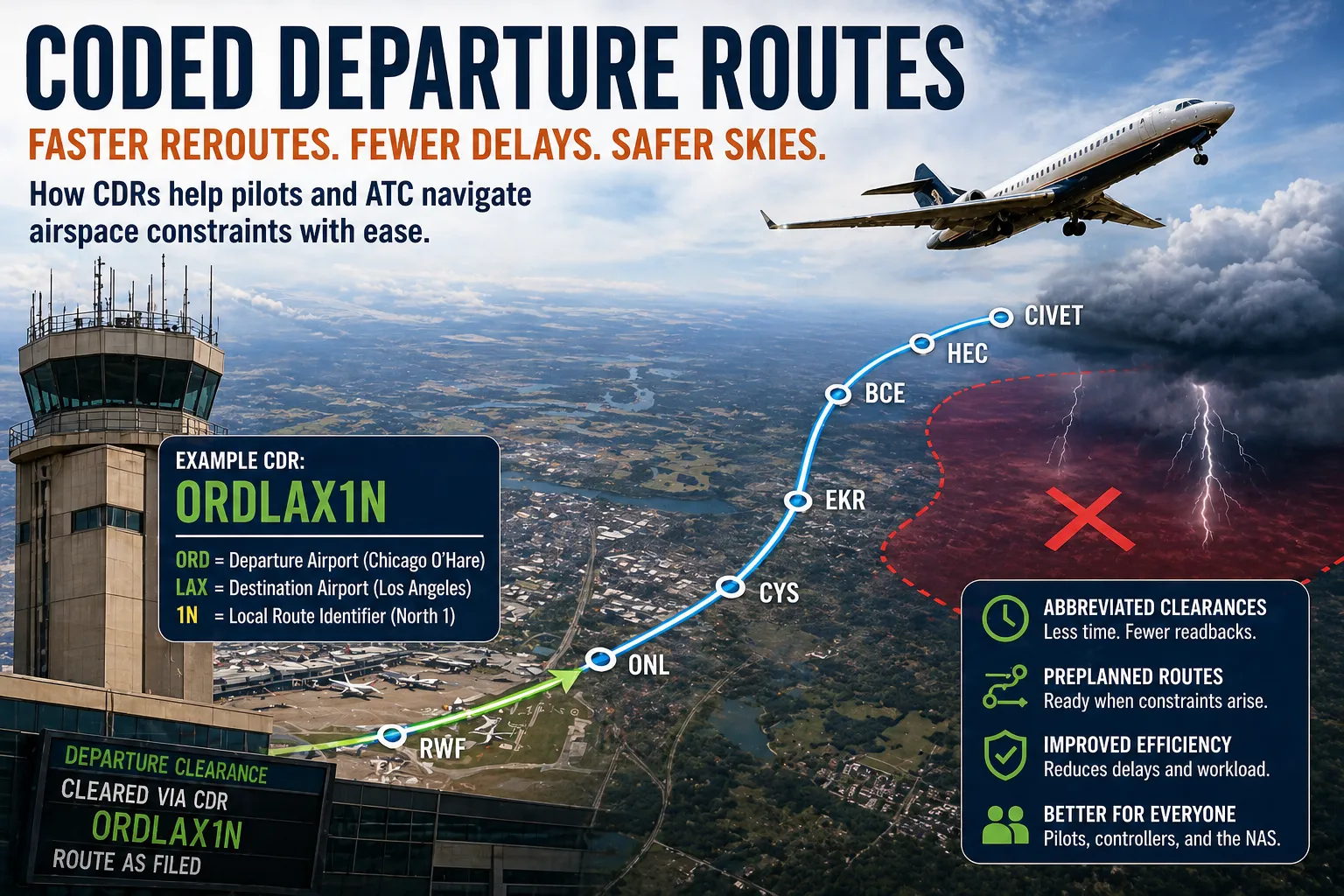
The basic idea is simple. Instead of building and communicating a lengthy alternate route from scratch, ATC can issue a short coded route identifier. That identifier represents a complete route stored in a route database. The result is less frequency congestion, less keyboard entry for controllers, shorter readbacks for pilots, and a common understanding of the reroute.
Why Coded Departure Routes Exist
Air traffic constraints are a normal part of daily operations in busy airspace. Thunderstorms may block a common departure corridor. Turbulence or convective weather may make a route undesirable. Traffic volume may exceed what a particular fix, airway, or sector can handle. A navigation outage or other system constraint may also affect the availability of a planned departure route.
Without a preplanned alternative, ATC may have to coordinate a new route in real time. That can take time, particularly at busy airports where many aircraft are waiting to depart and radio frequencies are already saturated. A long reroute also creates more chances for readback errors, clearance confusion, and delays while flight crews verify the new route against their fuel, navigation, and performance planning.
CDRs help solve that problem by turning a long, complex route into a short, standardized identifier. The route is already built, stored, and available for use when needed. When conditions require it, the controller can issue the CDR as part of an abbreviated clearance, and the pilot can accept it if the aircraft and crew are prepared.
What a CDR Actually Is
A Coded Departure Route is a preplanned route of flight that can be rapidly issued, coordinated, and communicated among pilots, controllers, and FAA automation systems. It is not merely a shortcut name for a departure procedure. It is a complete routing option designed to help aircraft depart when a normal route is unavailable or inefficient due to a system constraint.
CDRs are especially useful because they give ATC and pilots a known alternative before the pressure of a delay or reroute begins. Instead of inventing a new path during a weather event or traffic push, the system can rely on a route that has already been adapted for operational use.
A CDR may route the aircraft around a constrained departure path and then rejoin the filed en route route when practical. In other cases, it may create a substantially different route to the destination airport. That distinction matters for pilots because a CDR is not automatically a minor change. It can affect fuel planning, navigation requirements, arrival timing, and crew workload.
How the CDR Identifier Works
CDRs are identified by an eight-character route code. The structure is intended to make the identifier meaningful while still keeping it compact enough for fast ATC communication.
The first three characters identify the departure airport. The next three characters identify the destination airport. The final two characters are reserved for local facility adaptation, allowing the local air traffic facility to distinguish among different routing options.
For example, a coded route such as ORDLAX1N indicates a route from Chicago O’Hare International Airport to Los Angeles International Airport. The “1N” portion is a locally adapted identifier that may distinguish it as a particular north departure route or another facility-defined variation.
The real value becomes clear when comparing the short code with the full route behind it. A complete route may include multiple fixes, airways, transitions, and arrival components. Reading and entering that entire string can be time-consuming. A compact CDR identifier allows the same route to be communicated much more efficiently.
How CDRs Benefit Pilots
For pilots, the most visible benefit of a CDR is reduced delay. When a filed route is blocked by weather, traffic volume, or another constraint, the usual alternatives may be waiting on the ground or refiling a new flight plan. A CDR can provide another option by allowing ATC to issue a route that is already known to the system.
This can be particularly valuable at large terminal facilities where departure traffic may be heavy and constraints can change quickly. A pilot who is prepared for a CDR may be able to depart sooner than a pilot who must wait for a full reroute to be developed and coordinated.
CDRs also improve communication. A short coded route reduces frequency time and lowers the chance of a readback problem. In busy terminal operations, that matters. The fewer complex route strings that must be read, heard, corrected, and re-read, the more efficient the operation becomes for everyone on the frequency.
Another important benefit is shared awareness. Because the coded route is maintained in a database and used by air traffic facilities, pilots and controllers can refer to the same route structure. This does not remove the pilot’s responsibility to understand the clearance, but it does make route coordination more standardized.
How a CDR Can Affect Your Flight
A CDR can change the way a flight leaves the terminal environment. In many cases, it is designed to route the aircraft around a restricted or constrained departure path and then return it to the filed en route route when possible. That can make the reroute relatively manageable from the pilot’s perspective.
However, some CDRs may take the flight on a completely different route to the destination airport. That means pilots should not treat a coded route as a harmless administrative shortcut. It is still a clearance, and it must be evaluated like any other route amendment.
Before accepting a CDR, the pilot should be confident that the aircraft can navigate the route, that the crew understands it, and that fuel is sufficient for the revised routing. A route that works well for the system may still be unsuitable for a particular aircraft if it requires equipment the aircraft does not have, creates a fuel issue, or conflicts with operational limitations.
What “CDR Capable” Means
General aviation pilots who want to be eligible to receive abbreviated CDR clearances can indicate that capability in the remarks section of the flight plan. The phrase used is “CDR CAPABLE.”
That short remark carries important meaning. It tells ATC that the pilot in command is familiar with the CDR program and is prepared to accept a coded route if appropriate. It also implies that the pilot has access to current CDR information and can evaluate whether the route is acceptable.
In practical terms, a pilot who files “CDR CAPABLE” should be prepared in several areas:
- The pilot should understand how the CDR program works.
- The pilot should have a current list of available CDRs onboard or otherwise accessible.
- The aircraft should have the navigation equipment required to fly the route.
- The pilot should be able to accept a change from the filed route.
- The aircraft should have enough fuel for the revised routing.
This is not a casual remark to add because it sounds helpful. It is a statement of readiness. If a pilot is not familiar with CDR procedures or does not have access to current route information, adding “CDR CAPABLE” can create confusion at exactly the wrong time.
Where Pilots Find Available CDRs
CDRs are maintained in the FAA’s Route Management Tool, often referred to as RMT. This database allows pilots and operators to look up coded routes and review the full route associated with a CDR. The advisory circular describes the tool as field-searchable, which helps pilots retrieve routes by relevant route information.
The RMT is updated according to the FAA’s 56-day charting cycle. That update cycle is important because routes, fixes, procedures, and operational constraints can change. A pilot using outdated route information may misunderstand a clearance or prepare for a route that is no longer current.
For flight planning, the route database can be useful even when a pilot does not expect to receive a CDR. Reviewing available CDRs can help identify valid departure alternatives before filing. If weather or traffic constraints appear likely, this can give the pilot a better sense of what ATC may issue and what route options may be realistic.
How a Pilot Receives a CDR
At towered airports, controllers initiate and issue CDRs when they become necessary. The pilot does not simply file the CDR code as the flight plan route. Instead, the pilot may file the complete route associated with a CDR if desired, or indicate “CDR CAPABLE” in the remarks section so ATC knows the flight can receive an abbreviated coded clearance.
This distinction is important. A CDR code is not itself filed as the route in the same way a sequence of fixes and airways would be. It is a shorthand clearance tool used when ATC issues the coded route. Pilots who want to use CDR information during planning may file the complete route string associated with that CDR, but they should not assume that entering only the route code as the filed route is correct.
When ATC issues a CDR, the clearance may include the departure procedure and the coded route identifier, followed by an indication that the rest of the route remains unchanged. The pilot reads back the clearance using the CDR identifier. This shorter exchange is one of the main reasons CDRs are useful in busy terminal environments.
What to Do If the Clearance Is Unclear
A CDR is intended to simplify communication, but it does not eliminate the pilot’s responsibility to understand the clearance. If there is any uncertainty about the route, the pilot should ask for clarification. A pilot should not accept or depart on a clearance that is not fully understood.
In practice, this may mean contacting the tower or ground control by voice and requesting the full route clearance. That may take more time, but it is better than accepting a clearance based on guesswork. An abbreviated clearance is only helpful when both sides understand exactly what it means.
What If You Cannot Accept the CDR?
There are many legitimate reasons a pilot might be unable to accept an issued CDR. The aircraft may lack required navigation equipment. The route may require a capability that is unavailable. The revised routing may create a fuel issue. The pilot may not have the current CDR onboard. The clearance may also create operational concerns that make it unsuitable for the flight.
The pilot in command remains directly responsible for the operation of the aircraft and retains final authority over whether a clearance can be safely accepted. If an ATC clearance would cause a regulatory problem or place the aircraft in jeopardy, the pilot should request an amended clearance.
A refusal does not need to be complicated. A pilot can state that the flight is unable to accept the CDR and give a concise reason, such as lacking required equipment. ATC can then issue a full route clearance or provide another option. The key is to be direct, professional, and timely.
CDRs and Flight Planning Strategy
The best time to think about CDRs is before calling for clearance. If thunderstorms, outages, or volume constraints are possible at the departure airport, a pilot should consider whether CDRs may be relevant. This is especially true for flights departing large terminal areas where reroutes are more common and where CDRs are more likely to be used.
During planning, pilots should review likely weather constraints, fuel reserves, aircraft navigation capability, and route alternatives. A CDR may help avoid a delay, but it may also add mileage or change the flow of the flight. Fuel planning should account not only for the filed route, but also for practical reroute possibilities when the system is under stress.
For business aviation and general aviation pilots operating on tight schedules, CDR knowledge can be a real advantage. It can reduce surprises and allow more informed decisions when ATC offers a reroute. For student pilots and instrument trainees, the topic is also valuable because it shows how real-world IFR operations often involve system-level traffic management, not just flying a cleared route from one fix to another.
Why CDRs Matter in the National Airspace System
CDRs are a small but important example of how the National Airspace System balances safety, efficiency, and flexibility. A departure route may be perfectly valid on a clear, low-traffic day, yet unusable when thunderstorms block a corridor or demand exceeds capacity. Preplanned coded routes give the system a faster way to adapt.
For controllers, CDRs reduce workload during high-pressure situations. For pilots, they provide an organized alternative to waiting or receiving a long, complex reroute. For the system as a whole, they help keep traffic moving when constraints would otherwise create larger delays.
The concept also reinforces a broader lesson: efficient IFR flying depends on preparation. A pilot who understands available tools, uses current route information, and communicates clearly with ATC is better positioned to handle changes without confusion or unnecessary delay.
Practical Takeaways for Pilots
A pilot does not need to use CDRs on every flight, but understanding them can be valuable for operations from busy airports or during weather-impact days. The most important step is knowing whether a CDR may apply, whether the aircraft is equipped to fly it, and whether the pilot is ready to accept the abbreviated clearance.
Adding “CDR CAPABLE” to the flight plan should mean the pilot has done the homework. It should not be treated as a generic request for priority handling. It is an operational signal that the pilot can receive, understand, and fly a coded route if ATC issues one.
When a CDR is issued, the pilot should verify that the route is understood, check that aircraft equipment and fuel are adequate, and speak up immediately if the route cannot be accepted. CDRs are designed to improve efficiency, but safety and clarity remain the priority.
Key Takeaways
- Coded Departure Routes are preplanned alternate routes that help ATC issue faster reroutes during weather, outages, traffic volume, or other system constraints.
- Filing “CDR CAPABLE” tells ATC the pilot understands the program, has current CDR information available, and can evaluate whether the aircraft can safely fly the route.
- A pilot should never accept a CDR that is unclear, unsuitable for the aircraft, beyond navigation capability, or questionable for fuel or safety reasons.