
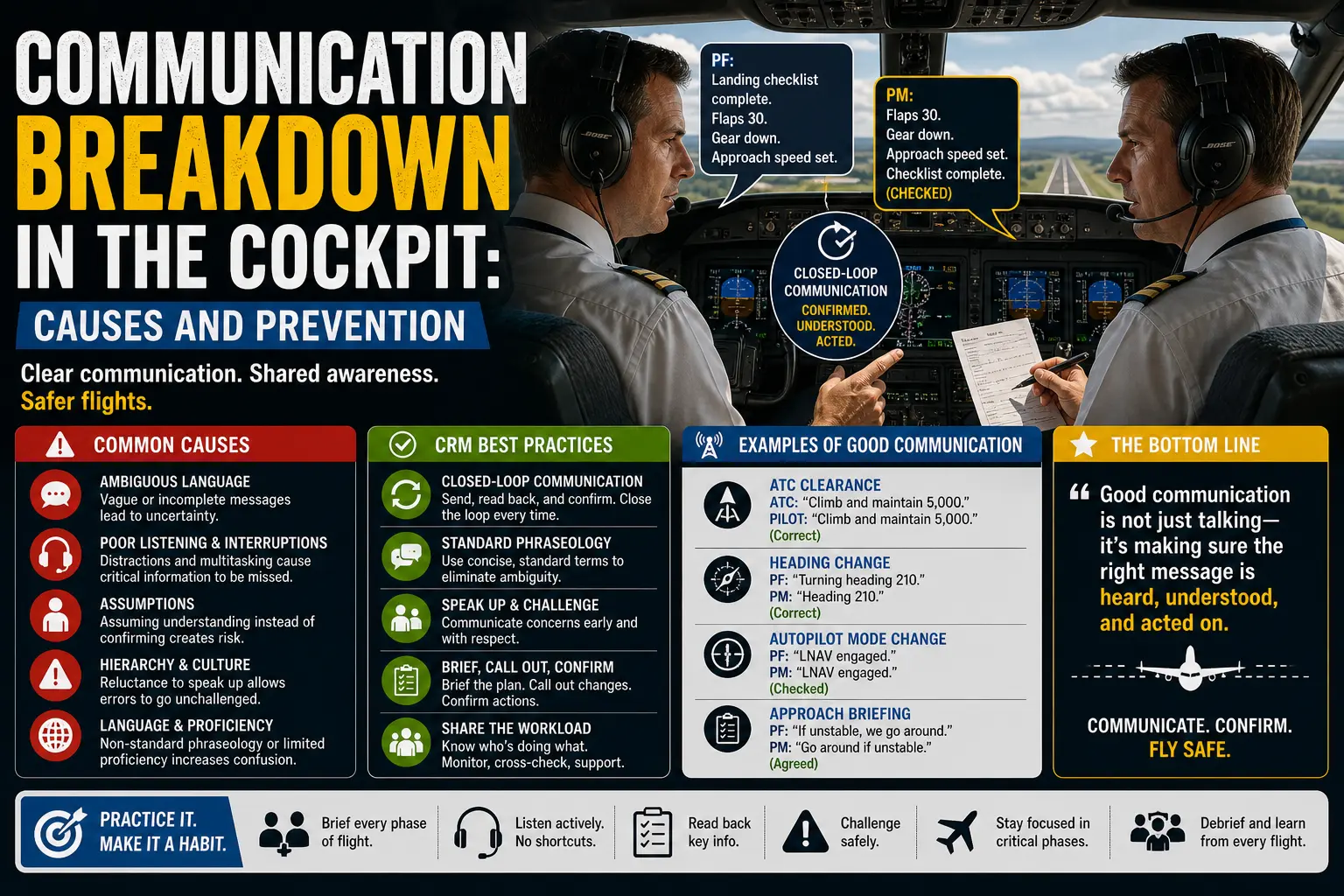
Communication breakdown in the cockpit is one of the most persistent human factors risks in aviation. When pilots fail to exchange clear, accurate information at the right moment, small errors can compound into operational problems that affect safety, efficiency, and decision-making. This article explains why cockpit communication failures happen, shows how Crew Resource Management principles and standard phraseology reduce risk, and gives practical guidance pilots and instructors can apply in training and line operations.
If you are a student pilot, flight instructor, airline or corporate pilot, or an operator responsible for safety training, this article outlines the core causes of miscommunication, practical CRM best practices, and the concrete actions that reduce misunderstandings. The primary phrase we will use throughout is "communication breakdown in the cockpit." Keep reading for real-world examples, common mistakes to avoid, and an actionable set of best practices you can start using on your next flight.
Understanding the Core Issue
At its simplest, a communication breakdown in the cockpit occurs when one crewmember's intent, observation, or instruction is not accurately received and acted on by another crewmember or an external party such as air traffic control. The breakdown can be a missing callout, an ambiguous phrase, a poor readback, or an assumption that information has been understood. The result is often a mismatch between the flightdeck's mental model and the aircraft's actual state.
Why This Matters in Real-World Aviation
Clear cockpit communication affects aviation across multiple domains. In training, misunderstandings slow progress and can normalize unsafe habits. In operations, they can lead to incorrect configuration, altitude deviations, unstable approaches, or misapplied automation. For decision-making, effective communication supports shared situational awareness so the crew can detect and recover from errors quickly. In maintenance and dispatch, ambiguous handoffs can cause delays or technical oversights. Addressing communication failure is therefore fundamental to operational safety and efficiency.
How Pilots Should Understand This Topic
Think of cockpit communication as a process with three parts: transmit, receive, and confirm. Transmit means conveying your information clearly and concisely. Receive means actively listening and cross-checking what you heard against instruments or other cues. Confirm means using readback, challenge-response, or closed-loop communication to ensure the transmitted message was understood and will be acted upon. When any of these steps is weak, the probability of a breakdown rises.
Miscommunication Examples
Concrete examples help make the problem tangible. Common scenarios include:
- Ambiguous callouts: A pilot says "we should be higher" without specifying a target altitude or who will correct it. The other pilot assumes the instrument will be adjusted and does not act.
- Incomplete readbacks: Air traffic control issues a climb to 5,000 feet and the pilot replies only "climbing," leaving the ATC uncertain whether the correct altitude was heard.
- Interrupted briefings: A runway change or approach briefing is cut short by radio calls, and the missed briefing detail later contributes to a configuration or routing error.
- Assumed intent: A pilot selects an automation mode without announcing it; the other pilot sees the mode change too late to catch an undesired vertical or lateral capture.
- Language or proficiency issues: Non-native speakers may use nonstandard phrasing that makes a critical clearance ambiguous.
Common Mistakes or Misunderstandings
Pilots and instructors often fall into predictable traps that enable communication breakdowns. These include:
- Relying on implied agreement rather than explicit confirmation. A nod or a quick "okay" is not the same as a proper readback or challenge-response.
- Allowing multitasking to interrupt critical exchanges, such as approach briefings or configuration callouts.
- Overconfidence in automation: trusting an autopilot or FMS mode without verbalizing mode changes and cross-checking instrument indications.
- Cultural or hierarchical reluctance to challenge a captain. When junior crewmembers hesitate to speak up, errors can go uncorrected.
- Using nonstandard or colloquial language in ATC communications or crew-to-crew exchanges, which invites ambiguity.
Practical Example
Imagine a two-pilot turboprop on final approach at night. ATC issues a last-minute descent to intercept the glideslope with a new crossing restriction. The pilot flying says, "Got it," but does not repeat the crossing restriction or new altitude. The pilot monitoring is setting up the approach checklist and misses the controller's revised altitude. When the aircraft approaches the published crossing altitude, the crew realizes the descent was not initiated and there is potential conflict with traffic on the procedure. The appropriate response includes an immediate challenge, clarifying readback to ATC, and if necessary, a go-around to reestablish a stable approach.
The example shows how a brief, ambiguous acknowledgment can leave a critical clearance partially acted on. A closed-loop readback such as "Descending to 3,000, intercepting glidepath" and a verbal acknowledgment from the pilot monitoring would have closed the loop and reduced the risk.
CRM Best Practices
Crew Resource Management is the framework most operators use to reduce human error and improve cockpit communication. Practical CRM principles that reduce communication breakdown include:
- Closed-loop communication: When a message is sent, the receiver repeats the critical element back to confirm understanding. This is especially important for clearances, altitudes, headings, and autopilot modes.
- Standard phraseology: Use concise, standardized language for routine tasks and ATC interactions. Where non-standard phrasing is unavoidable, explicitly restate critical numbers and actions.
- Assertiveness with respect: Encourage direct but respectful challenge and response when safety is at stake. Phrase concerns as observations plus a recommended action when possible.
- Briefings and callouts: Make briefings concise and ensure callouts for configuration, altitude, speed, and automation changes are audible and timely.
- Task management and workload sharing: Assign roles for critical phases (e.g., pilot flying vs pilot monitoring), and verbalize who will perform which actions to prevent duplication or omission.
- Use of checklists and cross-checks: Verbalize completed checklist items and cross-check each other's actions, especially for approach and landing.
Standard Phraseology: Why It Matters
Standard phraseology is not mere formality. It reduces ambiguity by limiting the number of ways a concept can be expressed. When both pilots and ATC use standardized terms and formats, the chance of misinterpretation decreases. Standard phraseology helps in four practical ways:
- Predictability: Crewmembers know what to expect and can listen for specific words that require action.
- Conciseness: Critical information is delivered in a compact form that survives high workload and background noise.
- Readback clarity: Numeric values and clear verbs reduce the risk of executing the wrong altitude, heading, or frequency.
- Interoperability: Standard terms are understood across different airlines, ATC units, and international operations.
In practice, emphasize repeating numbers and action verbs. For example, when cleared to an altitude, include the altitude in the readback. When changing autopilot modes, name the new mode and confirm the intent to engage it.
How to Practice and Train These Skills
Training is where improvements become habits. Instructors and training departments should use scenario-based training that specifically targets communication under stress, such as degraded weather, high workload, or adding a nonstandard ATC instruction. Simulators and LOFT sessions are effective environments to practice closed-loop exchanges, assertive challenge-response, and briefing discipline without operational risk.
Single-pilot operations can adopt CRM concepts too: brief the flight, verbalize critical actions, use sterile-cockpit discipline during critical phases, and build habits like repeating ATC clearances aloud and cross-checking against instruments.
Best Practices for Pilots
Adopt these practices consistently to reduce communication breakdown risk:
- Use closed-loop communication for all clearances and critical callouts. Always include the key numeric or action element in your readback.
- Speak up early and clearly if something does not match your mental model. Use factual language and, when appropriate, propose a specific corrective action.
- Maintain sterile-cockpit discipline during taxi, takeoff, approach, and landing to ensure critical briefings and callouts are completed without interruption.
- Brief transitions in automation and verbalize mode changes so both pilots understand the flight path intent.
- Practice standard phraseology in both ATC communications and intra-cockpit exchanges. When in doubt, be explicit rather than brief.
- Include communication scenarios in recurrent training and debriefs. Discuss near-misses and ambiguous exchanges as learning opportunities.
Frequently Asked Questions
What is closed-loop communication and when should I use it?
Closed-loop communication means the sender issues a message, the receiver repeats the critical elements back, and the sender confirms the repetition as correct. Use it for any clearance, altitude, heading, frequency, or mode change where misunderstanding could affect flight path or safety.
How does standard phraseology make a difference in the cockpit?
Standard phraseology reduces the number of ways information can be stated, which decreases ambiguity and improves predictability. It is especially valuable in high-workload conditions and when pilots communicate with controllers or crews from other organizations.
When should a crewmember challenge a command or decision?
Challenge when you believe an action could compromise safety or when information is incomplete or unclear. Use brief, factual statements and, if appropriate, offer an alternative. Effective CRM encourages challenges to be raised early rather than after an error materializes.
How can single-pilot operations apply CRM principles?
Single pilots can apply CRM by increasing verbalization, performing thorough briefings, using sterile-cockpit discipline, and practicing decision-making under simulated pressure. Verbalizing intentions and repeating critical clearances aloud helps create the same cognitive checks that a second pilot provides.
Key Takeaways
- Practical takeaway: Use closed-loop communication and repeat critical numbers and actions out loud to close understanding gaps.
- Safety takeaway: Assertive, respectful challenge and confirmation prevent small ambiguities from becoming operational threats.
- Training takeaway: Incorporate communication-focused scenarios, standard phraseology practice, and debriefs into recurrent training to build resilient habits.