
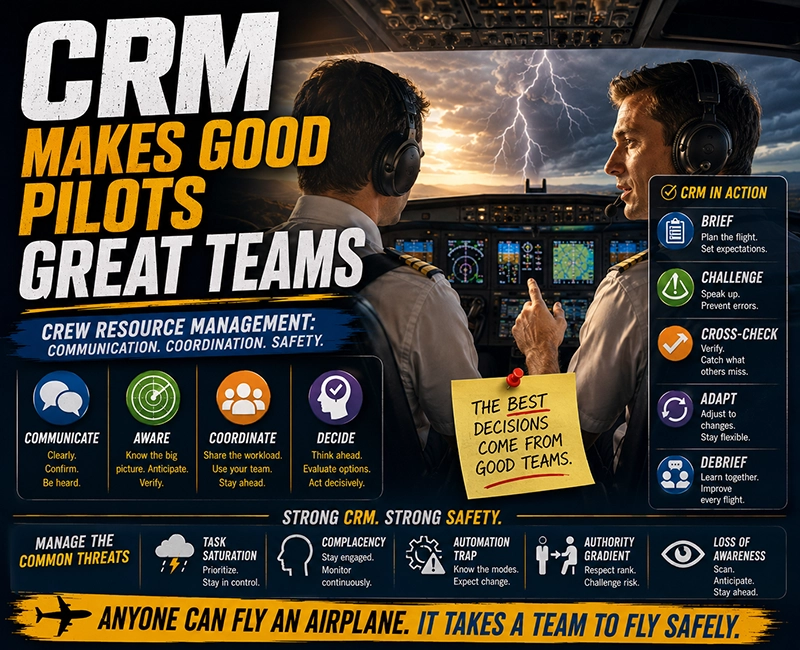
Crew Resource Management, widely known as CRM, is a foundational element of contemporary flight training. It describes the set of knowledge, skills, and attitudes that crews use to manage human performance, distribute workload, and make effective decisions when operating aircraft. For pilots, student pilots, instructors, and aviation professionals, CRM is not an optional add-on. It shapes safety culture, training design, and everyday cockpit behavior.
This article explains CRM in practical terms, shows how modern training translates theory into flight-deck behavior, and offers concrete guidance instructors and pilots can apply during lessons and operations. The goal is to make CRM actionable: to move beyond abstract principles so crews and instructors can build measurable, repeatable habits that reduce error, improve communication, and enhance decision-making under pressure.
What CRM Is and What It Is Not
At its core, CRM is about human performance and team interaction in complex environments. It includes non-technical skills such as communication, leadership, workload management, situational awareness, and decision-making. CRM also covers the management of automation, the recognition and mitigation of threats and errors, and the use of standard operating procedures and briefings.
CRM is not simply a set of phrases or a checklist to be recited. It is not limited to transport or multi-crew operations. Modern CRM principles apply across the full spectrum of aviation: single-pilot general aviation flights, multi-crew commercial operations, helicopter missions, and flight instruction. The difference between effective CRM and lip service is integration: CRM works when it is embedded into every phase of training, operations, and debriefing.
Why CRM Matters in Real-World Aviation
Human factors continue to be a primary contributor to aviation incidents and accidents. When crews communicate poorly, defer to authority without challenge, or mismanage workload and automation, the potential for error increases. CRM helps crews recognize and mitigate threats before they escalate into more serious errors.
In flight training, CRM improves learning outcomes by exposing students to realistic decision-making contexts rather than isolated maneuver practice. It prepares pilots for operational complexity: changing weather, air traffic control constraints, system failures, and time pressure. For flight instructors and operators, CRM fosters a training environment where errors become learning opportunities instead of stigmatized events to hide.
How Pilots Should Understand CRM
Pilots should think of CRM as a toolkit of behaviors and mental models rather than a single technique. Key components include:
- Communication: Clear, concise, and timely exchange of information. This includes standardized callouts, closed-loop communication, and assertive phrasing when safety is at stake.
- Situational awareness: Maintaining a correct understanding of the aircraft state, environment, and intent of others. It involves monitoring, anticipating, and verifying key parameters.
- Decision making: Structured approaches to evaluate options under time pressure. This includes recognizing when to revert to conservative actions and when to delegate or seek help.
- Workload management: Prioritizing tasks, delegating when appropriate, and using brief pauses or simple heuristics to prevent task saturation.
- Leadership and followership: The ability for the designated pilot to lead effectively and for teammates to speak up when they detect hazards. Followership stresses the responsibility to raise credible concerns and confirm actions.
- Automation management: Understanding automation modes, expected behavior, and risks such as mode confusion or complacency.
These components interact. For example, good communication supports situational awareness and decision making; sound workload management preserves cognitive bandwidth to detect threats.
Integrating CRM into Training: Methods and Approaches
Modern flight training uses several instructional approaches to teach CRM successfully. Scenario-based training places non-technical skills into realistic operational contexts. Line-oriented flight training (LOFT) and full-mission simulators allow crews to experience complex situations and practice team coordination. Evidence-based training frames learning objectives around behaviors that matter most to safety and uses performance data to refine instruction.
Quality debriefing is central. After a scenario, instructors should focus on observable behaviors and outcomes before attributing causes. Behaviorally anchored feedback makes CRM concrete: for example, praising a student who performed a timely and clear diversion briefing, or discussing how a missed callout contributed to increased workload.
Why This Matters in Real-World Aviation
Consider a commercial flight crew facing a sudden weather diversion. Effective CRM ensures the captain and first officer exchange a concise plan, coordinate with dispatch and ATC, manage cabin communications, and monitor the aircraft state while one pilot flies and the other handles communications and checklists. Without CRM, the crew can experience role confusion, missed tasks, and degraded performance under stress.
In single-pilot operations, CRM principles translate into managing external resources. That includes asking ATC for assistance, using company dispatchers, involving passengers in simple ways when appropriate, and maintaining a robust plan that accounts for contingencies. Single-pilot CRM emphasizes self-discipline, briefings with passengers, and effective use of automation and checklists.
How Pilots Should Practice CRM in Everyday Flying
Practice CRM deliberately. Integrate short CRM objectives into every flight lesson. Examples include: conducting a preflight briefing that assigns roles for cross-country legs, using closed-loop verification during checklist flows, and calling out deviations from planned altitudes or headings promptly.
Use short debriefs after each flight segment to reinforce behaviors. Ask probing questions that reveal reasoning rather than only evaluating outcomes. For instance, "What cues led you to start the diversion?" or "How did you prioritize tasks when the engine gauge trend indicated a potential issue?" This helps students externalize their mental models and allows instructors to correct misconceptions.
Common Mistakes or Misunderstandings
Several recurring errors weaken CRM effectiveness in training and operations:
- Treating CRM as a checkbox. When CRM becomes a rote recitation, crews miss the underlying purpose: managing human limitations. Phrases without context do not improve decision-making.
- Confusing deference with discipline. Respect for rank or experience must not suppress critical concerns. Trainees should be coached to voice safety-related observations assertively and constructively.
- Overreliance on automation. Automation can reduce workload but may also erode basic airmanship and degrade situational awareness if pilots do not understand system modes and failure modes.
- Poor debrief technique. Focusing only on technical performance ignores the situational and human factors that often drive errors. Debriefs that blame rather than teach reduce information flow and hinder learning.
- Ignoring single-pilot CRM. Some thinking treats CRM as a multi-crew problem. Single-pilot operations require explicit training in external resource use, workload management, and decision heuristics appropriate to lone pilots.
Recognizing these pitfalls helps instructors design training that counters them. Emphasize behavior change, not memorization.
Practical Example
Scenario: A student pilot and instructor are on a cross-country in a single-engine airplane. Midway, weather reports show a building line of convective activity along the planned route and a lowering cloud ceiling at the destination. ATC offers vectors to an alternate airport. The student is the pilot flying; the instructor is pilot monitoring.
CRM application in this scenario:
- Preflight and pre-departure: The crew briefed alternates and diversion criteria, assigned tasks, and confirmed fuel reserves. This established intent and decision thresholds.
- Recognition of threat: The pilot monitoring notices a trend in cloud base from ATIS and brings it to the pilot flying's attention immediately, using a concise phrase: "Cloud base trending lower—consider diversion."
- Decision making and workload management: The student declares intent to divert. The instructor takes over non-flying duties: communicating with ATC, running through the diversion checklist, and preparing the passenger briefing. The pilot flying concentrates on aircraft control and navigation under vectors.
- Communication and follow-up: Closed-loop communication confirms the cleared diversion and approach. The crew updates plan changes with dispatcher or flight service as needed and conducts a short debrief on the approach and crew coordination after landing.
Why this works: Role clarity, timely communication, and supportive monitoring reduced workload for the pilot flying and preserved situational awareness. The instructor transformed detection into managed action rather than delayed or ambiguous response.
Best Practices for Pilots and Instructors
Make CRM routine rather than exceptional. The following practices reinforce lasting habits and measurable improvement:
- Start every sortie with a concise briefing that covers roles, expected threats, and decision criteria. Keep it focused and actionable.
- Use standardized phraseology and closed-loop communication for critical tasks and callouts. This reduces ambiguity during high workload.
- Teach and practice brief-debrief cycles. Short debriefs after each event consolidate learning and identify behavioral targets for the next flight.
- Train automation management deliberately. Include sessions that focus on mode recognition, expected automation behavior, and recovery strategies for unexpected transitions.
- Emphasize challenge-and-response behaviors. Teach students how to make concise safety calls and how a captain should respond when challenged.
- Incorporate scenario variation. Use partial failures, weather changes, and ATC congestion to create realistic cognitive and crew-management demands.
- Model psychological safety. Instructors and operators should create environments where admitting error and reporting hazards is rewarded, not punished.
Measuring CRM Performance
To improve CRM, measure observable behaviors rather than rely solely on subjective impressions. Behaviorally anchored rating scales identify specific actions—such as timely callouts, effective task-sharing, or documented briefings—that can be observed and scored. Use these data to tailor training and to provide focused feedback.
Objective measures can include frequency of closed-loop confirmations, time to acknowledge ATC instructions, or successful completion of a diversion within defined parameters during a scenario. While numbers alone do not equal safety, they provide instructors and programs with a basis for targeted improvement.
Training Considerations for Different Operations
CRM implementation varies by operation type. Airline and commercial operations often have formal CRM syllabi embedded in recurrent training, emphasizing multi-crew coordination and formal debriefs. General aviation training frequently lacks formal CRM structure but can gain by adopting scaled-down CRM practices tailored to single-pilot realities.
Flight instructors teaching primary skills should weave CRM into fundamental lessons rather than reserving it for advanced courses. Early exposure helps students form good habits: pre-takeoff briefings, disciplined checklist handling, and explicit cross-checking reduce error potential before it becomes entrenched.
Common Safety Risks and Misunderstandings
Certain safety risks recur when CRM is misunderstood or poorly taught:
- Mode awareness failures: Pilots who are unfamiliar with automation modes may rely on systems behaving differently than expected, leading to surprise when the system transitions or fails.
- Normalization of deviance: Repeatedly accepting minor deviations without addressing root causes can create unsafe norms that persist in the operation.
- Authority gradient: Strong deference to seniority can prevent vital safety information from reaching decision-makers. Training should encourage respectful assertiveness.
- Task fixation: Focusing on one problem at the expense of overall aircraft state can lead to loss of situational awareness and missed cues.
Address these risks with targeted training that simulates high workload, requires explicit role switching, and rewards adaptive behavior.
Frequently Asked Questions
Is CRM only for airline crews?
No. CRM principles apply across aviation. While originally developed for multi-crew airline operations, CRM's non-technical skills benefit single-pilot training, helicopter operations, and flight instruction. Adapting the concepts to the operation's scale is the practical approach.
How soon should CRM be introduced in pilot training?
Introduce CRM concepts early and reinforce them throughout training. Embedding CRM into primary lessons creates habits that persist into advanced operations. Early practice of briefings, communication, and simple workload management pays dividends as aircraft complexity increases.
How do instructors evaluate CRM skills objectively?
Use behaviorally anchored checklists and scenario-based assessments that identify observable actions, such as timely callouts, clear briefings, and effective workload distribution. Combine qualitative feedback with measurable indicators to track progress.
Can CRM reduce automation dependence?
Yes. Effective CRM includes automation management, which means pilots should understand the automation's limits and practice hand-flying and mode recognition regularly. Balanced training reduces complacency and improves recovery from unexpected automation behavior.
What if a student is reluctant to speak up?
Create a training environment with psychological safety. Coach assertive communication with role-play, reward correct challenge behaviors, and provide private coaching that addresses underlying confidence or cultural issues.
Key Takeaways
- Practical takeaway: Integrate short CRM objectives into every flight and use concise briefings to set roles and decision criteria.
- Safety takeaway: Effective CRM reduces the risk of task fixation, communication failures, and automation mismanagement by preserving situational awareness and distributing workload.
- Training takeaway: Teach CRM early, reinforce it with realistic scenarios and structured debriefs, and measure observable behaviors to drive improvement.
CRM is a living practice. It grows from consistent training, honest debriefing, and an organizational culture that treats human limitations as manageable risks rather than sources of blame. By translating CRM theory into routine behaviors, pilots and instructors can improve safety margins, decision quality, and resilience in the face of operational complexity.