
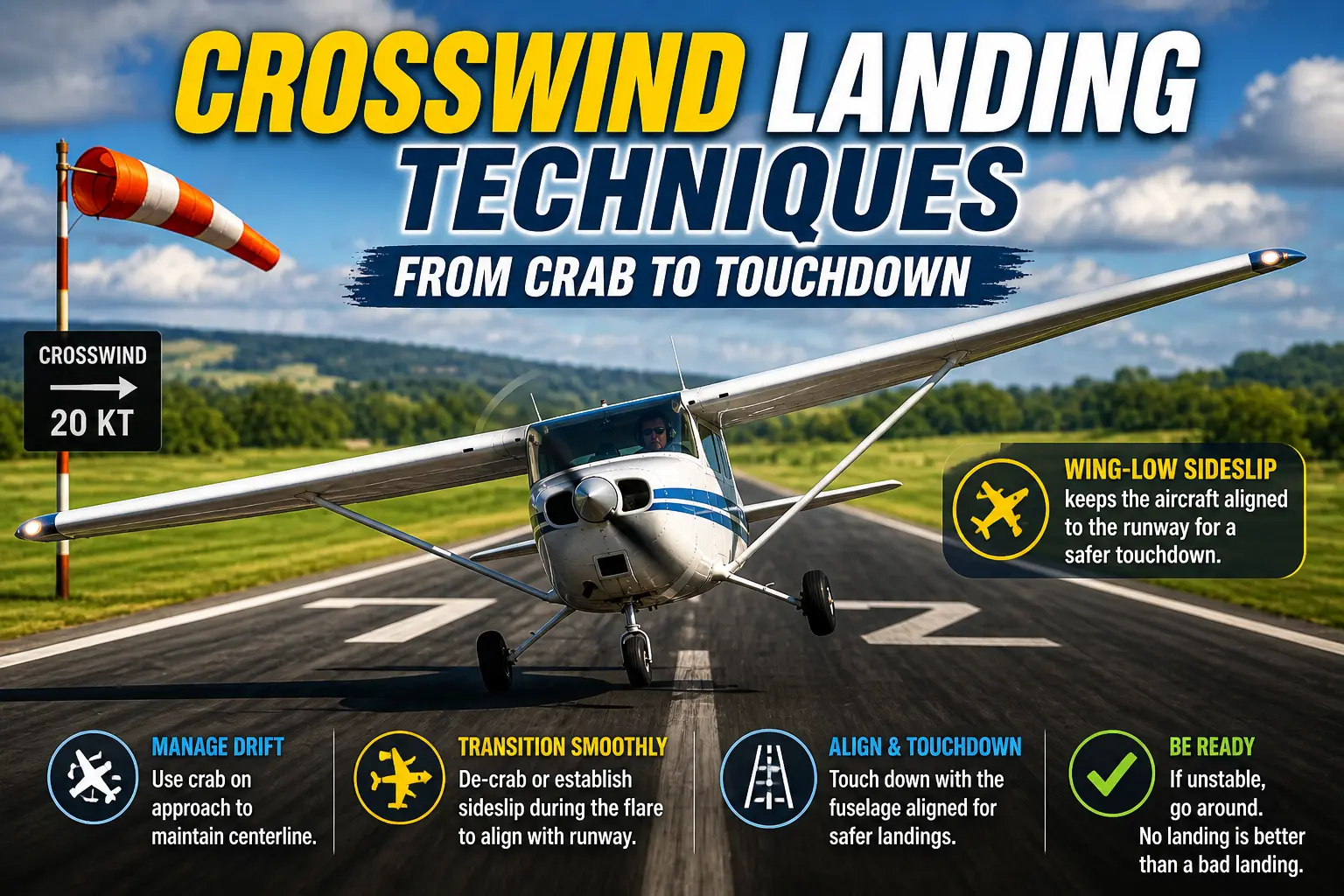
Crosswind landing techniques are essential pilot skills for safely putting an airplane on the ground in wind that is not aligned with the runway. Crosswind landing techniques appear in nearly every flight training syllabus because wind that pushes an aircraft off-track creates the need to manage drift, bank, and rudder to maintain runway alignment and a safe touchdown. This article covers the practical mechanics and decision-making of crab and sideslip methods, when to transition between them, and the common student mistakes instructors should watch for.
Read on for clear explanations, practical training tips, and a realistic example that will help student pilots, flight instructors, and active pilots improve crosswind technique and judgment. The focus here is on aerodynamic principles, control coordination, timing, and safety considerations rather than prescriptive requirements for any particular aircraft.
Crab Versus Sideslip: What Each Method Does
Both the crab and the sideslip are techniques to counteract the sideways drift caused by a crosswind. They differ in how the airplane aligns its longitudinal axis and how lift and lateral control are used to maintain the runway track.
Crab method: In the crab, the pilot points the airplane nose into the wind so the airplane's ground track remains aligned with the runway centerline while the fuselage is angled relative to that track. This uses yaw to cancel the drift. The airplane is essentially flying sideways relative to its heading so that the wind and heading combine to produce the desired track over the ground. A crab reduces the need for continuous bank to hold the runway centerline during the approach.
Sideslip (wing-low) method: In the sideslip, the pilot establishes a bank into the wind and applies opposite rudder to align the aircraft longitudinal axis with the runway while the bank counters lateral drift. The wing-low sideslip causes the airplane to fly with a sideways component of lift that offsets the wind. This method aligns the fuselage with the runway before touchdown, which reduces cross-controlled touchdown tendencies.
How the Two Methods Are Used Together
Many pilots use the crab during the stabilized portion of the approach because it is comfortable and efficient for maintaining the glide path and centerline with small rudder corrections. As the airplane nears the runway, most training programs and experienced pilots transition from a crab to a sideslip or perform a wing-low, rudder correction for touchdown. The reason is simple: touching down with the fuselage aligned to the runway minimizes side loads on the landing gear and reduces the risk of landing on the upwind wheel first then drifting sideways.
There are two common transition techniques between crab and sideslip. One is the de-crab just before touchdown: the pilot uses coordinated rudder to align the nose and simultaneously lowers the upwind wing to maintain runway track. The other is to establish the sideslip earlier on final so the airplane remains in that attitude through touchdown. Both approaches are valid; the pilot should choose the one that matches personal proficiency and the airplane's handling characteristics.
Transition Timing: When to Change From Crab to Sideslip
Timing the transition is a critical skill and a frequent training focus. Transition too early and you may introduce unnecessary sink or cause floating. Transition too late and you may not have control authority to align before touchdown, increasing the risk of a hard or off-center landing.
Practical guidance for transition timing:
- Stabilize the approach: Keep airspeed and glidepath stable while managing drift with the crab. A stabilized final allows predictable handling during transition.
- Start preparing: As you descend into the last few hundred feet and begin the roundout, plan your transition. Visual cues such as runway perspective, aiming point, and height should be stable.
- Make the change smoothly: Perform the de-crab or establish the sideslip decisively but smoothly. Avoid abrupt or excessive control inputs. The idea is to replace the yaw input with a combination of bank and rudder that maintains runway track without inducing a sideslip or skid.
- Consider aircraft behavior: Some airplanes have more effective rudder and may tolerate a late de-crab. Others respond better to an earlier sideslip. Practice in the specific make and model you fly to learn its handling.
Why This Matters in Real-World Aviation
Crosswind landings account for many routine training events and for a significant portion of weather-related landing incidents when not performed correctly. Proper technique reduces stress on the airframe, decreases the chance of ground loops in tailwheel airplanes, and protects tires, brakes, and landing gear from heavy side loads. For commercial and flight instructor operations, consistent, predictable crosswind technique supports safe operations and reliable training progress.
Beyond technique, decision-making is key. Knowing your personal minimums, understanding the aircraft's controllability in gusts, and electing a go-around when the approach becomes unstable are operational skills as important as the mechanics of the crab or sideslip.
How Pilots Should Understand the Aerodynamics
Think of crosswind handling as managing two goals: maintaining the ground track over the runway centerline and presenting the aircraft to the runway in a controllable attitude at touchdown. Aerodynamically, a crab uses yawing to keep track while sideslip uses lateral lift and rudder to balance drift and alignment. When you move from crab to sideslip, lift, drag, and side forces shift. A rapid rudder input without matching a bank can cause a skid, where the tail swings away from the wind, increasing the likelihood of loss of directional control. Conversely, too much bank without appropriate rudder allows the airplane to drift back toward the wind and miss the centerline.
Control coordination is not an abstract concept. Smooth, measured inputs, continuous visual assessment of the runway, and small corrections are the core of well-executed crosswind landings.
Common Mistakes or Misunderstandings
Students and inexperienced pilots commonly make several predictable errors. Recognizing these errors and understanding their causes helps instructors target training effectively.
- Late transition: Waiting until the last instant to de-crab can leave insufficient rudder authority to align the airplane before touchdown. The result is a skid or side-loaded landing.
- Overbanking: Applying excessive bank in an attempt to eliminate drift can create a hazardous descent rate or cause the upwind wing to strike the ground in tailwheel airplanes.
- Rudder misapplication: Too much or too little rudder during de-crab produces skidding or inadequate yaw correction. Students often confuse the correct sense and timing of rudder input.
- Crossing controls during flare: Holding opposing aileron and rudder through the flare is common, but it can mask poor coordination and result in a bounce or drift on touchdown.
- Ignoring gusts and variability: Treating a gusty crosswind the same as a steady one leads to surprises. Gusts demand active control and earlier decision-making about go-arounds.
Practical Example: Single-Engine Training Flight
Imagine a Cessna-type single-engine trainer on short final with a steady quartering crosswind from the left. The pilot holds a crab to maintain the centerline and a stable approach at recommended approach speed plus gust allowance. As the airplane descends through about 50 feet and the flare begins, the pilot smoothly applies right rudder to yaw the nose toward the runway while simultaneously lowering the left (upwind) wing slightly to maintain centerline. The aircraft settles onto all wheels with minimal side load because the fuselage is aligned with the runway and the bank counters lateral drift.
If the pilot had held the crab until flare and applied only rudder without lowering the wing, the nose would have yawed but the airplane would still drift laterally and land with the upwind wheel first. Conversely, if the pilot had excessively banked into the wind without matching rudder, the airplane could have slipped in and landed hard or touched down off-center.
Best Practices for Pilots
Develop habits that build consistent, safe crosswind landings.
- Practice both methods: Learn to fly a crab and a sideslip comfortably. Practice transitions in a variety of winds within safe personal and aircraft limits.
- Stabilize early: A stabilized approach reduces surprises. Keep airspeed, descent rate, and runway alignment steady before transition.
- Plan the transition: Know whether you will de-crab late or establish a sideslip early. Communicate the plan if you are an instructor or PIC flying with a student.
- Use small, timely corrections: Make gentle, coordinated inputs during the flare rather than large, abrupt movements.
- Monitor touchdown geometry: Aim to touch down with the fuselage aligned to the runway. For tricycle gear airplanes, this often means simultaneous or near-simultaneous main wheel contact. For tailwheel airplanes, different techniques and additional training are required.
- Be ready to go around: If alignment, airspeed, or descent rate is unstable during the transition, execute a go-around promptly. A go-around is a safe option and part of good crosswind decision-making.
Frequently Asked Questions
When should I use a crab versus a sideslip?
Use a crab during the stabilized portion of final to maintain the centerline with minimal continuous aileron input. Transition to a sideslip or perform a de-crab before touchdown so the fuselage is aligned with the runway. Practice both approaches and decide based on the airplane's handling and personal proficiency.
How do I know when to begin the transition?
Begin preparing to transition during the final stages of descent and start the actual de-crab or sideslip during the roundout or flare. The exact moment depends on aircraft responsiveness, wind strength, and pilot skill. The guiding principle is to leave enough time to align before touchdown without disrupting the stabilized approach.
What is the biggest danger of a poor crosswind landing?
Poor technique can produce skids, side-loaded touchdowns, or loss of directional control. These conditions can damage landing gear or tires and, in tailwheel airplanes, lead to ground loops. Proper timing, coordination, and readiness to go around mitigate these risks.
Key Takeaways
- Practical takeaway: Use the crab to maintain centerline on final and transition to a sideslip or de-crab smoothly during the flare so the fuselage aligns with the runway for touchdown.
- Safety takeaway: If the approach becomes unstable during the transition, execute a go-around rather than forcing a landing.
- Training takeaway: Practice both crab and sideslip techniques in your specific aircraft and under instructor supervision to learn the timing and coordination that work for that airframe.