
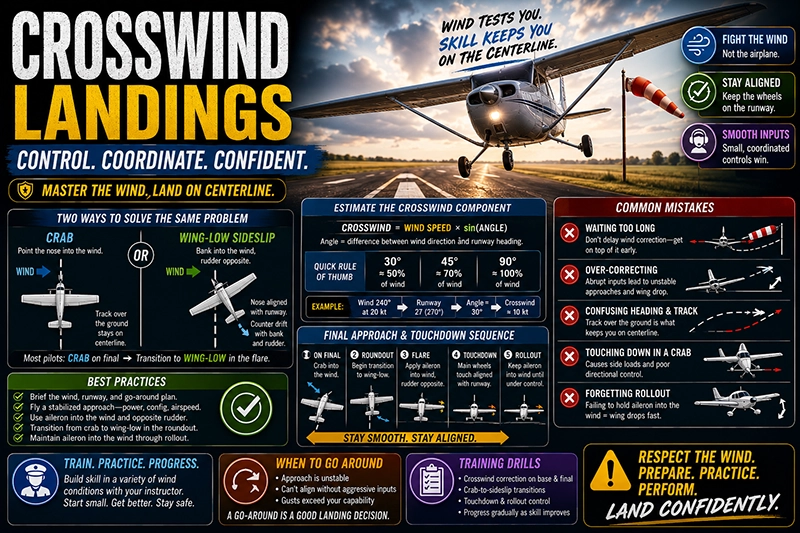
Crosswind landings are a fundamental skill every student pilot must learn. Managing a strong crosswind requires coordination, judgment, and a clear understanding of how wind interacts with your aircraft. This article explains the techniques, key aerodynamic concepts, common mistakes, and practical training tips to build competence and confidence when landing with a crosswind.
Whether you are practicing pattern work at a busy training field or preparing for a solo at a windy airport, the principles in this guide apply across single-engine trainers and larger general aviation airplanes. You will learn how to estimate the crosswind component, how to use crab and wing-low techniques, what to expect during flare and touchdown, and how to plan and execute a safe approach. Read on for realistic scenarios, safety considerations, and frequently asked questions from student pilots and instructors.
How Crosswinds Affect an Airplane
A crosswind produces a lateral force that pushes the airplane off the runway centerline and creates a sideslip when the aircraft’s longitudinal axis is not aligned with the relative wind. Pilots manage that lateral force using a combination of heading control and bank to maintain runway alignment and lateral control during approach, flare, and touchdown.
Two commonly used techniques solve the same problem with different control inputs. The crab technique aligns the airplane’s nose into the wind so the track over the ground follows the runway centerline. The wing-low, or sideslip, technique uses bank into the wind with opposite rudder to keep the airplane aligned with the runway while countering lateral drift. Pilots often transition from a crab on final to a wing-low sideslip just prior to touchdown to align the longitudinal axis with the runway while maintaining lateral control.
Why This Matters in Real-World Aviation
Crosswind handling is more than a training exercise. It affects aircraft safety, tire and landing gear loads, directional control after touchdown, and the ability to safely operate from wind-prone airports. Poor technique can lead to bounced landings, runway excursions, or damage to landing gear if a wing drops unexpectedly on touchdown. Good crosswind technique reduces pilot workload on short final and during rollout and improves passenger comfort during gusty conditions.
Operationally, a pilot must combine wind assessment, aircraft performance, and personal proficiency when deciding whether to accept or decline a landing in strong crosswinds. That judgment depends on experience, recent practice, and the airplane’s handling characteristics. Practicing crosswind work in training aircraft under instructor supervision builds the judgment needed to make those decisions safely in operational settings.
How Pilots Should Understand Crosswind Landings
Start with a mental model: picture the airplane’s track over the ground and the heading. If the heading differs from the runway alignment because the nose is pointed into the wind, the airplane is crabbing. If you bank into the wind and apply opposite rudder so the nose points down the runway, you are sideslipping. Both techniques keep the ground track on centerline but manage aerodynamic forces differently.
On final approach, use a stabilized approach: power, configuration, and airspeed set so you can focus on wind correction and alignment. Choose the technique you and your instructor practice and understand. Many instructors teach starting in a crab on downwind and base, and transitioning to a wing-low sideslip during the flare. This approach simplifies drift correction during the descent and allows a last-moment alignment before touchdown.
Crosswind control is primarily a rudder and aileron coordination task. Ailerons into the wind provide a horizontal lift component that counters lateral drift. Rudder aligns the nose with the runway to prevent weathervaning or skidding. Using too much rudder without adequate aileron can induce a skid; too much aileron without rudder can allow the nose to weathervane downwind. Smooth, coordinated inputs prevent abrupt changes in bank or yaw that can surprise the aircraft near the ground.
Estimating the Crosswind Component
A practical method to estimate the crosswind component uses the wind direction relative to the runway and the wind speed. The crosswind component equals the wind speed multiplied by the sine of the angle between the wind direction and runway heading. For many pilots, an easier mental shortcut is to use a rule of thumb for common angles: approximately 70 percent of the wind speed at 45 degrees; nearly the full speed at 90 degrees; and progressively less at shallower angles. Using a simple flight computer or an electronic calculator provides precise results during preflight planning.
Knowing the crosswind component helps with planning: determine whether the runway in use is suitable for your experience and the airplane. Aircraft manufacturers publish demonstrated crosswind performance in the pilot operating handbook for many models, but that is not a regulatory limit and should be combined with pilot proficiency and training conditions when making go/no-go decisions.
Common Mistakes or Misunderstandings
Students and inexperienced pilots often make similar errors when learning crosswind landings. One common mistake is waiting too long to establish wind correction, resulting in excessive crab or drift close to the ground. Another is over-correcting with abrupt rudder or aileron inputs that cause an unstable approach or a wing drop during flare.
Misunderstanding the difference between heading and track leads to poor decision-making on final. Pilots sometimes try to maintain a heading aligned with the runway while ignoring drift, which causes lateral displacement. Conversely, holding a crab into the wind all the way through touchdown without transitioning to alignment can place lateral stresses on landing gear and make directional control after touchdown difficult.
Finally, rushing the transition from crab to sideslip during the flare often results in either a heavy wing-first touchdown or cross-control that can cause a bounce. Smooth, deliberate control changes timed to the flare reduce the risk of abrupt loadings on the airframe.
Practical Example
Imagine you are flying a light trainer on final to runway 27 with a reported wind 240 degrees at 20 knots. The wind is 33 degrees from runway heading. Using the crosswind formula, crosswind component = 20 knots times sine of 33 degrees, which yields roughly 11 knots. With that information you plan your approach: select a technique you are comfortable with, brief a go-around point, and set a stabilized approach speed with small increments of power to control descent.
On base leg, begin correcting for drift with a small crab or heading into the wind. On final, maintain runway centerline with heading correction and be prepared to transition to a wing-low sideslip during the roundout to align the fuselage with the runway. During the flare, reduce the crab with coordinated aileron and rudder so the longitudinal axis is aligned for touchdown. After the main wheels touch, maintain aileron into the wind until positive directional control is established, then apply brakes as needed for rollout.
Best Practices for Pilots
Practice crosswind landings with an instructor in a variety of wind conditions to build judgment and control coordination. Use short, deliberate lessons focusing on one element at a time: drift correction on base and final, transition timing in the flare, and rollout control after touchdown.
- Plan: Determine the crosswind component during preflight or the approach briefing and choose an appropriate runway and technique.
- Stabilize: Fly a stabilized approach to reduce workload and leave mental capacity for wind correction and alignment.
- Coordinate: Use aileron into the wind and opposite rudder smoothly to counter drift and align the nose when appropriate.
- Transition deliberately: Practice moving from crab to wing-low during the roundout, not abruptly at touchdown.
- Maintain aileron on landing: Keep aileron into the wind until the airplane is firmly on the ground to prevent wing drop.
Common Training Drills
Work pattern entries focusing on crosswind correction: fly downwind with progressively stronger headings into the wind, then turn onto base and final while maintaining runway centerline. Practice the crab on final and transition to the sideslip in the roundout. Recurrent practice in a supervised environment improves the timing and smoothness of the control inputs.
When to Go Around
Decide early if conditions exceed your proficiency or the airplane’s safe operating capability. If final is unstable due to unexpected gusts or you cannot align the airplane with the runway without aggressive or abrupt control inputs, initiating a go-around is a safe and professional option. Treat the go-around as a normal part of crosswind operations and brief the expected maneuver during training flights so it becomes an automatic response when needed.
Common Mistakes or Misunderstandings
Many student pilots underestimate how much rudder is needed to counteract weathervaning, or overuse ailerons, which can cause excessive bank. Another misunderstanding is that full rudder alone will hold the airplane on centerline; rudder without aileron allows the wing to drift and can expose the landing gear to side loads on touchdown. Finally, a common training gap is not practicing rollout control: pilots may focus on touchdown but fail to maintain aileron into the wind after touchdown, leading to rapid wing drop as speed decreases.
Practical Scenario: Training Session Outline
Brief: Review runway heading, wind report, and crosswind estimate. Decide the technique to practice and go-around criteria.
Flight: Enter the pattern and fly a normal downwind. On base, start correcting for drift and establish a crab angle on final. Fly a stabilized approach and, during the roundout, smoothly apply aileron into the wind and opposite rudder to align the nose for touchdown. After touchdown, keep aileron into the wind and use rudder and brakes as needed to maintain centerline.
Debrief: Review what worked, what control inputs were smooth or abrupt, and when a go-around would have been appropriate. Repeat with slightly higher crosswind components as skill improves.
Frequently Asked Questions
How do I choose between crab and wing-low techniques?
Both techniques are effective. Use a crab to manage drift on long final and a wing-low sideslip to align the fuselage just before touchdown. In training, practice both so you are comfortable transitioning from crab to sideslip during the roundout.
When should I initiate a go-around in a crosswind?
Initiate a go-around if the approach becomes unstabilized, alignment cannot be achieved without abrupt control inputs, or gusts exceed your practiced capability. A timely go-around prevents forced, uncomfortable, or unsafe landings.
Does wind gusting change the technique?
Gusting requires anticipatory control: maintain a slightly higher approach speed within your training envelope, fly a stabilized approach, and be prepared for variations in lift. Avoid aggressive corrections; instead, make small, timely inputs to remain stable and aligned.
Will practicing in a stronger crosswind improve my landings?
Progressive practice with an instructor helps build skill, but practice should increase gradually. Avoid training in winds that exceed both aircraft handling characteristics and your personal proficiency. Safety and controlled exposure to more challenging conditions produce better outcomes than attempting abrupt jumps to high winds.
Key Takeaways
- Practical takeaway: Estimate the crosswind component before final and fly a stabilized approach so you can focus on alignment and control coordination.
- Safety takeaway: If the approach is unstable or alignment requires aggressive inputs, go around rather than forcing a touchdown.
- Training takeaway: Practice crab-to-sideslip transitions with an instructor and review touchdown and rollout technique to prevent wing drop and gear stress.