
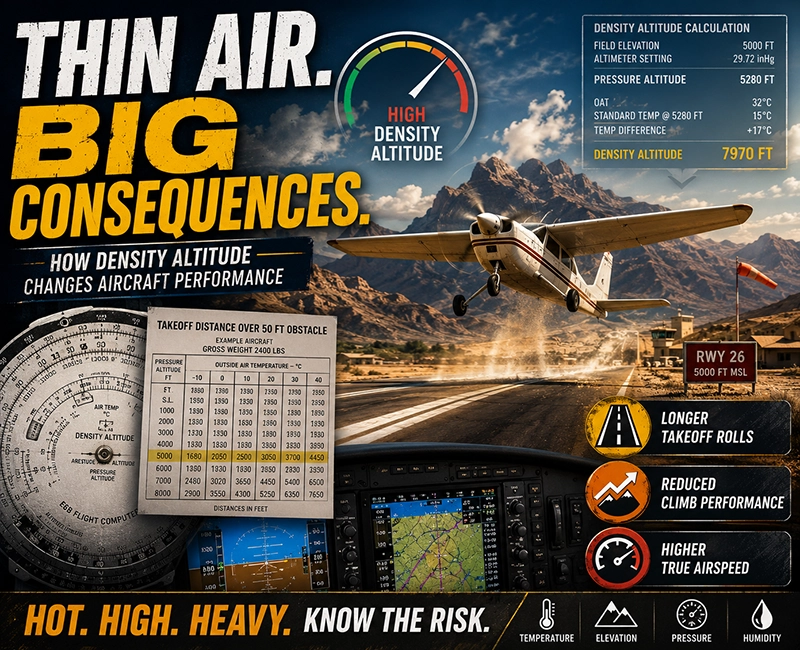
Density altitude is a fundamental concept that directly affects aircraft performance in every phase of flight. Pilots who understand how density altitude changes engine power, propeller efficiency, and wing lift make better operational decisions for takeoff, climb, approach, and landing. This article explains what density altitude is, how it forms, and how to translate the numbers into safer, more effective flying.
Early in your planning, density altitude should be part of your mental picture of the flight. It ties weather, pressure, and temperature to concrete aircraft behavior. Whether you fly light piston singles from short mountain strips or operate turboprops at high-elevation airports, an accurate understanding of density altitude reduces surprises and improves safety.
What Density Altitude Is, in Practical Terms
Density altitude is the altitude in the standard atmosphere at which the air density would be equal to the actual air density at the location. Put another way, it is the pressure altitude corrected for nonstandard temperature and, to a smaller extent, humidity. Because an aircraft "feels" the air density, many performance characteristics depend on density altitude rather than the actual field elevation.
Air density controls three primary things that affect aircraft performance:
- Engine power available. For normally aspirated engines, reduced air density means less oxygen for combustion and lower power output.
- Propeller and rotor efficiency. Propellers move a mass of air; lower density reduces the thrust they generate for a given RPM and pitch.
- Wing lift. Lift is proportional to dynamic pressure. With lower air density, the wing must fly at a higher true airspeed or higher angle of attack to produce the same lift.
Because these three effects combine, higher density altitude usually results in longer takeoff rolls, reduced climb rates, higher true airspeeds for the same indicated airspeed, and longer landing distances.
How Density Altitude Forms: Pressure, Temperature, and Humidity
Density altitude is influenced primarily by three atmospheric variables:
- Pressure. Lower barometric pressure reduces air density, increasing density altitude. Pressure changes with weather systems and with field elevation.
- Temperature. Warmer air is less dense. When the temperature is higher than standard for a given altitude, density altitude is higher than pressure altitude.
- Humidity. Moist air is slightly less dense than dry air because water vapor displaces heavier nitrogen and oxygen molecules. High humidity raises density altitude, but its effect is usually smaller than pressure or temperature.
In practical flying, temperature and pressure produce the largest and most immediate changes in density altitude. A hot, low-pressure day at a high-elevation airport yields the highest density altitude values and the most degraded performance.
Pressure Altitude Versus Density Altitude
Pressure altitude is the altitude in the standard atmosphere that corresponds to the observed pressure (after setting the altimeter to 29.92" Hg). It provides a baseline for performance calculations because most aircraft performance charts are referenced to pressure altitude. Density altitude starts with pressure altitude and corrects it for temperature deviation from the standard atmosphere. Many pilots compute pressure altitude first, then adjust for nonstandard temperature to get density altitude.
Because altimeters are calibrated to atmospheric pressure, indicated altitude is not a reliable indicator of aerodynamic performance when temperature departs from standard. A pilot flying at an indicated 5,000 feet on a hot day may be operating into conditions the airplane would normally encounter at a substantially higher density altitude.
How Density Altitude Affects Aircraft Performance
Understanding how density altitude affects individual systems clarifies why performance changes with the air. The effects are interrelated; reduced engine power further slows acceleration and climb, while reduced lift and propeller efficiency both lengthen ground roll and reduce climb gradient.
Engines
Normally aspirated piston engines rely on ambient air mass to provide oxygen for combustion. Lower air density results in less oxygen per intake stroke, so the engine produces less power. Turbocharged or supercharged engines maintain higher manifold pressures at altitude and are less sensitive to density altitude, but they are not immune; temperature and inlet conditions still affect their output and cooling.
Propellers
A propeller accelerates a column of air rearward to produce thrust. With thinner air, each blade bite produces less thrust at the same angle and RPM. That loss of thrust shows up as slower acceleration on the ground and a reduced rate of climb after liftoff.
Wings
Lift depends on air density, airspeed, wing area, and the lift coefficient. When density decreases, true airspeed must increase to generate the same lift at a given angle of attack. Because indicated airspeed is a function of dynamic pressure, indicated airspeed for rotation and approach remains the same, but the corresponding true airspeed and ground speed are higher in low-density conditions. Higher ground speed lengthens the takeoff roll and increases landing distances.
Climb Performance and Service Ceiling
The combined loss of engine power, thrust, and lift reduces climb rate and available excess power. High density altitude reduces the aircraft's climb gradient and may lower the maximum achievable altitude for safe cruise or mission completion. Pilots should consider alternate routes, higher climb speeds, or weight reduction when density altitude threatens climb performance.
Practical Methods to Determine Density Altitude
Pilots can determine density altitude several ways: using flight computers, electronic performance calculators, aircraft avionics, or by hand using pressure altitude and a temperature correction. Many flight apps and avionics do the calculation automatically when provided current altimeter setting and outside air temperature.
A common pilot technique is to calculate pressure altitude (set altimeter to 29.92 and read the indicated altitude, adjusted for field elevation or use the formula) and then correct for the difference between observed temperature and standard temperature for that altitude. Some rule-of-thumb corrections are widely used in the pilot community, but pilots should confirm the math and use the aircraft-specific performance charts from the aircraft flight manual or pilot operating handbook when making operational decisions.
Common Mistakes and Misunderstandings
Pilots make several recurring errors when dealing with density altitude. Recognizing these helps avoid operational surprises and safety issues.
One common mistake is relying solely on indicated altitude or field elevation. On a hot day, the aircraft behaves as though it is operating at a significantly higher altitude. Failing to translate the temperature and pressure conditions into density altitude leads to underestimating takeoff roll and overestimating climb performance.
Another misunderstanding is assuming that humidity is negligible. While humidity typically has a smaller effect than temperature or pressure, very humid conditions combined with heat and high elevation can meaningfully increase density altitude. Also, pilots sometimes forget that the aircraft’s weight and center of gravity affect required lift and takeoff performance, and those factors compound the effects of density altitude.
Finally, some pilots attempt to use performance numbers from other aircraft or generalized tables rather than the specific POH/AFM for the airplane they are flying. Performance varies significantly between models, configurations, and individual aircraft; always use the real aircraft’s published data or, when absent, use conservative assumptions.
Practical Example: Planning a High-Density Altitude Departure
Imagine a small single-engine airplane operating from an airport at 5,000 feet MSL on a summer afternoon. The altimeter setting indicates a pressure altitude close to field elevation, and the outside air temperature is well above standard for that altitude. The pilot calculates density altitude and finds it substantially higher than field elevation. How does that change the plan?
First, the pilot recognizes that takeoff ground roll will be longer and the initial climb rate lower. That suggests reducing gross weight if practical by carrying less fuel or payload, selecting a runway with extra length, and ensuring a clear departure path free of obstacles. The pilot reviews the POH takeoff and climb performance charts for the airplane at the computed density altitude and planned weight. If the charts show climb limitations or marginal performance, the pilot delays the flight, reduces weight, chooses a cooler time of day, or selects an alternate airport.
During the takeoff, the pilot uses proper short-field or soft-field technique if required by runway conditions, but recognizes that rotation and climb speeds indicated in the POH remain valid as indicated airspeeds while true airspeeds and ground speeds are higher. The pilot also expects slower acceleration and adjusts decision points for rejected takeoff or continued takeoff accordingly.
Operational Guidance and Best Practices for Pilots
Several habits and procedures help manage density altitude risk in everyday operations. These practices focus on planning, conservative decision-making, and using the aircraft’s published data.
- Always compute density altitude during preflight planning when temperature deviates significantly from standard or when operating from high-elevation fields.
- Use the actual aircraft POH/AFM performance charts for takeoff, climb, and landing at the computed density altitude and weight. If no chart exists for the computed condition, apply conservative margins.
- Consider weight reduction as a primary mitigation. Fuel, passengers, and cargo directly affect climb and takeoff distances when density altitude is high.
- Prefer cooler parts of the day for departures from high-elevation airports. Early morning temperatures can substantially lower density altitude for the same field elevation.
- Choose the longest, smoothest runway and depart into the wind. Increased headwind reduces ground roll and effectively offsets some density altitude penalties.
- Practice short-field and soft-field techniques in training so that those procedures are instinctive when higher density altitude makes stick-and-rudder precision more critical.
Training and Safety Considerations
Flight training should include density altitude scenarios. Simulators, high-elevation airfields, and structured lessons on performance planning reinforce correct habits. Instructors should emphasize: reading and interpreting the POH charts, conservative go/no-go decision making, and how to adjust technique when true airspeeds differ from indicated speeds.
Safety briefings before flights out of mountain or desert airports should address expected climb gradients, emergency options after takeoff, and the reduced margin available for obstacle clearance. Pilots operating in mountainous terrain should practice terrain-escape maneuvers, plan routes with sufficient climb capability, and consider alternate airports with lower density altitudes.
How Technology Helps and How It Can Mislead
Modern avionics and mobile apps can compute density altitude automatically and integrate it into performance calculators. These tools improve planning speed and reduce arithmetic errors, but they require correct inputs. Entering the wrong altimeter setting, temperature, weight, or runway conditions can produce misleading results.
When relying on electronic tools, cross-check important numbers manually or with a secondary source. Trust the aircraft’s POH/AFM as the ultimate authority for performance data; apps and avionics are aids, not replacements, for pilot judgment and aircraft-specific limitations.
Common Misconceptions Explained
Misconception: "Indicated airspeed changes with density altitude." Clarification: Indicated airspeed is a function of dynamic pressure and is what pilots use for control and stall margins. It does not directly reflect density altitude. However, true airspeed for a given indicated airspeed increases as density altitude rises, which affects ground speed and distance flown.
Misconception: "A turbocharged aircraft does not care about density altitude." Clarification: Turbocharged engines maintain manifold pressure better at altitude, so they are less sensitive to pressure altitude than normally aspirated engines. Nevertheless, the aircraft still experiences reduced aerodynamic effectiveness in thin air. The net performance change depends on the combination of engine, propeller, and wing characteristics.
Misconception: "Humidity is irrelevant." Clarification: Humidity has a measurable effect on density altitude, though usually smaller than temperature or pressure. In hot, humid environments, the combined effects can be operationally significant.
Practical Example with Conservative Approach (Illustrative)
To illustrate, consider a pilot planning a departure from a 5,000-foot airport on a hot day. The pilot computes density altitude and finds it considerably higher than 5,000 feet. Rather than assuming the airplane will perform as it does at sea level, the pilot consults the POH charts for takeoff distance and climb gradient at the computed density altitude and planned gross weight. If the chart indicates marginal performance or lacks data for that condition, the pilot reduces weight and delays departure until temperatures fall, or plans an alternate route with lower altitude terrain.
This example does not substitute for specific POH numbers. For any operational planning, use the aircraft’s published performance data and consult a qualified instructor or maintenance authority if in doubt.
Checklist of Pilot Actions When Density Altitude Is High
Use these actions as operational guidance rather than a regulatory checklist. They encapsulate prudent responses pilots should consider.
- Calculate density altitude and compare with field elevation and POH performance tables.
- Reduce weight when the performance charts indicate long takeoff or limited climb margins.
- Plan for higher true airspeed and ground speed on takeoff and approach.
- Consider departing at a cooler time of day or selecting a longer runway and optimal runway heading.
- Brief emergency options and obstruction clearance immediately before takeoff.
- Log and review any near-limits or marginal performance events as training opportunities.
Frequently Asked Questions
How do I quickly estimate density altitude in the cockpit?
Many pilots use an electronic flight computer, a flight planning app, or an onboard performance tool that computes density altitude from pressure altitude and outside air temperature. A quick manual method is to determine pressure altitude, then apply a temperature correction to estimate density altitude. Use the aircraft POH for precise performance numbers and treat any quick estimate as a planning aid rather than a final authority.
Does indicated airspeed change with density altitude?
Indicated airspeed is derived from pitot-static pressure and remains the primary reference for control and stall margins. It does not directly change because of density altitude. However, the true airspeed corresponding to a given indicated airspeed increases as density altitude increases, which affects ground speed, takeoff ground roll, and landing distance.
Can I rely on sea-level POH numbers if I’m flying from a high-elevation airport?
No. Performance charts in the POH are specific to pressure altitude, temperature, and weight. Sea-level numbers do not apply at higher density altitudes. Always use the POH/AFM performance charts that match your aircraft’s current configuration and the computed density altitude.
How much does humidity affect density altitude?
Humidity reduces air density because water vapor is lighter than dry air components. The effect is usually smaller than temperature or pressure changes but can be significant in hot, humid climates. Treat humidity as a secondary factor when computing density altitude; performance charts rarely include humidity corrections, so exercise judgment and add conservative margins if conditions are unusually humid.
Are turbocharged airplanes immune to density altitude effects?
Turbocharging helps maintain engine power at altitude by increasing manifold pressure, but it does not eliminate aerodynamic penalties. Wings and propellers still operate in thinner air, and climb performance remains affected. Use the aircraft’s POH to determine how turbocharging changes performance at specified density altitudes.
Common Operational Scenarios and Decision Points
Scenario 1: High-elevation airport, midday heat. Decision: Compute density altitude, consult POH, reduce weight, choose the longest runway, and consider delaying departure until cooler temperatures or selecting an alternate airport.
Scenario 2: Short runway with obstacles. Decision: Compute takeoff distance and climb gradient at density altitude and planned weight. If margins are marginal or absent, reduce weight or choose a different departure procedure or runway. Never assume a successful obstacle clearance without published performance support.
Scenario 3: Mountain flying with variable weather. Decision: Plan routes that provide lower-altitude terrain options, brief emergency fields, and ensure adequate climb margins. Consider the combined effects of density altitude and downdrafts or mountain waves on climb and descent performance.
Key Takeaways
- Practical takeaway: Compute density altitude on all high-elevation, hot, or low-pressure day departures and use POH performance charts for planning.
- Safety takeaway: High density altitude increases takeoff distance and reduces climb performance; mitigate by reducing weight, selecting longer runways, or delaying flight.
- Training/decision-making takeaway: Practice density-altitude scenarios in training and use conservative, aircraft-specific planning when charts are marginal or unavailable.