
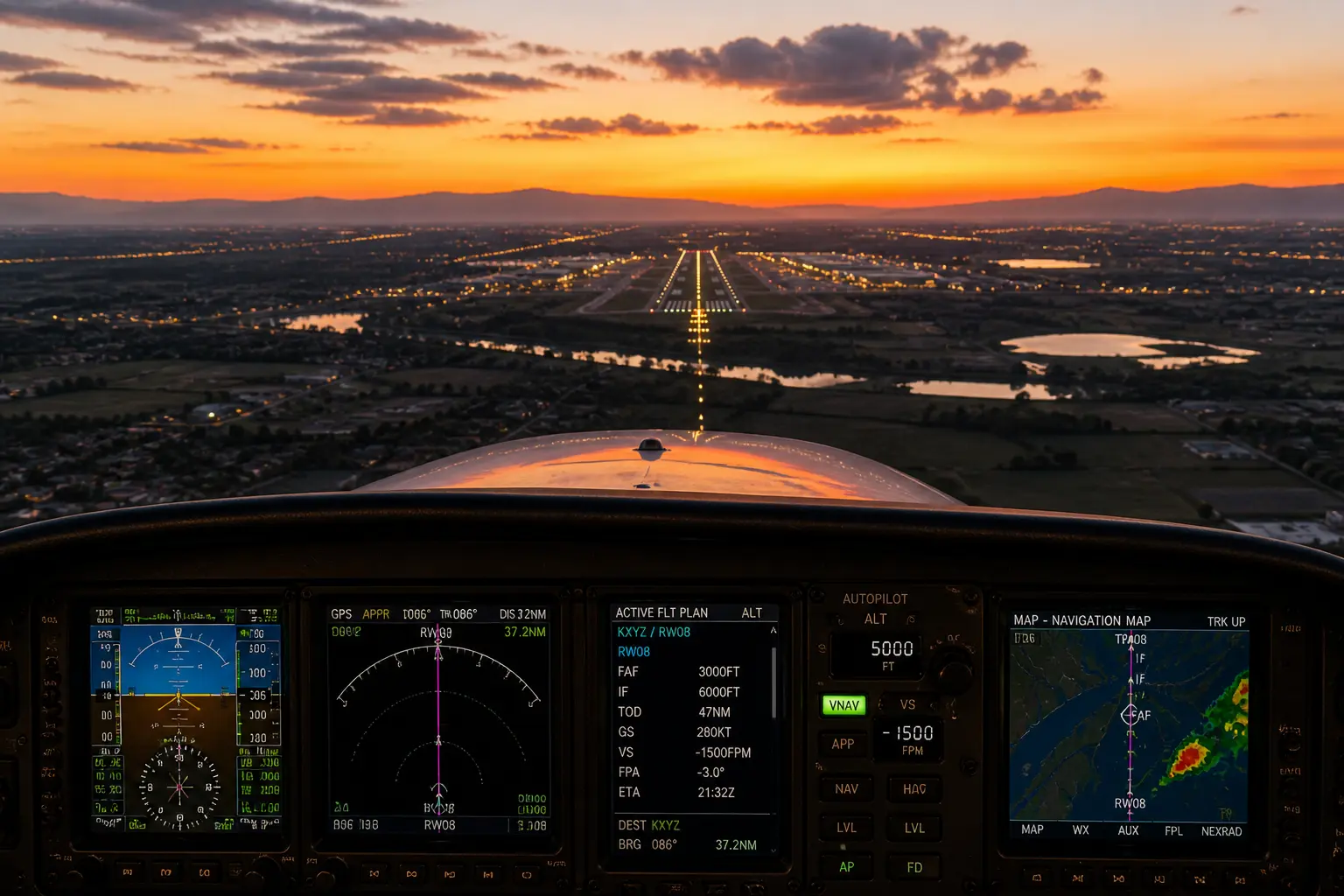
Descent planning is a core piloting skill that shapes safety, workload, and the quality of your final approach. Whether flying a single-engine trainer, a turbine business jet, or as a professional airline pilot, planning the descent early and deliberately reduces surprises, keeps energy under control, and makes the approach stable and predictable.
This article explains the practical elements of descent planning: calculating the top of descent, comparing VNAV automation with manual planning, and managing energy during the descent. You will get clear explanations of the core concepts, common mistakes to avoid, and an applied example you can use in training or operational briefings.
Core idea: How to think about the descent
A descent is a controlled conversion of altitude (potential energy) into a lower-energy state while managing speed (kinetic energy) and position to join the published approach or traffic pattern. Early planning connects where you are now with where you need to be for the approach - altitude, speed, configuration, and at what distance to begin the maneuver. The planning process reduces last-minute level-offs, high descent rates, and unstable approaches.
Top of descent calculation
Top of descent, or TOD, is the point where you begin a planned descent to meet your target altitude and approach constraints. A straightforward, widely used method uses the angle or gradient of descent that matches a 3-degree glideslope, since many instrument approaches are close to that gradient.
For a 3-degree descent the altitude change per nautical mile is about 318 feet. To compute a TOD distance in nautical miles:
Distance to lose (nm) = Altitude to lose (feet) / 318
Example: If you are at FL200 (20,000 feet) and must be at 3,000 feet for the initial approach segment (altitude to lose = 17,000 feet), the TOD distance is about 17,000 / 318 = 53.5 nautical miles. That number tells you where to start a continuous descent if you plan to follow an approximately 3-degree path and do not expect significant level-offs.
From that TOD distance you can estimate the required descent rate in feet per minute by using your planned ground speed: descent rate (fpm) ≈ ground speed (kts) × 318 / 60. A useful rule-of-thumb many pilots use is fpm ≈ ground speed × 5 for a 3-degree path, which is slightly conservative compared with the 5.3 factor from the 318 number.
These calculations are planning tools. Wind, ATC instructions, required level-offs, speed restrictions, and local terrain will change where you actually begin descending. Use the TOD calculation as a baseline, then adjust for operational constraints.
VNAV versus manual planning
Modern aircraft often provide vertical navigation, or VNAV, through an FMS or flight director. VNAV can compute a path and manage mode changes automatically, using programmed speeds and constraints to calculate a TOD and vertical path. VNAV reduces pilot workload and can produce efficient continuous descent profiles when properly programmed.
Manual planning means the pilot computes TOD, plans level-offs and speed changes, and flies them with vertical guidance from the autopilot, flight director, or by hand. Manual planning demands more monitoring but gives direct control over energy and configuration, which can be advantageous in nonstandard traffic flows, short-notice ATC changes, or when automation behavior is uncertain.
Key differences in practice:
- VNAV relies on correct inputs: weight, performance, speed constraints, and procedure coding. Incorrect data yields incorrect paths.
- Manual planning gives explicit checkpoints and decision points but requires greater workload and precise piloting to achieve a continuous descent.
- VNAV may try to meet an altitude constraint that requires thrust changes or level-offs; pilots must monitor and be ready to revert to manual control if the path becomes inefficient or unstable.
Energy management in descent
Energy management is the continuous balancing of potential energy (altitude) and kinetic energy (airspeed). Good descent planning moves energy out early and smoothly rather than converting it abruptly near the airport. The same principles apply whether you are flying VFR traffic patterns or flying an RNAV approach with vertical guidance.
Important practical points:
- Use thrust reductions early rather than relying solely on spoilers or large drag increments near the ground.
- Plan speed changes so that configuration (flaps and gear) can be selected without excessive sink or airspeed excursions.
- Avoid late, aggressive drag methods that induce high descent rates and unstable approaches.
Think in terms of energy gates: where you will reduce power, where you will begin configuration changes, and where you must meet speed and altitude constraints. That structure makes it easier to brief the approach and to spot deviations early.
Why this matters in real-world aviation
Descent planning affects safety, passenger comfort, fuel efficiency, and the ability to comply with ATC and published procedures. A properly planned descent reduces the need for rushed maneuvers, helps maintain separation, and keeps you within aircraft performance limits. In training, teaching descent planning explicitly builds good judgment and prevents the habit of improvising the descent on final approach.
Operationally, clear descent planning reduces the risk of high-energy approaches, unstable approaches, and go-arounds. It also helps meet noise abatement and fuel-burn objectives when flying company or environmental procedures that favor continuous descent approaches.
How pilots should understand descent planning
Pilots should internalize a simple mental model: determine how much altitude must be lost, choose an appropriate descent gradient, compute the approximate TOD, and decide speeds and configuration targets. Then brief the plan: where you will start descent, expected rate, where to slow and clean up, and a go-around decision point if the approach becomes unstable.
This model applies in two broad modes. In automation mode you verify the FMS VNAV path, confirm constraints, and cross-check predicted vertical speeds. In manual mode you compute the TOD yourself and fly the descent using vertical guidance tools or raw control inputs. Either way, monitor energy and be prepared to modify the plan when traffic, weather, or ATC require it.
Common mistakes or misunderstandings
Pilots often make avoidable errors during descent planning. Typical issues include:
- Starting the descent too late and then using high descent rates or excessive drag to meet constraints.
- Blindly following VNAV without confirming that constraints and speed targets are correct for the phase of flight.
- Delaying configuration changes until too low, which can spike descent rates or cause overspeed/overload on flaps and gear.
- Neglecting wind and temperature effects on ground speed, which change the required TOD location and descent rate.
Training gaps can include weak understanding of energy exchange and excessive reliance on automation. Reinforce manual calculation skills in the simulator and practice recovering from scenarios where VNAV behaves unexpectedly.
Practical example
Scenario: You are cleared to descend from FL180 to 3,000 feet for an RNAV approach. Your current groundspeed is 280 knots and there is a moderate headwind component.
1. Altitude to lose: 18,000 - 3,000 = 15,000 feet.
2. TOD distance using 3-degree approximation: 15,000 / 318 ≈ 47.2 nautical miles. That is the approximate point to begin a continuous descent if you want a 3-degree profile.
3. Planned descent rate: fpm ≈ groundspeed × 318 / 60 = 280 × 318 / 60 ≈ 1,484 fpm. Rule-of-thumb fpm ≈ GS × 5 would give roughly 1,400 fpm, a reasonable target.
4. Plan speed and configuration changes: brief deceleration to approach speed by 10-15 nm from the runway, initial flap set and gear extension according to checklist and aircraft speed limits. If ATC instructs an intermediate level-off or provides vectors, adjust the plan and recalculate TOD if necessary.
This example demonstrates how a simple calculation provides a baseline. Always cross-check the result against actual wind conditions and expected ATC clearances.
Best practices for pilots
Adopt habits that make descents predictable and safe:
- Compute a TOD early in cruise or enroute descent planning and brief it with your crew or instructor.
- Verify VNAV inputs if you plan to use automation. Confirm weights, speeds, and constraints are correct.
- Use conservative descent rates and begin power reductions early to avoid abrupt energy changes.
- Keep a clear plan for speed and configuration changes; tie them to geographic or instrument references.
- Practice manual TOD calculations regularly so you can revert to manual control confidently when needed.
Frequently Asked Questions
How exact does the TOD calculation need to be?
TOD is a planning tool, not an absolute constraint. Aim for a reasonable accuracy so you can achieve a continuous descent without large level-offs. Recalculate when ground speed changes significantly or when ATC gives instructions that affect your descent path.
When should I prefer manual planning over VNAV?
Prefer manual planning when traffic, short-notice vectors, nonstandard speed constraints, or unfamiliar automation behavior make VNAV predictions unreliable. Manual planning also helps maintain pilot proficiency in energy control and descent geometry.
What is the best way to manage energy during a high workload approach?
Plan power and configuration changes in advance, brief them, and prioritize maintaining a safe energy state over meeting a timetable. If workload becomes high, simplify the task by flying a stabilized approach profile or calling for assistance from the other pilot.
Key Takeaways
- Practical takeaway: Compute a TOD early and use it to shape a predictable descent profile that limits late high-energy corrections.
- Safety takeaway: Managing energy smoothly reduces unstable approaches, the need for late high thrust or drag, and the likelihood of go-arounds.
- Training takeaway: Practice both VNAV monitoring and manual TOD calculation so you can quickly adapt to automation anomalies or changing ATC instructions.