
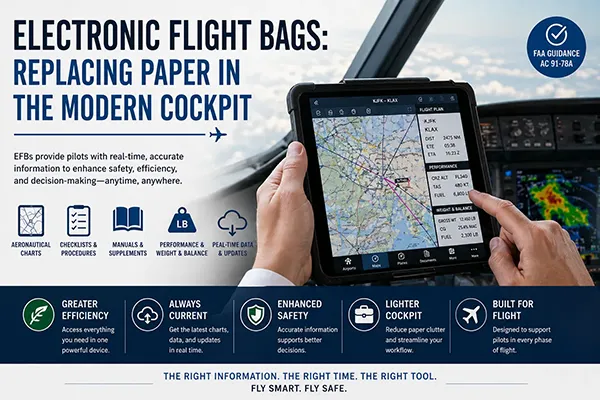
In modern aviation, efficiency is no longer just about performance in the air. It also comes from how pilots manage information. For decades, flight decks were filled with paper charts, manuals, and checklists. Today, that landscape is changing. Electronic Flight Bags, commonly known as EFBs, are transforming how pilots access and use critical flight information.
The FAA’s guidance makes one thing clear: this shift is not about convenience alone. It is about ensuring that digital tools provide the same reliability, accuracy, and accessibility as traditional paper sources. When used correctly, EFBs streamline operations. When used improperly, they can introduce risk.
Concept A: What is an Electronic Flight Bag
- An EFB is an electronic display system used in the cockpit or cabin to manage flight information.
- It can replace traditional paper materials such as charts, checklists, and pilot operating handbooks.
- EFBs may also include advanced functions like performance calculations, weight and balance, and fuel planning.
- They can exist as portable devices like tablets or as installed systems integrated into the aircraft.
- The system may also access hosted databases and software applications to support flight operations.
Concept B: Replacing Paper with Digital Information
- EFBs can be used in place of paper references if they provide equivalent information.
- The information displayed must be current, accurate, and validated by the pilot before use.
- EFBs cannot replace required aircraft systems such as navigation or communication equipment.
- The operator must ensure the device does not interfere with aircraft systems.
- Use of EFBs during flight is ultimately the responsibility of the pilot in command.
Key Differences
- Paper vs. Digital: Paper references are static, while EFBs provide dynamic, updateable data.
- Storage: EFBs consolidate large volumes of information into a single device.
- Functionality: EFBs can perform calculations and integrate multiple data sources.
- Responsibility: EFBs require active verification of data accuracy and system reliability.
- Flexibility: Information can be accessed and updated quickly across all phases of flight.
How-To / Process
- Verify that the EFB contains all required information equivalent to paper references.
- Ensure all data is current, accurate, and validated prior to flight.
- Confirm the device complies with portable electronic device regulations.
- Assess how the EFB integrates into cockpit workflow and placement.
- Train on all EFB functions, including backup procedures.
- Use cross-checking procedures to verify calculations and entered data.
- Evaluate system performance regularly to ensure reliability.
Why It Matters
The move from paper to digital is one of the most significant operational changes in general aviation. While EFBs offer clear advantages in efficiency and accessibility, they also shift responsibility onto the operator and pilot. The FAA evaluates how these tools are used in practice, making proper use critical to maintaining safety.
- EFBs reduce cockpit clutter and improve access to information.
- They support better decision-making through integrated data and calculations.
- Improper use or outdated data can introduce operational risk.
- Pilots must understand both capabilities and limitations of their EFB systems.
Key Takeaways
- EFBs replace paper, not required aircraft systems.
- All information must be current, accurate, and verified.
- Proper training and cockpit integration are essential.
- The pilot in command is responsible for safe use.
- When used correctly, EFBs improve both efficiency and safety.