
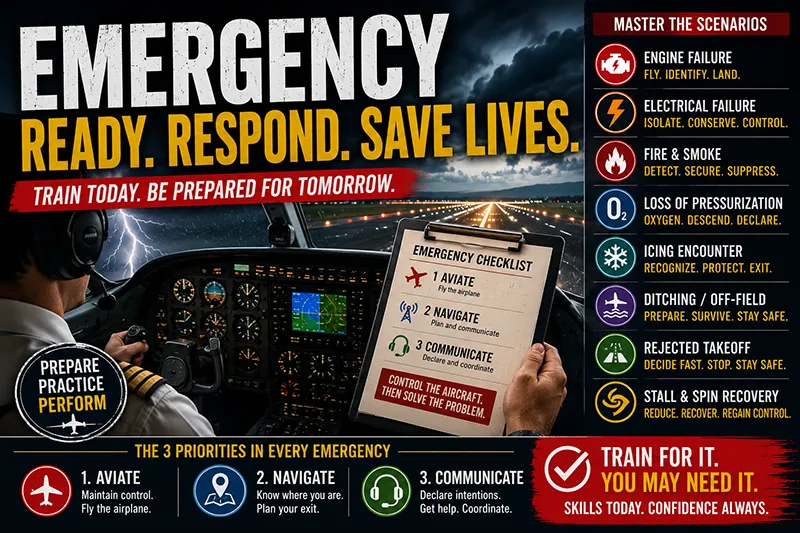
Every pilot spends time in the simulator or aircraft practicing emergency procedures. Those sessions build the mental frameworks, motor skills, and crew coordination needed when systems fail, power is lost, or the aircraft departs the expected flight profile. Emergency procedures training is not about memorizing a script. It is about learning prioritized decision-making under time pressure, recognizing the cues that indicate different failures, and executing actions that maximize safety for the aircraft and its occupants.
This article walks through the emergency procedures pilots most commonly train for, explains why each matters in operational flying, and shows how to translate doctrine into practical cockpit actions. The goal is to improve decision-making, reinforce sound airmanship, and highlight training gaps that deserve attention during recurrent training or instructor-led lessons.
Core emergency procedures pilots regularly train
Pilots across general aviation, commercial transport, and rotary-wing operations focus on a consistent set of emergencies because they have the greatest safety impact and occur with some frequency. Training typically covers handling the following situations in a way that emphasizes recognition, prioritization, and control.
Engine failure and forced landing. Practicing engine-out handling, choice of landing area, glide planning, and energy management is fundamental. For multi-engine pilots this includes asymmetric thrust handling, identifying a failed engine, and executing a secure engine shutdown when required.
Electrical failures and fires. Loss of electrical power or an electrical fire can degrade flight instruments, radios, and navigation equipment. Training covers isolating affected systems, using standby instruments, and following manufacturer or operator procedures for securing the source and preserving essential systems.
Smoke in the cockpit. Smoke is one of the most disorienting flight emergencies. Practice emphasizes donning oxygen or smoke masks if available, locating and suppressing the smoke source, and flying the aircraft on known pitch/power settings while troubleshooting.
Engine fire and fuel leaks. Engine fires—whether in the engine compartment or the cabin—demand immediate action. Training focuses on using fire suppression systems, shutting off fuel and electrical feeds, and preparing for an immediate landing when fire persists.
Loss of pressurization or rapid decompression. In pressurized aircraft, recognizing hypoxia and using supplemental oxygen quickly is lifesaving. Training includes emergency descent profiles, crew coordination, and communication with ATC to expedite an appropriate descent and diversion.
Stall and spin recovery. Recognizing the aerodynamic stall early, applying correct pitch and power inputs, and avoiding improper control inputs under stress are core skills. For aircraft susceptible to spins, recovery techniques and prevention strategies are practiced frequently.
Icing encounters. Encountering icing conditions is a slow-onset emergency that can rapidly change performance. Training covers recognizing performance degradation, activating deicing/anti-ice systems, and exiting icing conditions by changing altitude or diverting.
Engine restart and surge/contamination events. Restart techniques, assessing whether an in-flight restart is advisable, and handling compressor stalls or surge events belong in recurrent training syllabi, particularly for turbine-powered aircraft.
Ditching and forced off-field landings. Training prepares pilots to manage a planned descent into hostile terrain or water, including securing the cabin, selecting touchdown attitude, and post-landing survival considerations.
Rejected takeoff and high-speed aborts. Pilots practice recognizing a takeoff emergency during the roll and performing a confident rejected takeoff when required. This includes knowledge of airplane stopping performance and use of braking and aerodynamic aids.
Why these procedures matter in real-world aviation
Training for these emergencies reduces cognitive load when a real event occurs. The advantages are practical: faster recognition, fewer errors during initial response, and more effective use of crew resources. For single-pilot operators the emphasis is on setting the aircraft into a safe, flyable attitude and communicating with ATC while troubleshooting. For multi-crew operations the focus expands to task sharing, brief communications, and using memory aids to ensure critical items are completed.
Manufacturers publish emergency checklists and procedures for each system failure. Operators and instructors translate those into recurrent training scenarios that reflect likely failure modes in their fleet. The bottom line is that the more realistic and varied the training scenarios, the better prepared pilots are for novel or compound emergencies.
How pilots should understand emergency procedures
Treat emergency procedures as decision frameworks rather than rigid scripts. Most procedures start with control of the aircraft, aviate-then-navigate-then-communicate. The first task is always to maintain flying control and keep the aircraft in a safe flight regime. Only then can you troubleshoot systems, brief passengers, and plan a diversion or landing.
Understand the difference between immediate actions and follow-up actions. Immediate actions are those you perform to keep the aircraft safe in the seconds to a minute after an event. Follow-up actions are the steps you perform once the aircraft is stabilized. Many accidents result from spending too long on troubleshooting before ensuring stable flight.
Use memory items and flow patterns to expedite initial responses. Memory items are critical first steps that address immediate hazards. Flows are tactile or visual patterns that let you scan related systems quickly. Both are designed to limit omissions under stress.
Practice recognition of subtle cues. Some emergencies are noisy and obvious; others begin with small changes in sound, vibration, instrument behavior, or handling qualities. Scenario-based training that focuses on recognition and early response builds the mental models pilots need to detect failures earlier.
Common mistakes and misunderstandings
One common error is treating checklists as the first action instead of following the aviate-then-navigate-then-communicate principle. Pilots sometimes try to run a full checklist from memory while the aircraft is not yet stabilized. This can lead to loss of control or delayed landings.
Another mistake is fixation on a single solution. For example, in an engine failure pilots may focus solely on restarting instead of immediately securing a suitable landing site or configuring the aircraft for glide. Similarly, crews can over-rely on automation when an automated system is the source of failure.
Inadequate communication is a frequent problem. Clear, concise calls and delegation during an emergency reduce duplication of effort and ensure essential tasks are completed. Poor briefing to passengers or failure to declare an emergency with ATC can slow critical assistance.
Training gaps often arise when pilots only rehearse idealized, single-failure scenarios. Real-world emergencies may involve multiple concurrent failures, degraded weather, or unexpected human factors. Recurrent training should include compound scenarios to build resilience.
Practical example: single-engine failure in a light twin
Imagine you are flying a light twin at 4,500 feet on a VFR leg when a loud bang and yaw indicate a sudden loss of thrust on the left engine. Your primary priorities are to fly the aircraft, identify and secure the failed engine, and plan for a landing. First, establish the aircraft in a safe attitude and airspeed that provides control with asymmetric thrust. Apply appropriate rudder to counter yaw, set pitch for single-engine best rate or best angle as appropriate, and retract flaps or gear per the aircraft’s recommended profile to reduce drag.
Once flying is stabilized, run the engine-failure memory items: identify the failed engine, verify the condition by reducing power on the suspected engine, and secure it if confirmed by instruments or crew indications. Use checklists for engine shutdown and prepare a single-engine approach or off-field landing. Communicate with ATC, brief the passenger cabin, and manage time to prepare for touchdown. In this example, training that combined handling practice, engine identification drills, and single-engine approach practice will make the real event manageable and safe.
Best practices for pilots
Keep the following practices current through recurrent training and self-study:
- Practice aviate-then-navigate-then-communicate. Stabilize the aircraft before troubleshooting.
- Use memory items and flows for rapid initial response. Rehearse them until they are automatic.
- Train in varied scenarios, including compound failures, poor weather, and night operations.
- Drill crew resource management skills: clear calls, task delegation, and shared understanding of priorities.
- Review manufacturer and operator emergency procedures frequently, and practice transitions between checklist steps and flying tasks.
- Simulate realistic distractions during training to improve focus and task prioritization under stress.
Frequently Asked Questions
How often should pilots practice emergency procedures?
Recurrent training frequency depends on the pilot’s operation, aircraft, and regulatory environment. Regardless of formal intervals, pilots should practice core emergencies regularly in simulators or during dual instruction flights to keep skills sharp and responses automatic.
Should single-pilot operators use the same procedures as multi-crew pilots?
The underlying principles are the same, but single-pilot operations require simplification and careful workload management. Memory items and flows that can be performed single-handedly are essential. Single-pilot SOPs often prioritize immediate safe flight and simplified communications until the aircraft is stabilized.
How do I avoid fixation during an emergency?
Train to brief the situation immediately, assign roles where applicable, and set a single priority such as maintaining airspeed or configuring for landing. Use a short mental checklist: fly, look for landing options, communicate, then troubleshoot. Practicing under time pressure helps reduce fixation tendencies.
Are simulator sessions necessary for all emergencies?
Simulators provide a safe environment to practice many high-risk scenarios, including engine failures at critical speeds, system fires, and crew coordination challenges. While some emergencies can be rehearsed in the aircraft at low risk, simulators are invaluable for high-workload or dangerous events.
What should I include in post-event debriefs?
Debriefs should cover what happened, the actions taken, what went well, what could be improved, and any procedural or training changes that should follow. Honest, structured debriefs help convert a single incident into durable learning.
Key Takeaways
- Practical takeaway: Prioritize the flying task first; stabilize the aircraft before deep troubleshooting.
- Safety takeaway: Regular, realistic training reduces cognitive errors and improves early recognition of failures.
- Training takeaway: Use scenario-based recurrent training that includes compound failures and crew resource management practice.