
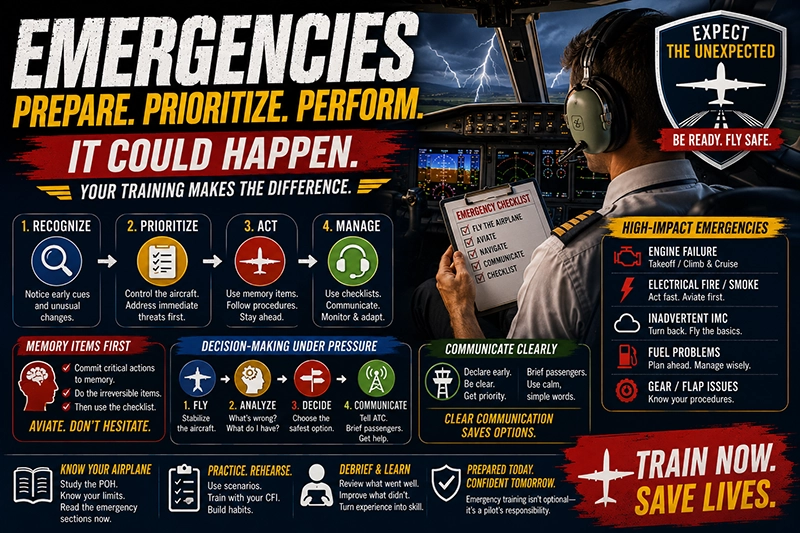
Emergency procedures for student pilots are essential knowledge, not just a syllabus requirement. Emergencies are low-probability events but high-consequence when they occur. Understanding how emergencies unfold, how to prioritize actions, and how to use aircraft systems, checklists, and judgment under pressure makes the difference between a routine resolution and an accident.
This article translates core emergency principles into practical training advice for student pilots, flight instructors, and training program managers. It explains how to learn and apply memory items, when to rely on the airplane flight manual or POH, how to coordinate with air traffic control and passengers, and how to train for realistic scenarios. The goal is improved preparedness, better decision-making, and safer outcomes across the training environment.
Understanding the Core Idea
An aviation emergency demands fast, competent action without sacrificing good judgment. The core idea is simple: recognize, prioritize, act, and manage. Recognition means noticing a developing problem early. Prioritization means selecting the most urgent tasks first. Acting means performing the immediate actions you have trained for, and managing means using checklists, communicating with ATC and passengers, and monitoring flight path and systems until the situation is resolved.
For student pilots this framework should be internalized during training flights so that procedural steps become habits and judgment skills evolve predictably. Emergencies are not a matter of rote memory alone; they require contextual assessment. For example, an engine roughness on a long cross-country at cruise altitude demands different immediate choices than the same symptom during initial climb after takeoff.
Why This Matters in Real-World Aviation
Training environments that emphasize realistic, context-rich emergency scenarios produce safer pilots. Many accidents involving personally flown light aircraft are linked to a combination of mechanical failure, poor decision-making, and inadequate emergency handling. Effective emergency training reduces the probability of those outcomes in several ways.
First, early recognition shortens the time between problem onset and corrective action, improving the chance to return to safe flight. Second, practiced memory items minimize fixation and task saturation; they keep the airplane controllable while the pilot consults reference material. Third, communication skills ensure ATC, company dispatch, and passengers or other crewmembers are informed, which expands options such as priority handling or diversion clearance.
For flight schools and instructors, embedding emergency training within routine lessons builds competency and reduces student anxiety when problems occur. Students who have rehearsed decision-making while practicing maneuvers are more likely to apply those skills in an unexpected event.
How Pilots Should Understand This Topic
Approach emergency procedures as a layered skill set made of three parts: technical procedure, cognitive strategy, and communication.
Technical procedure covers the memory items and checklist actions required to handle a specific failure. Memory items are the immediate, usually irreversible actions you commit to short-term memory to preserve control or reduce danger. Always prioritize aircraft control and safety of flight. After immediate items are completed, refer to the appropriate checklist and the airplane flight manual for further steps and system troubleshooting. For most aircraft, the POH provides the definitive guidance for system operation and emergency procedures.
Cognitive strategy is about decision making under stress. Use simple, repeatable decision heuristics: maintain control, analyze the problem briefly, decide a plan of action, and execute. Avoid diagnostic tunnel vision; fixating on a cause you cannot confirm may consume time better used managing altitude, configuration, and navigation to safe airspace.
Communication is both external and internal. External communication means clear, timely information exchange with air traffic control, other aircraft, and passengers. Internal communication is crew resource management; when flying with a CFI or another pilot, assign roles, verbalize actions, and confirm critical items aloud.
Key Emergency Types Student Pilots Should Train For
Training should focus on a few high-impact emergencies that require mastery of both procedure and judgment. These commonly include:
- Engine power loss at low altitude (takeoff/climb)
- Engine power loss at cruise altitude
- Electrical fire or smoke in the cockpit
- Partial or total electrical failure affecting radios and instruments
- Controlled flight into instrument conditions for a VFR pilot (inadvertent IMC)
- Fuel exhaustion or mismanagement
- Landing gear or flap failures when applicable
Each of these categories requires specific hands-on skills, decision-making, and communication steps. For example, an engine power loss early in the takeoff phase often means committing to a forced landing within gliding distance and configuring the airplane for the best possible touchdown. By contrast, power loss at cruise altitude allows more time for checklist-driven troubleshooting, selecting a suitable diversion airport, and communicating with ATC.
Memory Items Versus Checklists
Memory items are the first-line response for situations where immediate action preserves safety. Students must learn which items are truly time-critical and commit them to memory through repetition in training. Examples of appropriate memory items include securing a fire source, achieving glide speed, or shutting off fuel in case of fire. After performing memory items, pilots should consult the applicable checklist or POH procedures to confirm further actions.
Do not rely on memory for complex troubleshooting. Use checklists and the airplane flight manual for step-by-step guidance. During training, practice the transition from memory items to checklist use so that students understand when to switch from manual recollection to written procedures.
Decision-Making Under Pressure
Decision-making is the skill students need most in emergencies. A structured approach reduces errors: fly, analyze, decide, and communicate. First, stabilize the flight path. If the airplane is not under control, no amount of troubleshooting will help. Second, analyze the situation quickly: what systems are affected, what is the aircraft performance, how much altitude remains, what are nearest safe landing areas? Third, decide on an action that prioritizes safety—this might be landing straight ahead, returning to the airport, or continuing to a diversion field. Fourth, communicate the plan to ATC and passengers, and execute while continuing to monitor and update the plan as new information arrives.
Time management matters. Don’t spend excessive time diagnosing a problem when an immediate diversion would be the safer choice. Conversely, don’t prematurely commit to a forced landing when troubleshooting and a diversion are viable. Training scenarios should force students to practice these trade-offs so they become intuitive.
Human Factors: Stress, Startle, and Task Saturation
Human factors are often the hidden contributors to emergency mishandling. Startle and surprise can delay recognition and degrade performance. Task saturation leads to omissions. Students should practice stress-exposure training within a controlled environment so they experience the physiological effects and learn to rely on procedures and crew coordination to overcome them.
Flight instructors can create graduated scenarios—simple simulated failures early in training, more complex scenarios later—to build confidence. Debriefing after each scenario is essential: discuss what cues the student recognized, what decisions were considered, and what could be improved. Use recorded telemetry or cockpit audio when possible for detailed review.
Why Communication Matters
Transmission of intent is part of risk management. Declaring an emergency to ATC provides priority handling and can simplify the pilot’s tasks. Clear communications with passengers reduces panic and supports orderly cockpit resource use. When flying with an instructor, use callouts and confirmations to ensure shared situational awareness. When alone, brief passengers concisely about what you will ask them to do, such as securing loose items, following instructions on evacuation, or being prepared to assist after landing.
Students should practice standard phraseology so that in high-stress moments they can quickly convey the essentials. Use plain language as needed but maintain brevity and clarity; controllers will want the nature of the emergency, your intentions, and any immediate assistance required.
Common Mistakes or Misunderstandings
Several recurring errors appear in training and accident reports. Identifying them helps instructors tailor lessons to avoid these pitfalls.
1) Fixation on diagnosis. Students may spend too much time trying to find the cause rather than managing the flight path and configuring for safety. Teach the rule: fly first, then diagnose.
2) Ignoring or misusing checklists. Either neglecting the checklist or using it as a substitute for judgment can be dangerous. The checklist is a tool, not a replacement for basic airmanship and situational awareness.
3) Inadequate communication. Failing to declare an emergency, provide position reports, or request assistance limits options. Practice concise emergency communications during training flights.
4) Poor energy and configuration management. During engine-out practice or real power loss near the ground, improper flap or mixture settings, incorrect glide speed, or misuse of trimming can compromise the forced landing. Emphasize aircraft control and configuration that maximize survivability.
5) Overreliance on automation. Students trained primarily in glass cockpit airplanes may face difficulty when automation degrades or fails. Include hand-flying and basic attitude instrument flying in training curricula to mitigate this risk.
Practical Example: Engine Failure After Takeoff
Imagine you are a student pilot on a short cross-country. After liftoff and accelerating through initial climb, the engine begins to sputter and loses power. Altitude is low and the runway is behind you. This scenario compresses time and forces immediate prioritization.
First, control the airplane. Pitch for a safe glide attitude and maintain positive control. Second, pick an approach path and field—options might include continuing straight ahead to a clear field, turning back to the runway, or landing on a nearby road, depending on height, wind, and obstacles. The decision to turn back is time-sensitive; many accidents occur when pilots attempt steep turns at low altitude without adequate height and airspeed.
Third, apply your memory items such as fuel selector, mixture, and primer checks if those are part of immediate engine-restoration actions in your aircraft. While doing so, keep the airplane configured for the best glide and brief any passengers about landing preparations. Fourth, if the situation allows, declare an emergency and squawk the appropriate transponder code for priority handling. Finally, follow the POH checklist after establishing a safe flight path or during the descent if time permits.
Debrief this maneuver with an instructor. Discuss the influence of wind, terrain, and decision timing on the outcome. Practicing this scenario in a safe training environment will improve the student’s ability to respond correctly under stress.
Practical Example: Inadvertent Entry into Instrument Meteorological Conditions
A VFR student on a local flight encounters unexpectedly lowering ceilings and reduced visibility. The runway is behind and the aircraft is not equipped for sustained instrument flight with the student’s current experience. The primary threat is spatial disorientation and loss of control.
First, recognize the hazard quickly and admit the limitation. Second, initiate an immediate 180-degree turn to return to VMC if safe and feasible. If turning is not safe because of terrain, descend to get below the cloud base only if you are certain of the surface clearance and visibility. Third, declare an emergency to ATC if you need vectors to VMC conditions or assistance. Finally, use basic instruments and control inputs to maintain attitude until visual references return. Avoid abrupt control inputs that could exacerbate disorientation. Instructors should include VFR into IMC escape maneuvers in training, with emphasis on attitude flying and instrument cross-check techniques.
Best Practices for Pilots
Develop habits and routines that reduce the impact of an emergency.
- Know your aircraft: Study the POH thoroughly and highlight memory items and emergency checklist sections for quick review.
- Practice memory items under supervision until they are instinctive; then practice transition to the full checklist.
- Train for decision-making: include scenarios with competing priorities so students learn to evaluate options quickly.
- Include hand-flying and basic instrument skills in the curriculum to cope with electrical or attitude instrument failures.
- Use realistic simulation: inject realistic distractions, imperfect weather, and passenger presence to test composure.
- Debrief comprehensively: analyze not only what was done but why, and what alternatives might have been safer.
- Manage risk proactively: preflight planning should include briefed emergency landing sites and fuel reserves that account for contingencies.
Training Recommendations for Instructors and Operators
Flight instructors and training organizations should integrate emergency procedure training progressively. Begin with basic recognition and memory items in dual instruction early in the syllabus. Introduce more complex, multi-system failures after students demonstrate competence in single-issue scenarios.
Use simulators when available to expose students to rare or high-risk events such as complete electrical failure, in-flight fire indications, or engine-out at speed. Simulators reduce risk while allowing repetitive practice. Coordinate with maintenance and safety personnel to design realistic but safe failure injections for flight training.
Measure proficiency by assessing not only technical steps but also decision-making, communication clarity, and scenario debrief quality. Encourage cross-training among instructors in teaching emergency scenario realism and stress-management techniques.
Common Mistakes or Misunderstandings (Expanded)
Beyond the earlier list, pay attention to these misunderstandings that lead to suboptimal emergency response:
Assuming identical actions for all aircraft. Emergency steps differ by make and model; never assume one aircraft’s procedure applies to another. Students must consult and follow the POH for the airplane currently being flown.
Believing checklists are optional during real events. Checklists codify safe sequences and human factors considerations; they reduce omission errors. Teach students to practice using checklists even when they feel they know a procedure.
Underestimating the importance of decision speed. In many emergencies, a rapid conservative decision is safer than a delayed precise diagnosis. Teach decisive action supported by short re-evaluations rather than deferred commitment.
Frequently Asked Questions
How should a student learn memory items without becoming overwhelmed?
Start with a small set of true emergency memory items that preserve control or reduce imminent danger. Practice them repeatedly in the airplane during dual flights and in briefing sessions on the ground. Pair memory items with a clear cue and a physical action—this helps retention. Once the student consistently executes those reliably, expand to additional items and scenarios. Emphasize transition to the checklist after initial actions so the student knows memory items are the first step, not the entire response.
When is it appropriate to declare an emergency to ATC?
Declare an emergency whenever you need priority handling, assistance, or relief from air traffic procedures to maintain safety. If you are uncertain, brief declaration is appropriate: state the nature of the emergency, your intentions, and whether you need immediate vectors or priority landing. Declaring an emergency provides options and support; it is not an admission of fault or failure.
How can students practice emergencies safely?
Use staged scenarios during dual instruction and simulators for hazardous events. Keep injected failures within the aircraft’s safe operating envelope and ensure instructor supervision for any flight training that includes simulated power or system losses. For solo students, focus on mental rehearsal, cockpit flows, and pre-briefed emergency procedures. Always follow training organization policies and the instructor’s direction for in-flight simulated emergencies.
Are there emergencies students should never simulate in flight?
Yes. Do not simulate failures that could result in an irrecoverable situation, such as complete loss of engine at low altitude without dual instruction, or intentionally disabling critical systems without suitable safety margins and instructor oversight. Certain system failures, like full structural control loss, should only be studied theoretically or practiced in an approved simulator.
What role does the airplane flight manual (POH) play during an emergency?
The POH is the definitive source for an aircraft’s emergency procedures and operating limitations. Use it for non-immediate checklist items, system troubleshooting, and configuration guidance. Always follow the POH when it differs from general training practices. Students should familiarize themselves with the POH sections on emergency procedures long before they may need them.
Key Takeaways
- Practical takeaway: Practice memory items until you can perform them while maintaining basic aircraft control, then transition to the checklist for thorough troubleshooting.
- Safety takeaway: Prioritize flying the airplane and making conservative, timely decisions rather than investing time in diagnosis that delays safe action.
- Training/regulatory takeaway: Use the airplane flight manual and approved checklists as primary references and include realistic, instructor-supervised emergency scenarios in training syllabi.
Emergency preparedness is a continuous process. Student pilots who practice realistic scenarios, master immediate actions, and cultivate sound decision-making are better equipped to handle unexpected events. Treat emergency procedures as an active part of every lesson plan, and use debriefs to convert experience into lasting competence.