
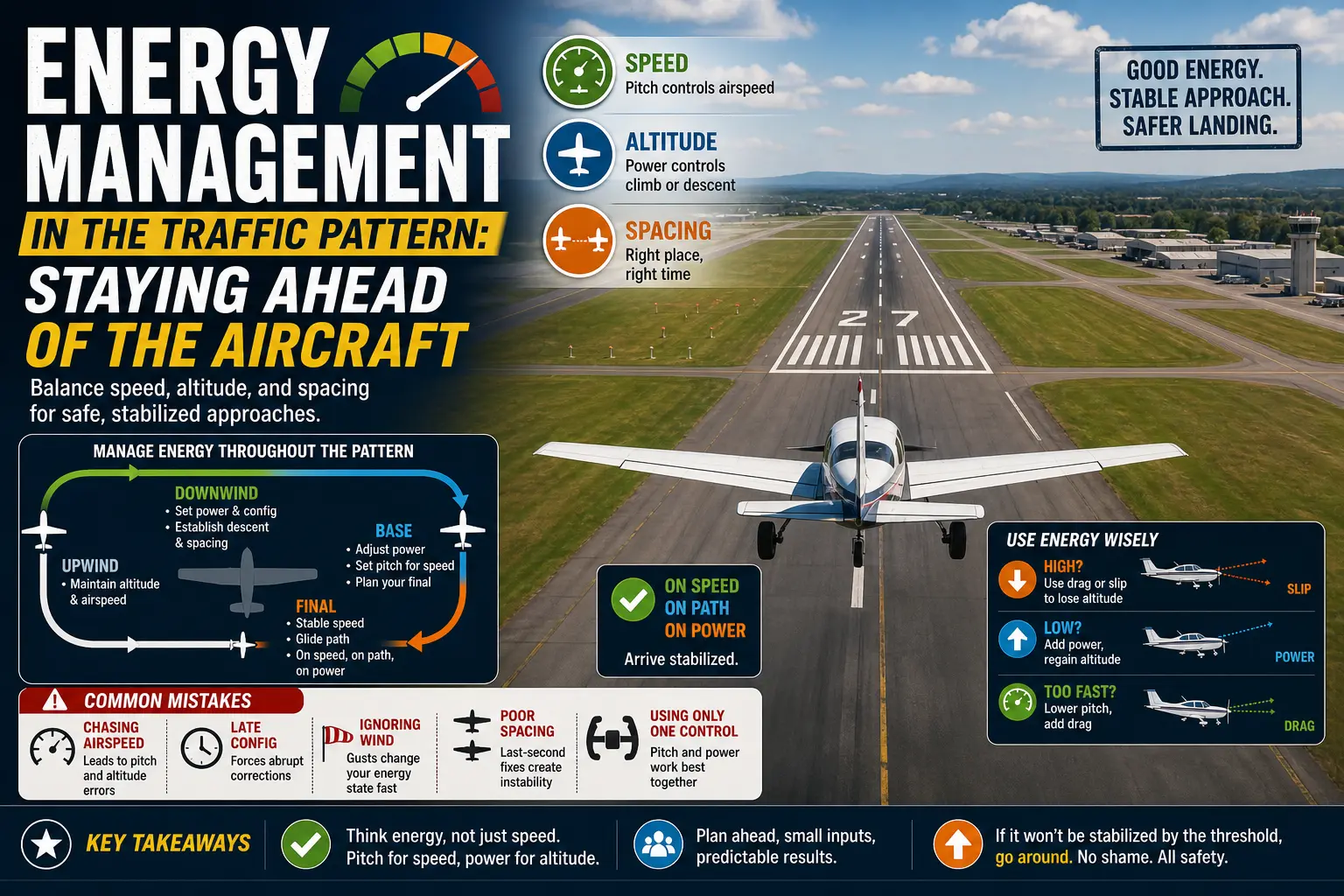
Energy management in the traffic pattern is a fundamental pilot skill that combines speed control, altitude control, and strategic spacing to produce safe, stable approaches and landings. Whether you are a student pilot learning the pattern, a flight instructor teaching judgment and aircraft control, or a pilot refreshing core skills, mastering energy management helps you remain ahead of the airplane instead of reacting to it.
This article explains how to think about speed versus altitude control, identifies common student errors, and presents practical pattern spacing techniques you can apply today. You will get clear explanations of the underlying principles, real-world training applications, and concise takeaways you can use on every circuit.
Understanding the core idea: energy, speed, and altitude
Aircraft energy is stored in two primary forms. Kinetic energy is the energy of motion and is proportional to the square of airspeed. Potential energy is stored in altitude. In the traffic pattern you convert between these two forms constantly: using power or elevator to gain airspeed or altitude, and reducing power, extending drag, or descending to lose energy. The basic control tools are pitch and power. Pitch primarily controls airspeed in a given configuration and power primarily controls the airplane's ability to maintain or change altitude. Controlling both deliberately is the heart of pattern energy management.
Thinking about energy helps you avoid chasing individual parameters. For example, a common trap is to focus solely on maintaining an exact airspeed while allowing glide path or spacing to deteriorate. Better is to maintain a comfortable energy state that keeps the airplane stabilized where you want it to be: on the correct downwind spacing, at the right pattern altitude, and configured for a stabilized final approach.
Why energy management matters in real-world aviation
In real operations, traffic patterns are rarely perfectly calm or predictable. Wind shifts, gusts, mixed traffic types, and runway surface conditions all change how energy conversion plays out. Good energy management reduces workload, improves safety margins, and makes your flying more predictable for other pilots and controllers. For flight instructors it is a teaching thread that links basic aircraft control with judgment, traffic pattern discipline, and risk mitigation.
Operationally, sound energy management promotes stabilized approaches. A stabilized approach reduces go-arounds, abnormal procedures, and the risk of landing long or landing with excessive airspeed. It also helps maintain proper spacing so that you do not create conflicts or surprise other traffic in the pattern.
How pilots should understand speed versus altitude control
Separate the roles of pitch and power in your mental model. Pitch is your primary tool for controlling airspeed; power is your primary tool for controlling descent or climb rate. In practice this means you set a pitch attitude to establish a target airspeed and then adjust power to maintain the desired vertical path and spacing. When you need to trade altitude for speed or vice versa, plan the exchange and execute smoothly.
Examples of common energy exchanges in the pattern include:
- Reducing power on downwind while leaving a small pitch change to achieve your desired descent into base leg.
- Using a shallow slip to increase descent rate without increasing speed when you are high on final and need to lose altitude quickly.
- Adding power and slightly lowering the nose to regain lost airspeed when gusts slow you below target on base or final.
Always consider configuration changes. Extending flaps increases lift at lower speeds but also increases drag and changes the pitch/airspeed relationship. Anticipate the energy effect of flaps, gear, or other configuration changes so you can counteract undesired speed or altitude changes with appropriate power or pitch inputs.
Pattern spacing techniques: predictable position through energy control
Effective spacing is about controlling ground track, descent rate, and airspeed so you arrive at the final approach threshold on the desired glide path and at proper spacing from the aircraft ahead. Techniques that work for most pilots include:
- Visual references: Choose an aiming point on the runway or a landmark on final that represents your desired touchdown zone. Use consistent references on downwind and base to judge when to turn.
- Downwind spacing: Establish your downwind leg at the proper lateral distance from the runway that gives you predictable turn geometry to base and final. If you are consistently too close or too far, adjust your downwind track rather than compensating with last-second pitch changes.
- Power management: On downwind, set a power and configuration that yields a controlled descent to base without large pitch or power corrections. If you need to extend downwind for spacing, add power and climb slightly while maintaining safe pattern altitude.
- Using glide path control techniques: When high, use increased drag (flaps or slip) to lose altitude without gaining airspeed. When low, add power early and adjust pitch to recover energy rather than diving to the runway.
- Anticipate traffic and ATC instructions: If instructed to extend downwind or make a 360 for spacing, adjust power and configuration proactively so you remain in a good energy state throughout the maneuver.
Common mistakes or misunderstandings
Students and even experienced pilots can fall into predictable errors when managing energy in the pattern. Recognizing these helps you avoid them.
Chasing the airspeed indicator: Students often make abrupt pitch changes to chase an airspeed bug. That can induce overshoots in pitch and undesirable altitude excursions. A better approach is to set a pitch for the target speed, allow for small variations, and use power to trim your vertical path.
Late or rushed configuration changes: Delaying flaps or landing checks until late on final forces abrupt power and pitch corrections. Configure the airplane early enough to see the effect and stabilize before you reach the base-to-final turn.
Poor anticipation of wind and turbulence: Wind shear on short final, gusts on base, and downbursts can all rapidly change energy state. Students sometimes fail to maintain a margin of energy to counteract these disturbances. Maintain conservative margins and be ready to add power when winds are variable.
Poor spacing through the pattern: Trying to close or lengthen spacing with last-second power inputs can create large pitch and descent errors. Use predictable downwind lateral placement and planned power changes to manage spacing smoothly.
Overreliance on a single control: Treat pitch and power as partners. Overcontrolling with only pitch or only power creates unnecessary coupling and increases workload.
Practical example: a training sortie in a single-engine trainer
Imagine a training flight in a typical light single on a busy afternoon. On downwind you are targeting your normal pattern speed and have the first-stage of flaps set. A slower aircraft ahead announces on base-to-final, and you must increase spacing to avoid becoming a factor. Rather than turning early and steep, add a small increment of power and maintain your downwind track while trimming to maintain the chosen airspeed. This increases your ground track and allows you to fly an extended downwind without abrupt attitude changes. When you are ready to turn base, retract the extra power gradually while adjusting pitch to achieve a slightly higher descent rate. If you find yourself high on final, use a controlled slip to increase descent rate without accelerating. If you end up low because you misjudged spacing or winds, add power, establish a climb or level-off, and consider going around if the approach is no longer stabilized.
Key points in this example are anticipation and smooth energy exchanges. By planning a small power increase early, you avoid an abrupt pitch-down or last-minute dive onto final. By using slips or flap changes deliberately you control descent without increasing speed.
Best practices for pilots
Adopt these practical habits to improve energy management on every flight:
- Think in terms of energy state: Monitor whether you have excess or deficit energy relative to where you want to be in the pattern.
- Set stable reference speeds and configuration points for your aircraft and stick to them consistently during training flights. Confirm by checking the aircraft operating handbook for recommended pattern speeds for your model.
- Use small, anticipatory power adjustments rather than large, reactive ones.
- Plan configuration changes and make them early enough to observe their effect.
- Practice slips and other descent techniques in a safe training environment so they become predictable tools for final approach control.
- When in doubt about whether an approach will be stabilized by threshold, execute a timely go-around instead of forcing a marginal landing.
Frequently Asked Questions
How do I decide whether to trade altitude for speed or speed for altitude in the pattern?
Decide based on your desired position and the situation. If you are high and close to the runway, you will usually want to lose altitude without increasing speed, so add drag or reduce power while keeping a safe pitch attitude. If you are low and fast, add power and raise the nose slightly to convert speed into altitude until you can safely clean up the approach. Always consider aircraft configuration and consult the aircraft operating handbook for recommended speeds.
What is a stabilized approach and how does energy management support it?
A stabilized approach is one where the airplane is on the correct flight path, at the appropriate speed, in the proper configuration, and with power settings that maintain a predictable descent rate. Managing energy through smooth pitch and power control and predictable configuration changes is the practical way to achieve stabilization before final approach. If the approach cannot be stabilized, a go-around is the safest option.
When should I use a slip in the traffic pattern?
Use a slip when you need to increase your rate of descent without gaining speed, typically when you are high on final and close to the runway. Practice slips in a training environment to understand their effects and the required control inputs. Slips change the airplaneâs aerodynamics and may have airframe-specific limitations, so ensure you are familiar with your aircraft's handling characteristics.
How do wind gusts affect pattern energy management?
Gusts add variability to airspeed and lift. Maintain a small energy margin when gusty: aim for stable airspeed plus a reasonable tolerance and be prepared to add power quickly for gust-induced slowdowns. Anticipate how gusts on base and final will alter your descent rate and spacing.
Should I extend downwind or turn base early to improve spacing?
Extending downwind with a planned power change is often safer and more predictable than turning base early and forcing a steeper turn. Early turns tend to compress spacing and can require abrupt energy changes. Choose the method that best preserves a stabilized approach path.
Key Takeaways
- Practical takeaway: Use pitch for speed and power for altitude; plan your exchanges and make small, anticipatory adjustments.
- Safety takeaway: Maintain a stabilized approach energy state and be prepared to go around if the approach becomes unstable.
- Training/decision-making takeaway: Teach and practice slips, predictable configuration points, and downwind spacing techniques to develop consistent pattern discipline.