
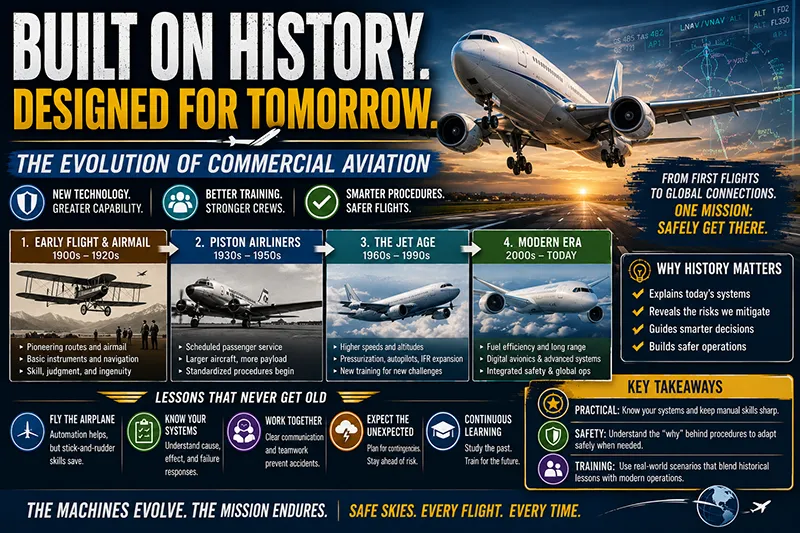
Commercial aviation has transformed dramatically since the earliest passenger flights. For pilots, instructors, and aviation professionals, understanding how aircraft design, operations, training, and safety culture evolved helps explain why modern procedures exist and how to apply lessons from the past to current flying. This article traces key developments in commercial aviation and translates them into practical insights you can use in flight training, operations, and safety management.
Beyond a historical narrative, the value of this article lies in connecting technological advances and regulatory change to everyday pilot decisions. You will find practical examples, common misunderstandings to avoid, and operational takeaways that relate directly to flight planning, cockpit resource management, aircraft systems, and risk assessment.
The arc of commercial aviation: major phases
Commercial aviation progressed through several overlapping phases: early experimental flight and airmail operations, the emergence of piston-engine airliners, the jet age that expanded speed and range, and the modern era of high-efficiency turbofan aircraft, digital avionics, and integrated safety systems. Each phase introduced new capabilities and new operational demands for pilots and airlines.
Early passenger and airmail routes established the concept of scheduled service and operational discipline. Piston airliners brought larger payloads and more structured procedures. Jet engines increased cruise speed and altitude, which required new training in high-altitude aerodynamics, pressurization, and high-speed aeroplane handling. Later improvements in avionics, navigation systems, and engine reliability produced longer nonstop routes and progressively higher safety margins.
Why this history matters in real-world aviation
Knowing how commercial aviation evolved clarifies why current systems exist and what risks they mitigate. For example, improvements in engine reliability changed diversion planning and fuel requirements. Advances in navigation—from ground-based beacons to GNSS and RNP procedures—altered instrument approaches and airline route structure. The growth of automation reshaped cockpit duties, pivoting pilot tasks from raw aircraft control to systems management, monitoring, and decision-making.
For flight training and operations, the historical context explains performance requirements, the rationale behind checklists and redundancy, and the development of emergency procedures. Pilots who understand the origin of a procedure are better positioned to apply it when conditions deviate from the norm.
How pilots should understand this topic
Think of aviation history as a progressive layering of risk controls. Early pilots relied primarily on personal skill and simple instruments. As aircraft became faster and more complex, designers and regulators added systems and procedures to manage new risks. Modern commercial aircraft contain multiple redundant systems, sophisticated flight-management computers, and rigorous maintenance programs—each layer reduces certain risks but introduces new human factors and system-interaction considerations.
For practical understanding, focus on three areas:
- Systems cause-and-effect: Know what a system is supposed to do, how failures present, and how the design mitigates those failures.
- Operational trade-offs: Faster aircraft and complex systems can improve safety and efficiency but require different training and higher proficiency in monitoring and decision-making.
- Human factors: Automation reduces workload in steady flight but increases the need for cross-checking, mode awareness, and manual flying practice.
Common mistakes or misunderstandings
Several recurring issues emerge when historical development and modern practice collide.
First, overreliance on automation. Pilots trained primarily on automation can lose basic manual flying proficiency and mode awareness. When automation behaves unexpectedly or disengages, delayed or inappropriate pilot responses can escalate an otherwise manageable situation.
Second, treating procedures as rote checkboxes rather than understanding their purpose. For example, a checklist item tied to pressurization or bleed-air management exists because of thermal, structural, or system-interaction risks. Understanding why the procedure exists helps pilots make safer decisions when circumstances differ from the checklist scenario.
Third, underestimating legacy operational constraints. Some airports, airspace, and procedures are vestiges of earlier aircraft capabilities; recognizing those constraints can improve planning for climb gradients, engine-out performance, or diversion alternates.
Practical example
Consider a mid-sized airline operator flying a short route between a coastal regional airport and a major hub using a modern turbofan regional jet. During cruise, the flight crew receives an advisory about possible volcanic ash at the destination filed hours earlier. Operationally, the crew must combine historic knowledge about ash encounters, modern aircraft tolerance, and company procedures.
From a historical perspective, turbine engines have proven vulnerable to ash ingestion; though modern engines have greater resilience and redundant systems, ash can still cause thrust loss or instrument contamination. Practically, the crew evaluates weather and NOTAMs, coordinates with dispatch for fuel and alternates, and discusses possible diversion points and crew rest implications. If the aircraft loses an automated system due to contamination, the crew must revert to basic flying skills and checklist-driven troubleshooting, demonstrating the interplay between historic hazard knowledge and modern systems management.
Best practices for pilots
Practical habits drawn from aviation's evolution help maintain safety and effectiveness:
- Maintain manual-flying currency: Regularly practice hand-flying in predictable and unusual configurations to preserve stick-and-rudder skills.
- Build system mental models: Study systems to the point where you can predict behavior under normal and failure conditions.
- Practice scenario-based training: Use realistic failures and degraded automation during simulator sessions to practice decision-making and crew coordination.
- Prioritize communication: Clear, concise callouts and task sharing reduce errors during high workload periods.
- Plan for contingencies: Use lessons from past developments—such as fuel planning for extended-range operations—to prepare robust alternates and fuel reserves.
Frequently Asked Questions
How did the jet age change pilot training?
The transition to jet aircraft increased cruise speeds and flight altitudes, which required additional training in high-altitude aerodynamics, pressurization, rapid pressurization changes, and high-speed aeroplane handling. It also introduced procedures for jet-engine management and new emergency scenarios. Training evolved to include simulator time for high-speed flight, high-altitude stalls, and system failures unique to turbine aircraft.
What operational lessons from early aviation remain important today?
Fundamentals such as energy management, situational awareness, weather avoidance, and disciplined decision-making remain central. Early airmail and commercial operations highlighted the importance of planning, conservative fuel margins, and robust contingency options—principles still reflected in modern operational policies.
How has automation changed day-to-day flight crew roles?
Automation shifted routine control tasks to systems and software, making pilots managers of systems and strategic decision makers. Pilots still need manual flying skills, but much of the daily workload involves mode management, monitoring system behavior, and handling non-normal events when automation is limited or unreliable.
What are typical misconceptions about aircraft reliability over time?
One common misconception is that modern aircraft are invulnerable to older hazards. While reliability and redundancy have improved, new vulnerabilities—such as complex software interactions or uncommon system degradations—have emerged. Pilots should respect both improved reliability and the need for vigilance.
Is historical accident knowledge relevant for current pilots?
Yes. Studying past accidents and incidents remains one of the most effective ways to understand how human, technical, and organizational factors interact. The underlying causal themes frequently reappear, and that knowledge helps pilots anticipate and mitigate risks.
Key Takeaways
- Practical takeaway: Combine systems knowledge with manual-flying practice to maintain a resilient skill set for routine and abnormal operations.
- Safety takeaway: Understand why procedures exist; that awareness helps you adapt them safely when faced with unexpected situations.
- Training and regulatory takeaway: Emphasize scenario-based training that reflects both historical lessons and modern system interactions to support sound decision-making.
Understanding the evolution of commercial aviation gives pilots and instructors a framework for interpreting modern aircraft behavior, procedures, and safety culture. The machines and systems have changed, but the core responsibilities of safe planning, disciplined execution, and continuous learning remain constant.