
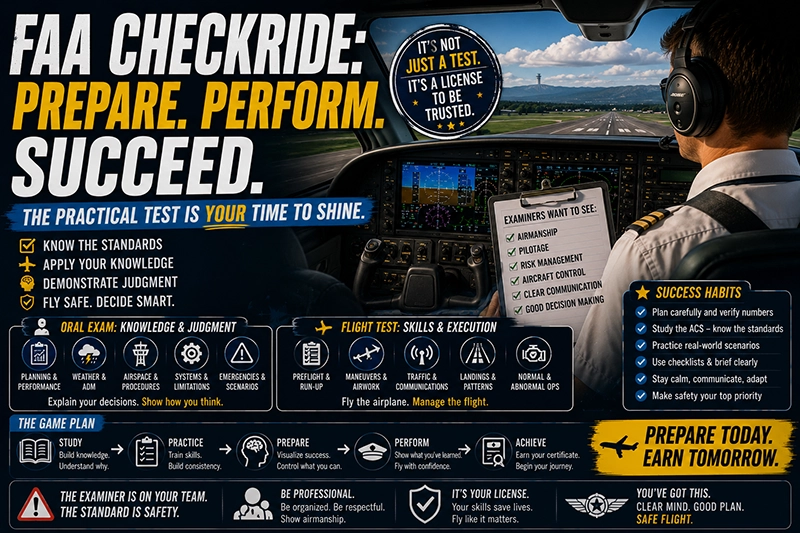
Preparing for your FAA checkride is a major milestone in any pilot's training. Whether you are seeking a private pilot certificate, an instrument rating, or a commercial certificate, the FAA checkride - formally called the practical test - evaluates your knowledge, judgment, and ability to operate an aircraft safely and competently.
This article explains what to expect during the checkride, how examiners typically structure the oral and flight portions, and practical steps you can take to reduce stress and increase your chance of success. The goal is to give student pilots, flight instructors, and training providers a clear, practical view of the process so preparation can focus on real-world flying skills and sound aeronautical decision making.
The Checkride Structure: Oral Exam and Flight Test
An FAA checkride generally has two linked segments. The first is the oral exam. The second is the flight test. The oral portion is not a simple quiz. Examiners use it to assess your knowledge, planning, risk management, and ability to apply regulations, procedures, and aeronautical decision making to realistic scenarios. Expect questions about aircraft systems, performance planning, weather, airspace, navigation, emergency procedures, and the specific maneuvers you will demonstrate in the aircraft.
The flight test evaluates you in the airplane or simulator. It typically follows the planned profile you discussed during the oral exam, though the examiner may adjust tasks to evaluate specific skills. During the flight portion you will be observed for aircraft control, cross-check and scan, communication, traffic and airspace management, and problem solving under realistic pressures.
Why This Matters in Real-World Aviation
The checkride is not just a gatekeeper for a certificate. It is a practical safety assessment. Examiners look for pilots who can operate safely, manage risks, and adapt when conditions change. Aircraft operations require continuous decision making: choosing safe altitudes, recognizing and responding to system failures, planning fuel and weight, and maintaining situational awareness in busy airspace. A well-prepared pilot demonstrates these skills consistently, both on the ground and in the air.
Flight training that emphasizes scenario-based instruction and risk management produces pilots better prepared for varied operational environments. The checkride serves as a capstone to verify that training translated into practical competence. Passing confirms you have the baseline skills and judgment for the certificate you sought. More importantly, the habits and knowledge you demonstrate are the same ones that keep you safe after you receive your certificate.
How Pilots Should Understand the Checkride
Think of the checkride as an assessment of applied aeronautical knowledge and practical skills rather than a rote skills test. Examiners are evaluating your ability to integrate multiple inputs - aircraft performance, weather information, airspace requirements, and human factors - into safe decisions.
During the oral exam you should be able to explain why you made planning choices, not just list figures. For example, when discussing weight and balance, show how the numbers affect takeoff and climb performance and your contingency plans. When questioned on weather, explain how a forecast or actual observation would change your go-no-go decision and in-flight actions.
In the flight portion, the examiner wants to see consistent control of the airplane, effective communication, and an appropriate scan of instruments and the outside world. Demonstrate smooth control inputs, anticipate aircraft energy changes, and verbalize your plan when appropriate. Use brief, clear calls to your examiner if you need clarification or intend to deviate from the planned profile for safety.
What to Expect During the Oral Exam
The oral typically begins with document checks and a review of the training and endorsement record. Expect discussion of the aircraft's airworthiness and required documents, as well as your personal certification documents. After that, the examiner will cover planning and judgement topics.
Common oral subjects include:
- Flight planning and performance - weight and balance, takeoff and landing distances, climb performance, and fuel planning.
- Weather and aeronautical decision making - interpreting METARs, TAFs, and other forecasts; risk assessment and mitigations.
- Airspace and procedures - operating in controlled airspace, communication requirements, and special use airspace considerations.
- Aircraft systems and limitations - how systems operate, normal and abnormal procedures, and safe operating limits.
- Emergency procedures and scenario-based questions - how you would respond to engine malfunctions, electrical failures, or unexpected weather changes.
The examiner may use scenario-based questions to explore how you prioritize tasks. For instance, you might be given a cross-country plan, then asked how a forecasted thunderstorm or a partial panel condition would affect your plan. The objective is to see how you identify hazards, evaluate options, and select a safe course of action.
What to Expect During the Flight Portion
Flight tasks are planned during the oral exam. The examiner will brief the requested maneuvers and the sequence, then you will perform them in the aircraft. Common emphases during flight evaluation include:
- Preflight inspection and run-up - demonstrating system knowledge and identifying discrepancies.
- Takeoff, climb, and departure - handling the airplane safely while managing tasks and communications.
- Maneuvers - slow flight, stalls, steep turns, and other certificate-appropriate maneuvers if required by the certificate sought.
- Traffic pattern work and landings - maintaining stabilised approaches and safe energy management.
- Emergency and abnormal procedures - simulated engine failures, radio failures, or instrument failures as appropriate.
Throughout the flight, maintain clear radio communications, manage workload by prioritizing tasks, and keep the aircraft within safe operational limits. If a task requires deviation for safety, inform the examiner of the reason. Examiners expect safety-first choices; a conservative, well-explained deviation will not automatically cause failure.
How Examiners Evaluate Performance
Examiners assess whether your knowledge, skills, and judgment meet the standards for the certificate or rating. They look for the consistent application of basic airmanship: accurate control inputs, timely planning, and effective risk mitigation. Failures are usually tied to unsafe actions, repeated poor control of the aircraft, or a fundamental lack of understanding rather than isolated minor errors.
Communication is part of that assessment. Clear, correctly formatted radio calls, proper use of checklists, and concise briefing of maneuvers show discipline and situational awareness. In the oral exam, clear explanations that show an ability to apply knowledge are weighted more heavily than memorized answers.
Common Mistakes and Misunderstandings
Several recurring issues commonly trip up candidates during checkrides. Being aware of them can shape your preparation.
Poor preflight planning is a top problem. Candidates sometimes bring incomplete performance calculations or fail to translate numbers into operational decisions. Always go beyond calculating numbers - explain how the numbers influence your plan and backups.
Another area of weakness is weather interpretation. Being able to read a METAR or TAF is not just about decoding, it is about assessing how conditions will affect your flight and what mitigations you will use. Understand how wind, visibility, ceilings, and convective activity influence your risk assessment.
In the cockpit, rushed checklists and sloppy cockpit discipline can undermine confidence. Use checklists deliberately, verbalize critical steps, and maintain a consistent scan. Repeated small control errors during maneuvers suggest incomplete mastery of aircraft control and often result in unsatisfactory performance.
Finally, many candidates misinterpret examiner behavior. Examiners are not adversaries. Their questions and task adjustments are designed to probe understanding and judgment. If an examiner changes the plan, treat it as a realistic test of adaptability and respond with an appropriate, safety-focused plan.
Practical Example: Cross-Country Checkride Scenario
Imagine you are preparing for a private pilot practical test that includes a cross-country segment. During oral planning you present a flight plan between two airports, including weight and balance, fuel calculations, and alternates. The examiner then introduces a complication - a line of convective activity along your planned route and a forecast of lowering ceilings at your destination.
Your expected responses would show how you used available weather information to modify the plan. You might describe selecting an alternate route that keeps you in VMC, increasing fuel reserves, filing a flight plan with revised routing, or postponing until conditions improve. In the flight portion you would then demonstrate situational awareness by monitoring changing conditions, using navigation resources to remain clear of restricted areas, and executing a safe diversion if weather or traffic dictates.
This scenario tests several competencies at once: weather interpretation, performance planning, flight planning flexibility, and enroute decision making. The examiner is looking for a coherent risk assessment, a reasonable mitigation strategy, and correct in-flight actions that align with the plan.
Best Practices for Pilots Preparing for the Checkride
Preparation is a mix of disciplined study, realistic practice, and mindset work. Here are practical behaviors and habits that improve readiness:
- Use scenario-based training - practice real-world decision making instead of rote memorization. Create complications during training flights and work through them with your instructor.
- Know the applicable standards - study the current Airman Certification Standards or practical test standards for your certificate to understand expected tasks and proficiency levels.
- Practice clear explanations - during oral preparation, explain the 'why' behind your planning and procedures, focusing on safety implications and alternatives.
- Build checklist discipline - use checklists consistently, and brief key items aloud, especially when working with an examiner who will be observing crew coordination and cockpit discipline.
- Simulate stressors in training - practice managing distractions, communications, and time pressure while maintaining control and safe decision making.
- Review aircraft performance - know how weight, density altitude, and configuration affect takeoff, climb, and landing distances, and have contingency plans.
- Train emergency responses until they are automatic - practicing engine failure procedures, radio failure, and diversion protocols reduces cognitive workload when real problems occur.
How to Manage Nerves and Interact with the Examiner
Nerves are normal. A calm, organized approach communicates competence. Arrive well-rested, with completed planning documents neatly arranged. If you do not understand a question, ask for clarification rather than guessing.
When a maneuver does not go as planned, correct smoothly and explain your actions. Examiners note how you respond to unexpected events. Demonstrating a controlled, prioritized response shows judgment and airmanship. If you are unsure about a procedural detail, explaining your reasoning and acknowledging limits can be more effective than pretending to know.
What Happens If You Don’t Pass
Not passing a checkride is disappointing but not uncommon. Failing gives you clear feedback on the areas needing improvement. Use the debrief to identify specific deficiencies and return to targeted training with your instructor. A measured training plan focusing on those weaknesses is the most efficient path to reattempt the practical test.
Recordkeeping and Documents to Bring
Bring the required personal and training documents and have copies where appropriate. Be prepared to show logbook entries for required training and endorsements, evidence of medical certification, photo identification, and the aircraft's documents including airworthiness and registration. Organize these items in a folder so the examiner can review them quickly during the oral exam. Having documents arranged demonstrates professionalism and reduces early stress.
Common Myths About the Checkride
A few myths create unnecessary worry. One is that examiners try to fail candidates. Examiners are generally experienced pilots concerned with safety and competence. Their objective is to determine whether you meet the standard. Another myth is that every single procedural slip leads to failure. Minor errors, if corrected and not repeated, do not typically decide the outcome. However, repeated unsafe actions or a fundamental lack of understanding will.
Finally, some pilots expect the examiner to hand-hold through maneuvers. Examiners may provide prompts, but you should be prepared to demonstrate tasks independently, explain your rationale, and make go/no-go decisions without prompting.
Frequently Asked Questions
How long does a typical FAA checkride take?
Time varies by certificate or rating and by the complexity of the aircraft and tasks. The oral may take an hour or more, and the flight portion depends on the maneuvers and cross-country elements. Plan for the whole day to allow for weather-related adjustments and debriefing.
Can I use my own airplane for the flight test?
Many candidates use their own or rented aircraft. The aircraft must be in an airworthy condition with the required documents on board. Knowing your aircraft's systems and limitations thoroughly is an advantage when using your own airplane.
What happens during the debrief?
The debrief reviews areas of satisfactory performance and any deficiencies. If you pass, the examiner will explain any required endorsements or follow-up items. If you do not pass, the debrief should identify the reasons so you can work on a targeted training plan before reattempting the practical test.
Should I memorize every line of the regulations?
Memorization of regulations is less important than understanding how regulatory requirements apply to real decisions. Know the regulatory foundations that affect flight planning and operations, but focus most of your study on practical application and scenario-based decision making.
What is the best way to prepare for the oral exam?
Use a combination of focused study and oral practice. Discuss real scenarios with your instructor, explain your planning choices out loud, and answer questions without notes. Practicing under realistic time pressure improves the clarity and conciseness of your explanations.
Key Takeaways
- Preparation should combine solid preflight planning with scenario-based training to demonstrate applied knowledge and judgment.
- Safety and sound decision making are core to examiners' evaluations; prioritize conservative, well-explained choices when conditions or systems create risk.
- Use the oral exam to show how numbers and regulations influence real operational decisions; use the flight portion to demonstrate consistent, disciplined aircraft control and workload management.
Successfully completing an FAA checkride is both a demonstration of your current skills and a springboard to more advanced aviation experience. Focus your preparation on real-world scenarios, disciplined cockpit habits, and clear explanations of your decision making. With targeted practice and a safety-oriented mindset, the practical test becomes an opportunity to show you are ready for the next phase of your flying career.