
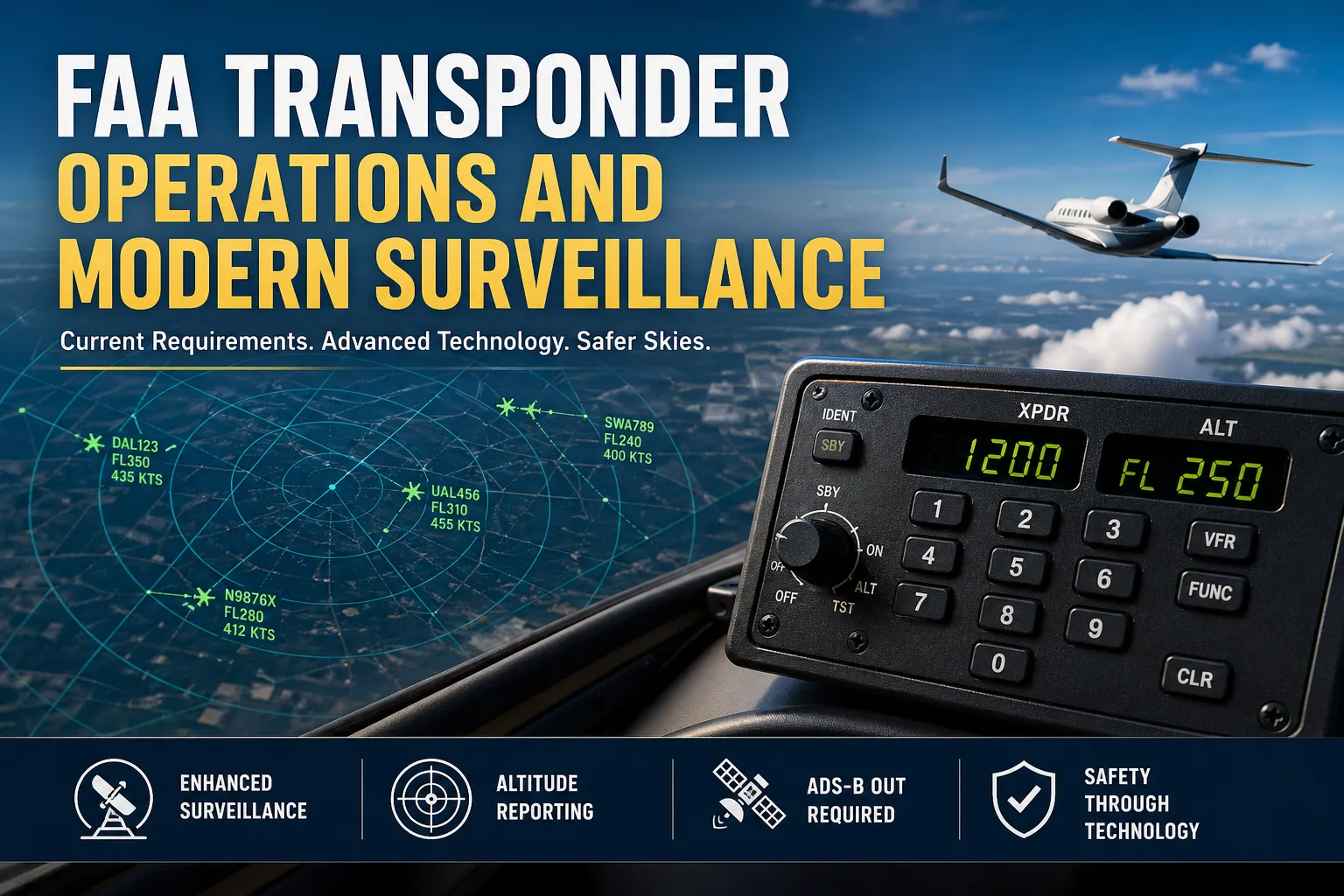
The FAA’s Advisory Circular 91-50, published in 1977, highlighted a critical shift in aviation. As air traffic increased, simple radar returns were no longer enough to safely manage aircraft. The need for reliable identification and altitude reporting became essential. While the circular focused on the importance of transponders in that era, today’s National Airspace System has evolved into a far more advanced and integrated surveillance environment.
Understanding how transponders fit into modern aviation requires looking at both their historical purpose and their current role alongside newer technologies like ADS-B. For pilots, this knowledge is not just academic. It directly affects how they operate in controlled airspace, how they interact with air traffic control, and how safely they integrate into the broader system.
The Origins of Transponder-Based Surveillance
The concept behind transponders began during World War II with Identification Friend or Foe systems. These early systems allowed radar operators to distinguish between allied and enemy aircraft. After the war, this technology was adapted for civilian use as radar became part of air traffic control.
Initially, controllers relied on primary radar, which displayed only a raw target. This made identifying specific aircraft difficult, especially in congested areas. As traffic increased, controllers needed a faster and more reliable method to identify aircraft without requiring pilots to perform turns or other maneuvers for identification.
The Air Traffic Control Radar Beacon System solved this problem by allowing aircraft to actively respond to radar interrogations. Each aircraft transmitted a coded reply, which appeared on the controller’s display along with identifying information. [oai_citation:0‡AC91-50 Transponder Operation.pdf](sediment://file_00000000652c7208b62b9984d662430b)
Over time, this system expanded from a limited number of identification codes to thousands, allowing controllers to track and manage large volumes of traffic with precision. The addition of altitude reporting further enhanced situational awareness by giving controllers a three-dimensional picture of the airspace.
How Transponders Work in Practice
A transponder is essentially a radio transmitter and receiver that responds to ground-based radar signals. When interrogated by a secondary surveillance radar, the transponder replies with a coded signal that includes identification and, if equipped, altitude data.
The pilot controls the transponder through a panel interface, selecting a four-digit code assigned by air traffic control or using standard codes for specific situations. When altitude reporting is enabled, the system transmits pressure altitude derived from an encoding altimeter.
In normal operations, pilots use the ALT setting, which enables both identification and altitude reporting. Standby mode prevents replies, and ON mode transmits identification without altitude data. Understanding these modes is essential, especially during ground operations or when following ATC instructions.
Modern Transponder Modes Explained
Transponder technology has evolved into multiple operating modes, each with increasing capability:
- Mode A: Provides a four-digit identification code, allowing controllers to associate a radar target with a specific aircraft.
- Mode C: Adds altitude reporting, transmitting pressure altitude in 100-foot increments.
- Mode S: Introduces selective interrogation, unique aircraft addressing, and enhanced data capabilities.
Mode S transponders are particularly important in modern airspace because they reduce signal congestion and support advanced systems such as Traffic Collision Avoidance Systems and ADS-B.
Current FAA Transponder Requirements
Today’s FAA regulations require transponder use in far more airspace than originally envisioned in the 1970s. Under 14 CFR 91.215, aircraft must be equipped with an operable transponder with altitude reporting capability in key areas of controlled and high-altitude airspace.
These include:
- All operations in Class A, B, and C airspace
- Within 30 nautical miles of Class B primary airports, commonly known as the Mode C veil
- Above the ceiling and within the lateral boundaries of Class B or C airspace up to 10,000 feet MSL
- At altitudes above 10,000 feet MSL, excluding airspace below 2,500 feet AGL
These requirements ensure that aircraft operating in busy or complex environments remain visible to air traffic control at all times.
ADS-B Out and the Next Generation System
The introduction of ADS-B Out represents one of the most significant advancements in aviation surveillance. While transponders respond to radar interrogations, ADS-B continuously broadcasts an aircraft’s position using GPS-based data.
As of January 1, 2020, ADS-B Out is required in nearly all airspace where a Mode C transponder is required. This effectively ties modern surveillance requirements to both systems working together.
ADS-B provides several advantages:
- More precise position information than traditional radar
- Continuous broadcasting rather than intermittent replies
- Improved situational awareness for both ATC and pilots
Aircraft equipped with ADS-B In can also receive traffic and weather information, enhancing cockpit awareness and decision-making.
Operational Considerations for Pilots
From a pilot’s perspective, proper transponder operation is a fundamental part of flight preparation and execution. Before entering controlled airspace, pilots should verify that the transponder is functioning correctly, the correct code is set, and altitude reporting is active.
It is also important to understand standard transponder codes. Codes such as 1200 for VFR flight, 7700 for emergencies, 7600 for radio failure, and 7500 for unlawful interference are universally recognized and carry immediate significance for ATC.
Incorrect settings or failure to use the transponder properly can result in loss of radar services, denied airspace entry, or increased workload for both pilots and controllers.
Maintenance and Inspection Requirements
Transponder systems are subject to strict maintenance standards. FAA regulations require that transponders and altitude reporting equipment be inspected every 24 calendar months. These inspections verify accuracy, signal strength, and system integrity.
Maintenance personnel must ensure that the equipment meets regulatory performance standards and that all work is properly documented. Aircraft owners are ultimately responsible for ensuring compliance and maintaining airworthiness.
Even minor inaccuracies in altitude reporting can have significant consequences in controlled airspace, making proper maintenance essential for safe operations.
Why Transponders Still Matter
Despite the introduction of ADS-B and satellite-based surveillance, transponders remain a critical component of the aviation system. They provide redundancy, support legacy radar infrastructure, and serve as the backbone for many collision avoidance systems.
The principles outlined in AC 91-50 still hold true today. Accurate identification and altitude reporting are essential for safe and efficient air traffic management. What has changed is the level of integration and precision now available to both pilots and controllers.
For anyone operating in today’s airspace, understanding transponder requirements is not optional. It is a core part of flying safely and effectively within the system.
Key Takeaways
- Transponders evolved from military identification systems into a critical part of civilian air traffic control.
- Modern FAA regulations require altitude-reporting transponders and ADS-B Out in most controlled and high-altitude airspace.
- Proper operation, correct coding, and regular maintenance of transponder systems are essential for safety and regulatory compliance.