
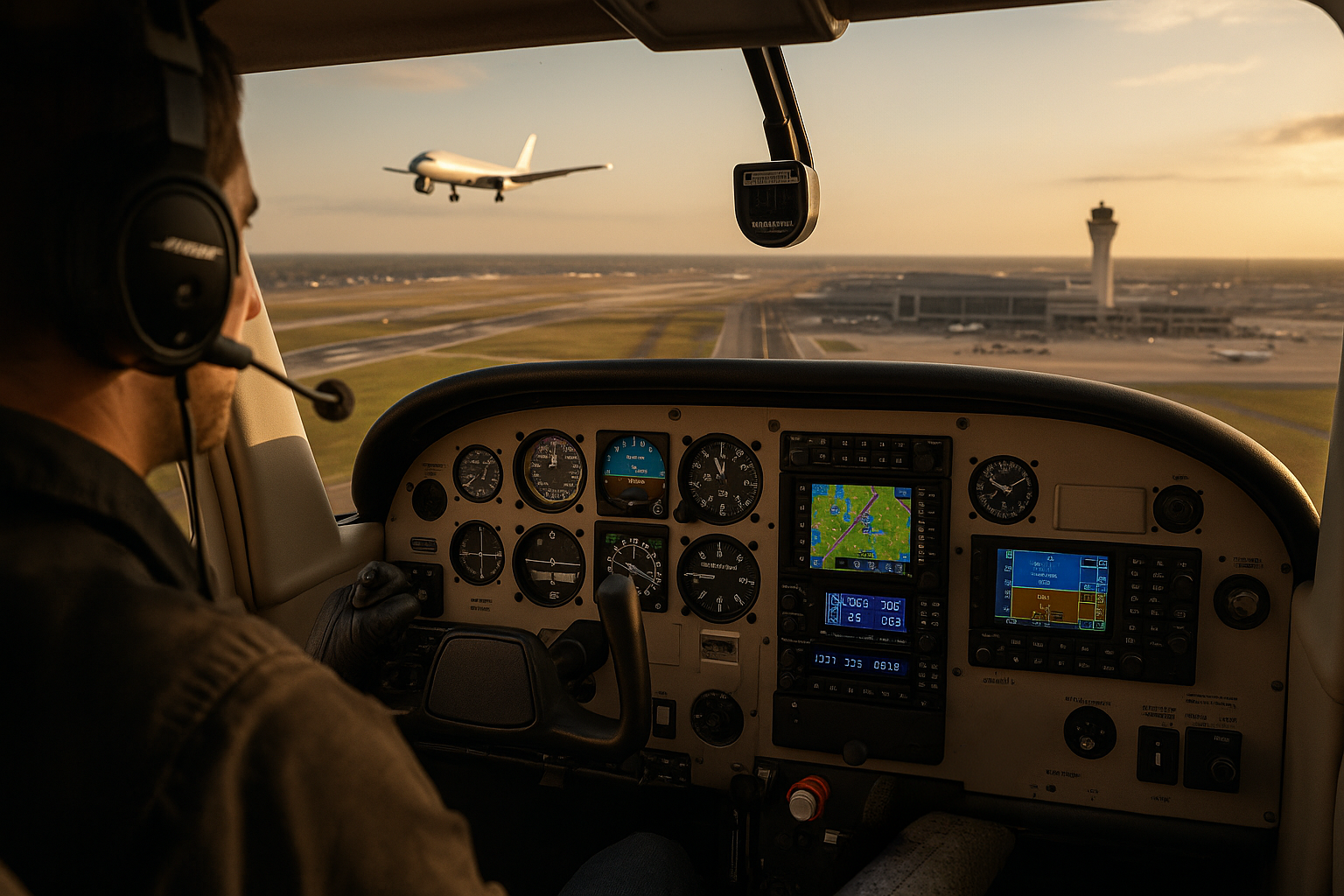
Class B airspace is one of the most demanding environments a pilot will fly in. For pilots, student pilots, and instructors, operating in busy Class B airspace requires precise communication, strong traffic scan discipline, and purposeful preflight and inflight decision-making. This article breaks down the practical challenges of flying in Class B, explains how those challenges affect training and operations, and provides actionable strategies to reduce risk and improve pilot performance.
The material that follows focuses on operational understanding and pilot judgment. It emphasizes what pilots need to do before and during a flight to integrate safely with dense traffic flows and complex air traffic control (ATC) procedures. The aim is to provide realistic, cockpit-focused guidance rather than a regulatory lecture, while noting where pilots should confirm regulatory details with official sources.
Understanding the Core Challenge
At its core, the challenge of flying in busy Class B airspace is managing high traffic density with tight sequencing and precise communication. Aircraft of many different performance levels, from small single-engine trainers to large transport-category jets, operate in the same airspace. That mix creates high workload for pilots and controllers, increases the need for accurate position awareness, and shortens the margin for errors in navigation, communication, and spacing.
In practical terms, pilots must manage several simultaneous tasks: maintain assigned altitudes and headings, monitor and follow ATC clearances, scan for traffic visually, manage aircraft systems and performance, and anticipate sequencing or reroutes. The cognitive load can spike quickly during taxi, departure, arrival, or when traffic conflicts occur. Training and cockpit routines that reduce wasted attention and prioritize the right information are essential.
Why This Matters in Real-World Aviation
Operating in busy Class B airspace directly impacts several critical areas of flight operations. From a safety perspective, the close proximity of aircraft increases the potential for airspace conflicts and near-miss incidents if pilots fail to maintain situational awareness. From a training perspective, student pilots often first encounter high-density operations during supervised flights, and instructors must expose students to realistic communication and traffic-management tasks without overloading them.
Operationally, business and commuter operators must meet scheduling demands while maintaining safety and compliance. Flight planners need to account for potential delays, routing constraints, and required equipment. For flight instructors, teaching students to fly safely into and around Class B airspace is a key step in progressing toward private and instrument ratings. Beyond the cockpit, airport and airspace design, ATC procedures, and operator standard operating procedures all interact with pilot behavior to determine outcomes.
How Pilots Should Understand Class B Airspace
Pilots should view Class B as an environment defined by three interacting elements: traffic density, ATC control and sequencing, and the diversity of aircraft performance. Each element increases the complexity of the operating environment in different ways.
Traffic density shortens decision time. When several aircraft are arriving or departing nearly simultaneously, pilots must quickly integrate ATC instructions with visual scanning and aircraft handling. This requirement makes clear, efficient radio communications and cockpit organization vital.
ATC control and sequencing mean pilots are often given precise headings, altitudes, or vectors to maintain separation. Responding accurately and promptly to those instructions preserves safety margins. Pilots should practice concise readbacks, confirm understanding when instructions are ambiguous, and avoid assumptions about implied clearances.
Diversity of aircraft performance creates flow-management challenges. A heavy jet will have different climb, descent, and spacing characteristics than a single-engine piston airplane. Pilots should anticipate how their aircraft’s performance affects sequencing, speed adjustments, and spacing relative to other traffic.
Key Operational Themes
Several operational themes recur when experienced pilots and instructors discuss busy Class B operations. These themes help organize training and in-flight priorities.
First, predictable and practiced cockpit flows reduce mental load. Simple organization steps such as setting radios and navigation devices before entering the pattern, briefing likely arrival tasks, and trimming the aircraft early leave more attention for traffic and ATC exchanges.
Second, effective communication is short, clear, and confirms essential details. Avoid long transmissions that obscure the instruction. Use standard phraseology and confirm readbacks for headings, altitudes, and clearances when needed. If a clearance seems inconsistent with traffic or terrain, ask ATC to clarify promptly.
Third, visual scan discipline and target-scan techniques matter. When workload is high, pilots should use structured scan patterns that prioritize the most likely conflict axes given the traffic flow, and use outside scanning in short, frequent bursts rather than long unfocused looks.
Common Mistakes and Misunderstandings
Several predictable mistakes recur among pilots new to busy Class B operations. Recognizing these errors helps instructors design focused training and allows pilots to self-check in real flights.
One common error is underestimating radio workload. Pilots who are unfamiliar with the tempo often spend too long composing transmissions or mishear instructions when multi-party transmissions occur. Practicing crisp readbacks and learning to interleave listening, speaking, and flying reduces this risk.
Another frequent misunderstanding is the assumption that visual contact with traffic removes the need for ATC coordination. Seeing another airplane does not relieve the pilot of following ATC sequencing and clearances. Visual acquisition may be fleeting, and visual geometry can be deceptive in busy patterns.
Misjudging performance and spacing is also common. Some pilots fail to anticipate how a climb or descent profile will affect spacing behind faster or slower traffic. Instructors should emphasize planning speed and configuration changes early when integrating into a flow.
Finally, many pilots are inadequately prepared for simultaneous tasks at high workload moments. For example, trying to tune a navigational radio, reconfigure the aircraft, and execute an ATC vector simultaneously often leads to missed instructions or control deviations. Practiced flows and delegation of tasks, when possible, reduce the chance of error.
Practical Example: VFR Arrival Into a Busy Class B
Picture a VFR flight in a single-engine trainer approaching a large metropolitan airport within busy Class B airspace. The pilot has filed a simple plan, completed the preflight briefing, and is six miles from the Class B shelf with inbound traffic being sequenced by ATC.
Before entering the busy area, the pilot sets the radio to the approach frequency, squawks the transponder code assigned previously by the tower or clears the code as required, and briefs a short arrival plan: expected altitude, potential go-around points, and runway expected. The instructor on board runs a quick verification to ensure the student knows where to find the nearest visual reference points and how to respond to a go-around instruction.
ATC issues a clearance to enter the Class B and vectors for sequencing behind a faster, turbocharged airplane. The pilot reads back the heading and begins the turn while simultaneously trimming and confirming the assigned altitude. Visual scanning identifies the other airplane on a converging path. The pilot notes separation is marginal and informs ATC, who issues a slight turn to increase spacing.
On final, a slower aircraft is instructed to go-around by ATC. The Class B arrival converges with multiple aircraft liftoff paths. The pilot keeps the aircraft configured, maintains a stabilized approach speed, and prepares for a possible go-around due to a late sequencing change. Maintaining a sterile cockpit during critical phases reduces distraction; the pilot defers non-essential conversation and focuses on flying the airplane and monitoring ATC instructions.
This example highlights the need for rapid task switching, a prioritized scan, and the discipline to execute brief but accurate communications while flying precise control inputs. It also demonstrates how pre-briefed contingency plans reduce decision time when ATC modifies sequences.
Training and Skill Development
Training for busy Class B operations should be incremental and scenario-based. Start with basic radio and phraseology drills in low-pressure environments, then progress to simulated busy-airspace scenarios in the aircraft or flight simulator. Instructors should grade tasks by complexity, adding elements like simultaneous radio calls, missed approaches, or traffic conflicts as the student gains competence.
Scenario training that replicates real workload conditions helps pilots develop automatic responses for common events and frees cognitive resources for unexpected problems. Practice includes: rapid tuning and readbacks, establishing and maintaining assigned headings and altitudes, executing immediate remedial actions such as climbs, descents, or turns, and practicing go-arounds in the traffic environment.
Instrument pilots, even when flying VFR, benefit from instrument procedures training related to busy airspace since ATC vectors and traffic flows often use instrument approaches and departure corridors. Cross-training broadens situational understanding and prepares pilots to follow complex ATC instructions reliably.
Common Misunderstandings About Equipment and Requirements
Pilots often misunderstand what equipment improves safety versus what is legally required. Having a functioning radio, reliable navigation aids, and a transponder improve safety and ATC’s ability to provide traffic advisories. Advanced avionics such as traffic advisory systems and ADS-B In provide significant situational awareness benefits, but their absence does not automatically preclude safe operation if pilots mitigate with disciplined scan and communication.
Because regulations and local procedures can vary, pilots should verify legal entry requirements and equipment mandates for their planned route and destination before flight. When in doubt, confirm with official sources or ATC to avoid surprises in the cockpit.
Best Practices for Pilots
Below are practical habits and decision-making principles that improve safety and performance in busy Class B airspace.
- Plan thoroughly. Pre-brief arrival and departure expectations, alternate routes, likely frequencies, and contingency actions.
- Use a sterile cockpit mindset during high-workload phases. Defer non-essential tasks and conversations.
- Practice concise, standard radio communications. Prioritize clarity for headings, altitudes, and clearance items.
- Organize the cockpit. Set radios, navigation aids, and transponder codes before they become urgent.
- Maintain a structured visual scan. Use short, purposeful scans that focus on the most likely conflict vectors.
- Anticipate performance effects. Adjust airspeed and configuration early to manage spacing behind different classes of aircraft.
- Brief go-around options early. Know where to go and what to do if sequencing changes or traffic conflicts occur.
- Use available traffic information systems if equipped. Treat ADS-B In or TCAS advisories as supplemental information, not an absolute substitute for visual lookouts and ATC coordination.
- When uncertain, ask ATC for clarification. A brief request for re-read or confirmation is preferable to acting on a misunderstanding.
Common Mistakes and How to Avoid Them
Recognizing predictable errors helps pilots and instructors design training to mitigate them.
Mistake: Overloading on transmissions. Solution: Keep transmissions concise; if a long exchange is needed, break it into smaller, manageable steps.
Mistake: Failing to brief contingencies. Solution: Include at least one clear go-around or reroute plan during the arrival briefing.
Mistake: Visual complacency. Solution: Maintain frequent outside scanning and cross-check instruments to confirm closure rates and relative position.
Mistake: Poor cockpit flow. Solution: Adopt a standard pre-entry flow that includes setting frequencies, verifying transponder operation, and arranging charts for quick reference.
Decision-Making Under High Workload
Decision-making in busy Class B is primarily about prioritization. The highest priorities are aircraft control and obstacle avoidance, followed immediately by compliance with ATC instructions that affect separation. Secondary tasks like detailed navigation or non-essential checklist items should be deferred until the aircraft is stabilized and the pilot has capacity.
Use simple decision rules that are easy to apply under stress. For example, if a clearance or instruction would reduce a safe margin or is unclear, request clarification. If separation becomes marginal, advise ATC and execute a safe maneuver rather than risk an undetected conflict. Having decision rules pre-planned reduces hesitation and preserves safety margins.
Coordination With ATC and Other Pilots
Successful integration into busy airspace depends on smooth coordination with ATC and cooperative behavior from other pilots. Communicate expected intentions where appropriate, and be ready to accept vectoring or spacing instructions. When multiple aircraft are on frequency, listen to others to build a mental model of the flow; this context helps anticipate upcoming instructions and traffic conflicts.
Remember that ATC prioritizes sequencing and separation, and controllers may alter clearances rapidly to resolve conflicts. Maintain flexibility and be ready to adapt while maintaining flight path control and safety.
Technology and Instrumentation: How They Help and Where They Fall Short
Modern avionics and traffic systems provide pilots with enhanced situational awareness, but they also create potential pitfalls. Traffic displays can be extremely useful for detecting non-visual traffic and for confirming ATC advisories. However, they can also create complacency if pilots assume displayed traffic is complete or perfectly accurate.
ADS-B In provides valuable traffic and weather information, but reception depends on the other aircraft being equipped and on line-of-sight limitations. Pilots should use these tools as supplements to visual scanning and ATC coordination, not as replacements.
Practical Preflight Checklist for Busy Airspace Operations
A compact preflight routine focused on busy-airspace operations reduces the chance of missed steps or last-minute confusion. The goal is to create a clear mental model of the approach and to ensure essential equipment and charts are ready.
- Confirm required equipment and transponder functionality.
- Review current airspace configuration and any NOTAMs affecting routes or procedures.
- Set primary frequencies and have secondary frequencies available on standby.
- Brief expected arrival routing, altitudes, and missed approach/go-around options.
- Assign pilot and instructor tasks for busy segments—who talks to ATC, who flies if workload increases.
Frequently Asked Questions
Do I always need ATC clearance to enter Class B airspace?
Clearance and equipment expectations vary by location and operation. Pilots should confirm regulatory requirements for their flight and seek clarification from ATC when uncertain. If you are unfamiliar with local procedures, include a preflight check with official publications or ATC.
How should student pilots be introduced to busy Class B operations?
Introduce students incrementally. Start with radio communications and phraseology practice in a quieter environment, then progress to simulated busy-airspace flights. Instructors should increase complexity gradually while explicitly teaching scan techniques, cockpit flows, and contingency planning.
What common traffic scan techniques work best in busy airspace?
Short, systematic scans that alternate between near, mid, and far visual sectors work well. Focus on high-risk conflict axes based on the traffic flow and use instrument cross-checks to confirm closure rates. Avoid long, unfocused looks outside the cockpit that miss instrument or traffic cues.
How can a pilot prepare for rapid changes in sequencing or clearances?
Prepare contingency plans during your arrival briefing. Identify safe altitudes, visual references for navigation, and go-around procedures. Keep configurations and speeds that allow for rapid maneuvering if instructed to change heading or altitude suddenly.
Are traffic advisory systems reliable enough to replace visual scanning?
Traffic advisory systems are valuable tools, but they are complements to visual scanning and ATC coordination. They may not display all traffic, can be subject to reception limitations, and may present false or stale targets. Always maintain an outside scan and use advisory systems to augment situational awareness.
Final Thoughts for Instructors and Students
Busy Class B airspace is a valuable training ground that sharpens pilot skills in communication, traffic management, and decision-making. For instructors, the priority is to build capability steadily: start with radio discipline and cockpit flows, then add realistic traffic scenarios and time-pressured decision-making. For students, embrace frequent practice in the aircraft and simulators, and seek feedback on radio technique, scan discipline, and approach stabilization.
Remember that preparation reduces stress. Pilots who brief carefully, set radios and transponders early, and establish clear contingency plans will be better equipped to handle the inevitable surprises that occur in busy airspace.
Key Takeaways
- Practical takeaway: Use disciplined cockpit flows and pre-brief arrival contingencies to free mental bandwidth for traffic and ATC coordination.
- Safety takeaway: Maintain structured visual scanning and prioritize aircraft control and separation when workload spikes.
- Training takeaway: Incremental, scenario-based practice of radio communication, sequencing, and go-around procedures develops reliable habits for busy Class B operations.