
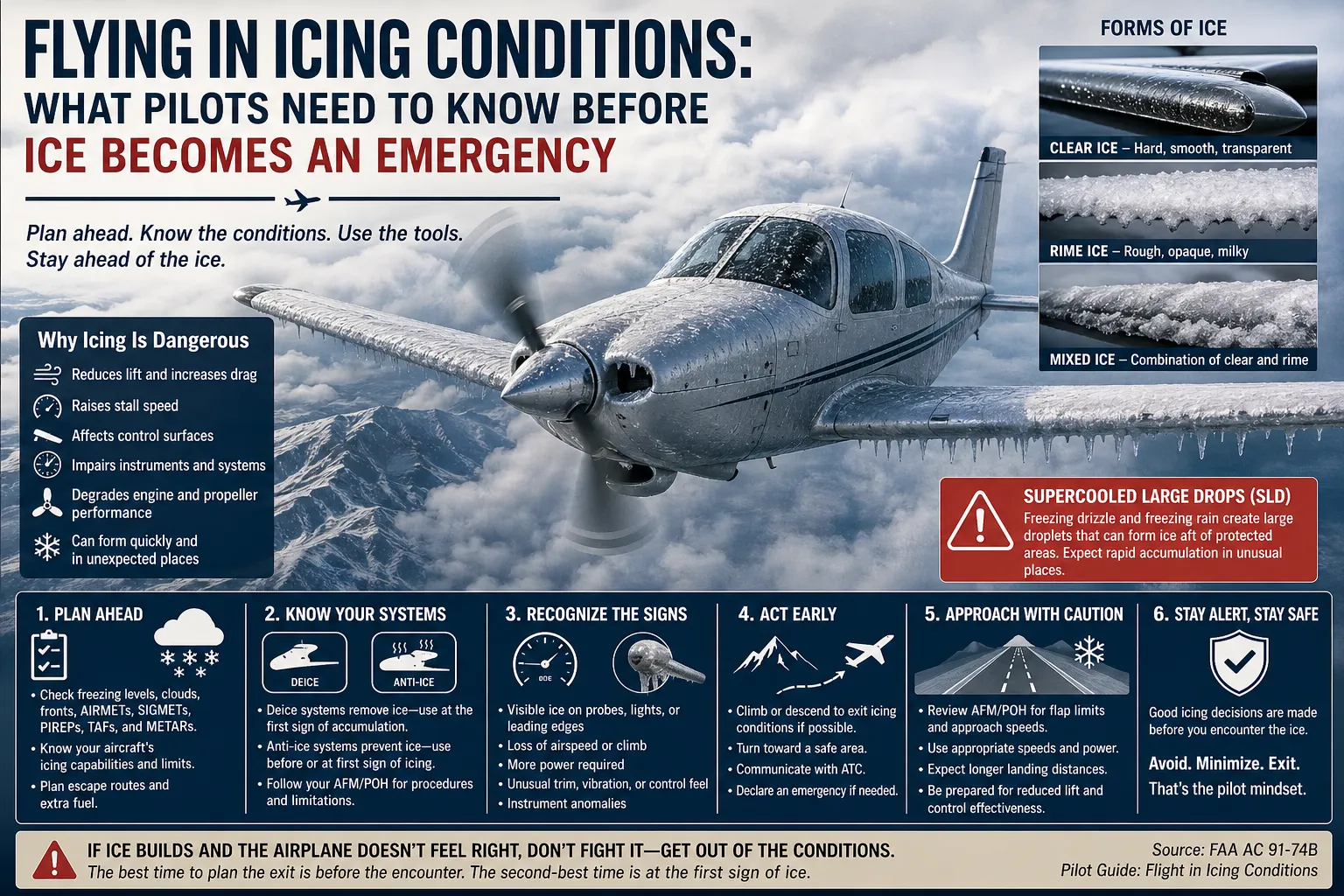
Aircraft icing is one of aviation’s most deceptive hazards. It can begin subtly, with a thin, rough coating on a leading edge or a small accumulation on a probe, then quickly change the way an airplane flies. A pilot may first notice a slight loss of airspeed, a need for more power, a change in trim, or a strange vibration. By the time the airplane feels dramatically different, the margin between controlled flight and a stall, roll upset, or emergency descent may already be narrowing.
The FAA’s guidance on flight in icing conditions emphasizes a simple but important idea: ice is not just frozen water attached to an aircraft. It is an aerodynamic contaminant. It changes airflow, increases drag, reduces lift, interferes with control surfaces, and may affect instruments, engines, antennas, propellers, and visibility. Understanding icing is therefore not just a winter-weather skill. It is a year-round risk-management skill for any pilot who flies in clouds, precipitation, or temperatures near freezing.
Why Icing Is So Dangerous
Most structural icing forms when an airplane flies through supercooled liquid water. These droplets remain liquid even though the outside air temperature is below freezing. When they strike the aircraft, they freeze and adhere to surfaces such as wings, tailplanes, propellers, antennas, engine inlets, windshields, and probes.
The most obvious concern is ice on the wing, but the wing is only part of the problem. Ice can accumulate on the tailplane, where it may not be visible from the cockpit. It can block a pitot tube or static port, distort stall warning indications, reduce propeller efficiency, interfere with engine airflow, and cause vibration or signal distortion from antennas. In turbine aircraft, ice crystals near convective weather can even accrete inside engines without obvious airframe icing.
The aerodynamic effects can be severe. A relatively small amount of rough ice on a leading edge can reduce the maximum lift a wing can produce and cause the wing to stall at a lower angle of attack than normal. At the same time, drag rises. This combination is especially dangerous because the airplane may require more power to maintain altitude while also having less stall margin than the pilot expects.
The Temperature Range That Deserves Attention
Many pilots associate icing only with very cold temperatures, but the greatest icing threat often occurs not far below freezing. Clouds near 0 °C can contain abundant liquid water, which provides the raw material for ice accretion. As temperatures drop much colder, clouds increasingly contain ice particles rather than liquid droplets, and those particles are less likely to adhere to unheated aircraft surfaces.
This does not mean very cold weather is automatically safe. Ice crystals at high altitude can create serious turbine engine hazards, and localized atmospheric conditions can vary. But for many airframe icing encounters, the temperature band close to freezing deserves special respect. The FAA guidance also warns pilots to be especially alert near outside air temperatures between about -5 °C and +2 °C, where runback ice can form behind protected areas.
Runback ice occurs when water flows aft from a heated or protected surface and refreezes on an unprotected area. This can create ridges in places where the pilot may not expect ice to form, and those ridges can disturb airflow over wings, tailplanes, or control surfaces.
Cloud Type Matters
Not all clouds produce the same icing threat. Stratus clouds often cover wide areas and may contain icing layers that extend for thousands of feet, although a climb or descent of a few thousand feet can sometimes exit the icing layer. Cumulus clouds, by contrast, may contain higher liquid water content and can produce rapid ice accumulation, but they are often more limited horizontally.
Orographic clouds can also be hazardous. When moist air is forced up rising terrain, it cools and may form clouds with significant liquid water. Wave clouds can contain high liquid water content as well. Pilots operating near mountains should treat visible moisture and freezing temperatures with particular caution because terrain can limit escape options.
Frontal weather is another major icing environment. Warm fronts commonly produce widespread layered clouds as warm air gradually rides up over colder air. Cold fronts can lift moist air more abruptly, creating cumuliform clouds with higher liquid water content. When crossing a front, the practical goal is usually to minimize time spent in the frontal zone rather than fly along it.
Clear, Rime, and Mixed Ice
Aircraft structural icing is often described as clear, rime, or mixed ice. These labels are useful because they say something about how the ice formed, but pilots should remember that the aerodynamic danger depends heavily on the location, shape, size, and roughness of the accretion.
Clear ice is typically glossy, hard, and relatively transparent. It forms when larger supercooled droplets freeze more slowly after impact, allowing water to spread before solidifying. Clear ice can form horns or ridges that significantly disrupt airflow.
Rime ice is rough, milky, and opaque. It forms when smaller droplets freeze rapidly on impact, trapping air in the ice. Although rime ice may appear less dense than clear ice, it can still be aerodynamically serious, especially if it forms a rough leading-edge shape.
Mixed ice contains characteristics of both. It can appear cloudy and irregular, and it may create shapes that are especially disruptive to airflow. From the pilot’s perspective, the precise label is less important than recognizing that any ice on critical surfaces should be treated as a performance and control hazard.
Supercooled Large Drops: A Special Hazard
Supercooled large drops, often called SLD, include freezing drizzle and freezing rain. These droplets are larger than typical cloud droplets, which means they can travel farther aft before striking the aircraft. As a result, ice may form behind areas normally protected by boots or anti-ice systems.
This is one reason SLD is especially hazardous. A pilot may see ice forming in unusual places, such as aft of the protected leading edge, on unheated portions of windows, behind engine nacelle lips, or across broader areas of the airframe. Propeller spinners may show ice extending farther aft than expected. The aircraft may also experience a rapid performance degradation that seems out of proportion to the visible ice on the main wing surfaces.
Freezing rain often suggests warmer air above and subfreezing air below, but freezing drizzle can form within a cloud without a warm layer overhead. That distinction matters because a climb may not always be the best escape route. Pilots need to evaluate freezing levels, cloud tops and bases, terrain, aircraft performance, and available ATC options before deciding whether climbing, descending, turning around, or diverting is the safest response.
Certification Does Not Make an Airplane Invincible
An aircraft approved for flight in icing conditions has been evaluated for specific icing envelopes and must be operated according to its Airplane Flight Manual or pilot’s operating handbook. That approval is important, but it is not a guarantee that the aircraft can safely remain in all icing conditions indefinitely.
Icing certification has limits. Some conditions, including freezing drizzle and freezing rain, may fall outside the icing environments for which many aircraft were originally certified. Even aircraft with functioning ice protection can encounter liquid water content, droplet sizes, or ice shapes that exceed their tested assumptions. If ice begins accumulating rapidly, appears aft of protected areas, or causes abnormal handling or performance, the correct mindset is not “the airplane is certified.” The correct mindset is “the airplane is telling me to leave.”
For aircraft not certificated for flight in icing conditions, the guidance is more direct: avoid icing conditions and exit immediately if they are encountered. Equipment such as pitot heat, alternate static air, carburetor heat, or limited deice capability may help in an inadvertent encounter, but it does not turn the aircraft into a known-ice airplane.
Ice Protection Systems Require Proper Timing
Deicing and anti-icing systems are not the same. Deicing systems remove ice after it has formed. Pneumatic boots are a common example. They inflate and deflate to break ice loose from leading edges. Because some residual or intercycle ice may remain, pilots must understand the system’s limitations and operate it according to the aircraft manual.
Older training sometimes warned pilots to wait before activating pneumatic boots because of concern over ice bridging. Modern FAA guidance emphasizes that many manufacturers now advise activating boots at the first indication of icing. The FAA recommends activating deicing systems at the first sign of ice accumulation unless the aircraft manual says otherwise.
Anti-icing systems, by contrast, are designed to prevent ice from forming. They may use heated bleed air, electrical heat, or chemical fluid. These systems generally should be activated before entering icing conditions or at the first sign of visible moisture in conditions conducive to icing, depending on the aircraft manual. Using an anti-ice system as though it were a deice system may reduce effectiveness or create additional problems.
The pilot’s operating handbook or Airplane Flight Manual remains the controlling source. Different aircraft have different system designs, activation procedures, minimum power settings, temperature limits, and approach requirements.
The Tailplane Is Easy to Forget and Dangerous to Ignore
Most pilots are taught to think first about wing ice, but tailplane icing can be just as serious. The tailplane is often thinner than the wing, which can make it an efficient ice collector. It may also be difficult or impossible for the pilot to see from the cockpit.
In many aircraft, the tailplane provides downward lift to balance the airplane. When flaps are extended, airflow changes can increase the negative angle of attack on the tailplane. If the tailplane is contaminated with ice, it may stall, producing a sudden nose-down pitch. This is known as ice-contaminated tailplane stall.
The risk is especially important during approach and landing because that is when flap extension, lower altitude, reduced power, and high workload come together. Some aircraft manuals limit flap use in icing conditions, and some aircraft may require partial-flap or no-flap approaches if ice remains. Pilots should follow aircraft-specific guidance and avoid improvising configuration changes when abnormal handling appears.
Autopilot Use Can Hide the Warning Signs
The autopilot can reduce workload, but in icing conditions it can also mask important handling cues. As ice accumulates, the autopilot may quietly add trim or adjust pitch to maintain altitude. The pilot may not feel increasing control forces or deteriorating stability until the autopilot disconnects or the aircraft approaches stall.
This is especially concerning in vertical speed mode during climb. If ice reduces climb performance and the autopilot continues trying to maintain a selected vertical speed, airspeed can decay toward stall. The pilot must monitor airspeed closely and maintain appropriate margins above stall speed for the configuration and conditions.
In cruise, holding, descent, and approach, pilots should watch for abnormal trim movement, unusual pitch attitudes, unexpected power requirements, and declining airspeed. Some pilots may choose to periodically hand fly in icing conditions if workload and aircraft procedures allow, because it can reveal handling changes earlier. The key is not simply whether the autopilot is on or off. The key is whether the pilot is actively monitoring what the airplane is doing.
Flight Planning Is the First Icing Strategy
Good icing management begins before engine start. A proper preflight weather review should include freezing levels, cloud bases and tops, frontal positions, AIRMETs, SIGMETs, PIREPs, Current Icing Products, Forecast Icing Products, METARs, TAFs, and route-specific terrain or airspace constraints.
PIREPs are particularly valuable because they describe actual conditions encountered by aircraft at specific times and places. However, pilots should interpret them carefully. A “light icing” report from a large, fast, well-protected aircraft may not mean light icing for a slower piston single. Similarly, the absence of icing reports does not mean the absence of icing. It may simply mean no one recently flew through the affected area, no one reported it, or conditions varied sharply with altitude and location.
Before departure, pilots should also identify escape options. In many icing encounters, the most important question is not “Can I keep going?” but “Where will I go if this gets worse?” Practical planning includes considering whether a climb or descent is realistic, whether terrain permits an immediate altitude change, which airports along the route offer suitable runways, and whether extra fuel is needed for deviations or increased drag.
Ground Contamination Is Part of the Same Hazard
Inflight icing gets much of the attention, but frost, snow, and ice on the ground can be equally dangerous. Even small amounts of contamination can degrade lift and increase drag during takeoff. Pilots should remove all frost, snow, and ice from critical surfaces before flight.
Cold-soaked fuel can also create clear ice on wing surfaces even when the outside air temperature is above freezing. A pilot who sees a clean-looking wing in marginal conditions should still inspect carefully, especially when the aircraft has recently descended from cold altitude conditions and then sat in moist air on the ground.
Deicing and anti-icing fluids can help protect an aircraft before takeoff, but they are not inflight icing protection. Holdover times are limited, conditions can change, and pilots must verify that the fluid type and procedure are approved for the aircraft.
Recognizing Trouble in Flight
Ice encounters rarely announce themselves with a single unmistakable cue. More often, the pilot must assemble a picture from several clues. Ice on a visible probe, windshield wiper, landing light, or strut may be the first sign. A gradual loss of airspeed, increasing power requirement, unusual trim, vibration, degraded climb, or abnormal control feel may follow.
Instrument anomalies are also possible. A blocked pitot tube can cause unreliable airspeed indications. A blocked static port can affect the airspeed indicator, altimeter, and vertical speed indicator. A frozen stall warning sensor may fail to warn at all, and even a working stall warning system may not activate before an ice-contaminated wing stalls at a lower-than-normal angle of attack.
Pilots should be especially cautious when rain or drizzle is visible at temperatures near or below freezing, when drops splash or splatter on impact, or when flying into areas reporting precipitation near freezing. Automated surface observations may not always report freezing drizzle or freezing rain when other precipitation is occurring, so the absence of a specific freezing precipitation report should not create false confidence.
Approach and Landing Demand Extra Respect
Many icing accidents occur in the final phases of flight. The reasons are clear: the aircraft is low, slow, changing configuration, often descending through clouds or precipitation, and the pilot’s workload is high. Ice that seemed manageable in cruise can become much more serious as flaps, gear, power changes, and lower airspeeds alter the aircraft’s aerodynamics.
Before approach, pilots should review the aircraft manual for required speeds, flap limitations, use of ice protection, and landing distance adjustments. If ice remains on the aircraft, approach speed may need to be increased according to approved guidance. A higher approach speed increases landing distance, and runway contamination can increase it further.
Flap extension should be treated with care. In some aircraft, additional flaps may trigger abnormal pitch or roll behavior if ice is present. In others, retracting flaps after an anomaly may create a different hazard. This is why aircraft-specific guidance matters so much. The pilot should not rely on generic instincts when the manual gives specific procedures.
During landing, ice on the wing may reduce lift unpredictably in the flare. Carrying appropriate power and avoiding an excessive flare may be necessary when ice contamination remains. Directional control after touchdown can also be affected if ice has built up on landing gear components.
Communicating With ATC
Air traffic controllers cannot know whether an aircraft is certified for icing, how well its systems are functioning, or how the airplane is handling. The pilot must communicate clearly. If icing affects performance, requires a route or altitude change, or threatens safety, ATC needs to hear that directly.
If an aircraft not approved for icing inadvertently enters icing conditions, the pilot should exit as soon as possible and declare an emergency if necessary. Waiting for a routine clearance while the airplane is losing airspeed or controllability can be dangerous. The pilot in command has final authority and responsibility for the safety of the flight.
Reports to ATC and PIREPs also help other pilots. Accurate icing reports should include location, altitude, aircraft type, icing intensity, temperature if available, and the effect on the aircraft. A timely report of no icing can also be useful because it helps refine the weather picture.
A Practical Pilot Mindset
The safest pilots do not treat icing as a test of bravery or equipment. They treat it as a dynamic threat that requires planning, early recognition, system knowledge, and decisive action. The goal is not to prove the aircraft can handle ice. The goal is to avoid ice when possible, minimize exposure when it is unavoidable, and exit before performance or controllability becomes uncertain.
That mindset applies across aircraft categories. A student pilot learning weather theory, a general aviation pilot planning an IFR trip in winter, a turboprop crew operating near frontal weather, and a jet crew navigating high-altitude convective systems all face different versions of the same core problem: ice changes the airplane, often faster than expected.
Good icing decisions are usually made early. Once the aircraft is slow, heavy with ice, close to terrain, near minimum fuel, or descending toward a contaminated runway, the options narrow. The best time to plan the exit is before the encounter. The second-best time is at the first sign of ice.
Key Takeaways
- Aircraft icing is an aerodynamic hazard that can reduce lift, increase drag, raise stall speed, affect controllability, and interfere with critical systems.
- Certification for flight in icing conditions has limits, and pilots must follow the aircraft’s AFM or POH rather than assume the airplane can tolerate every icing environment.
- Effective icing management begins with preflight planning, continues with vigilant monitoring in flight, and depends on early, decisive action to avoid or exit hazardous conditions.