
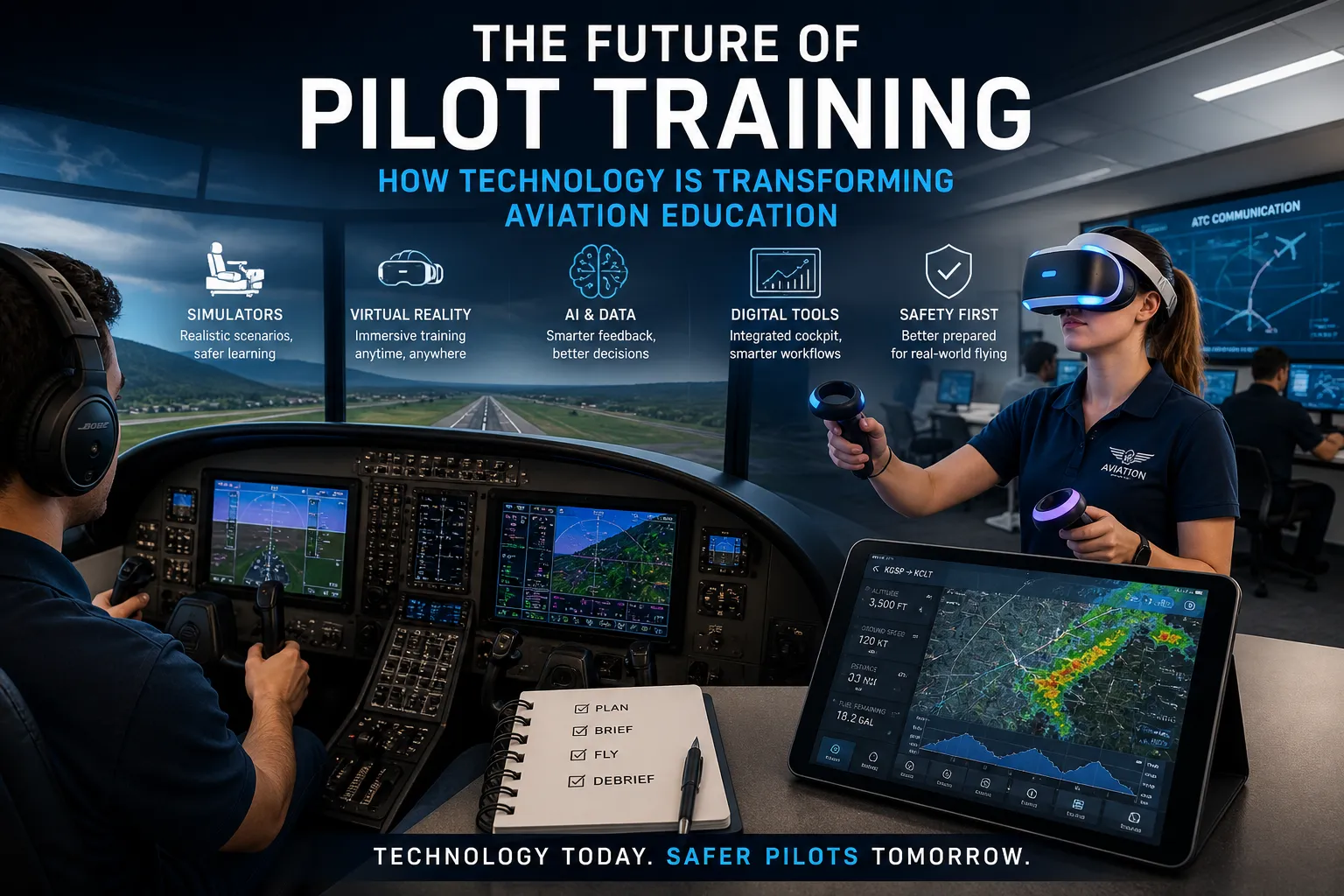
Pilot training is entering one of the most significant periods of change in modern aviation. From advanced flight simulators and virtual reality training devices to data-driven instruction, online ground school, electronic flight bags, and scenario-based learning, aviation education is becoming more realistic, measurable, and accessible. For student pilots, flight instructors, airline crews, and aviation training organizations, the future of pilot training is not about replacing aircraft time. It is about using technology to make every hour of training more focused, safer, and more effective.
The best aviation technology does not remove the need for stick-and-rudder skill, aeronautical decision-making, aircraft systems knowledge, or disciplined cockpit habits. Instead, it gives pilots better ways to practice, review, fail safely, and improve before they face the same challenge in actual flight. That shift matters because modern aviation demands more than memorized procedures. Pilots must manage automation, interpret data, communicate clearly, recognize risk early, and adapt when conditions change.
Why Pilot Training Is Changing
Traditional pilot training has always depended on a combination of ground instruction, aircraft flight time, instructor feedback, and personal study. That model remains essential, but it has limitations. Aircraft are expensive to operate. Weather can delay lessons. Some emergencies cannot be safely demonstrated in flight. Students may struggle to repeat a maneuver enough times to build confidence. Instructors may not always have objective data showing exactly where a student’s performance changed during a maneuver, approach, or emergency procedure.
Technology is helping close those gaps. Modern aviation training tools can recreate complex weather, system failures, busy airspace, night operations, high workload arrivals, and abnormal cockpit situations without exposing the pilot or aircraft to unnecessary risk. They also allow instructors to pause, replay, debrief, and measure performance in ways that were not practical in a purely aircraft-based training environment.
This does not mean the airplane becomes less important. Real aircraft training remains where pilots learn aircraft feel, environmental awareness, real-world workload, radio communication, traffic scanning, and judgment. The transformation is that more preparation can happen before the engine starts, which allows flight time to be used more deliberately.
Flight Simulators and Aviation Training Devices
Simulation is one of the most important technologies shaping the future of aviation education. Full flight simulators, flight training devices, and aviation training devices allow pilots to practice procedures, instrument flying, emergencies, cockpit flows, and decision-making in a controlled environment. The FAA distinguishes between different types of devices, and training credit depends on the specific approval, qualification, and curriculum involved. Pilots should never assume that every simulator hour counts the same way for a certificate, rating, or approved course.
For student pilots, aviation training devices can be especially valuable for learning instrument scan, checklist discipline, avionics operation, navigation, radio setup, and cockpit workflow. For instrument students, simulation can make it easier to practice holds, approaches, missed approaches, partial-panel procedures, and weather decision-making without waiting for the right real-world conditions. For airline and turbine aircraft training, high-fidelity simulators allow crews to practice abnormal and emergency scenarios that would be unsafe or impractical in the aircraft.
The key is using simulation as training, not entertainment. A simulator session should have a lesson objective, performance standard, instructor guidance, and a debrief. Poor habits developed in a simulator can transfer to the aircraft if the device is used casually. Good habits can transfer as well when the session is structured carefully.
Virtual Reality and Extended Reality in Flight Training
Virtual reality and extended reality are becoming more serious aviation training tools. These systems can place a pilot in an immersive cockpit environment where visual references, cockpit layout, traffic, terrain, and weather can be presented in ways that support procedural and scenario-based learning. For some types of training, VR may improve repetition, engagement, and access to realistic scenarios.
VR is particularly promising for tasks that depend on cockpit familiarization, flows, callouts, scan patterns, threat recognition, and procedural memory. A pilot can rehearse preflight procedures, emergency actions, aircraft systems interactions, or approach briefings without tying up an aircraft or full-motion simulator. In advanced applications, VR and mixed reality can support helicopter, advanced air mobility, and complex cockpit training where visual environment and spatial awareness are central to performance.
However, VR is not a magic shortcut. It must be matched to the training task. A headset cannot fully reproduce aircraft motion, control feel, physiological stress, turbulence, or the subtle sensory cues pilots experience in flight. Instructors and training organizations should use VR where it improves learning and avoid using it as a substitute for experiences that require real aircraft handling or appropriately qualified simulation.
Data-Driven Training and Objective Feedback
One of the biggest changes in pilot training is the move toward data-driven instruction. Modern avionics, simulator platforms, learning management systems, and digital training records can provide detailed information about how a pilot performed. Instead of relying only on memory after a lesson, instructors may be able to review altitude deviations, airspeed control, bank angle, approach stability, checklist timing, automation use, and flight path management.
This type of feedback can make debriefing more precise. A student who says, “I felt behind the airplane,” can see where workload increased. An instructor who notices unstable approaches can identify whether the issue begins with briefing, configuration timing, descent planning, power management, or scan breakdown. A training manager can identify trends across multiple students or crews and adjust curriculum before weak areas become safety problems.
Data is most useful when it supports instruction rather than replacing instructor judgment. Numbers alone do not explain why a pilot made a decision. A good debrief connects performance data with human factors, workload, risk management, and practical technique.
Scenario-Based Training and Real-World Decision-Making
Technology is also accelerating the shift from isolated maneuver practice to scenario-based training. In scenario-based training, pilots learn skills in realistic operational contexts. Instead of simply practicing a diversion, a student might plan a cross-country flight, encounter lowering ceilings, manage fuel concerns, communicate with air traffic control, evaluate alternates, and make a conservative decision before the situation becomes urgent.
This approach is especially valuable because many aviation accidents do not begin with a lack of basic aircraft control. They often involve judgment, planning, weather interpretation, automation management, distraction, fatigue, or a failure to recognize a deteriorating situation. Technology allows these scenarios to be repeated, varied, and debriefed in detail.
For example, an instrument student can practice an approach in simulated marginal weather, experience an unexpected missed approach, deal with a radio frequency change, and then decide whether to try again or proceed to an alternate. A commercial pilot candidate can practice passenger pressure, performance calculations, and go or no-go decisions. A flight instructor candidate can practice teaching while managing safety margins and student errors.
Online Ground School and Digital Learning
Online ground school has changed how pilots study aerodynamics, regulations, weather, aircraft systems, navigation, and procedures. A well-designed digital course can combine video, diagrams, quizzes, scenario questions, progress tracking, and review tools. This gives students more flexibility and allows instructors to use in-person time for discussion, application, and correction rather than basic content delivery.
Digital learning works best when it is integrated with flight training. Watching a lesson on weather theory is useful, but applying that knowledge to tomorrow’s route, aircraft performance, fuel planning, and alternate selection is where learning becomes operational. Instructors should connect online assignments to actual flights, simulator sessions, and oral questioning.
Students should also be careful not to confuse test preparation with pilot preparation. Passing a knowledge test is important, but safe flying requires understanding, judgment, and the ability to apply information under pressure. Digital tools should support deeper learning, not encourage memorization without context.
Electronic Flight Bags and Training for the Modern Cockpit
Electronic flight bags have become central to modern aviation operations. Pilots now use tablets and installed avionics for charts, weather, performance planning, navigation, checklists, traffic awareness, and document management. Because these tools are common in real cockpits, pilot training must include disciplined EFB use.
The training challenge is that electronic tools can either improve situational awareness or create distraction. A student who spends too much time heads-down manipulating a tablet may miss traffic, altitude deviations, or a radio call. A pilot who does not understand the limitations of displayed weather may make poor weather decisions. A pilot who relies on automation without understanding the underlying navigation can lose awareness when something changes.
Good EFB training includes setup before flight, battery and backup planning, chart management, weather interpretation, route changes, traffic display limitations, and sterile cockpit habits. The goal is not simply to know which buttons to press. The goal is to use digital information while still flying the aircraft, communicating clearly, and thinking ahead.
Artificial Intelligence in Aviation Education
Artificial intelligence is beginning to influence aviation education through adaptive study tools, training analytics, automated feedback, scenario generation, and administrative support. AI can help identify weak knowledge areas, create customized quizzes, summarize training records, or suggest review topics based on student performance. In larger training organizations, AI-supported analytics may help detect trends across classes, fleets, or instructor groups.
AI may also support simulator training by generating dynamic scenarios or helping instructors vary weather, traffic, system failures, and operational pressures. Used carefully, this can make training less predictable and more realistic.
But AI must be treated as a support tool, not an aviation authority. Pilots should verify regulatory, procedural, aircraft-specific, and safety-critical information against approved manuals, regulations, instructor guidance, and official training materials. In aviation, confident-sounding information is not enough. Accuracy, traceability, and operational context matter.
Practical Examples of Technology in Pilot Training
A private pilot student learning crosswind landings might first study wind correction theory online, then practice sight picture and control inputs in a training device, then fly with an instructor in real crosswind conditions. The simulator helps introduce the concept, but the aircraft teaches feel, timing, and real runway environment cues.
An instrument student might use a desktop aviation training device to practice briefing approaches, loading procedures into the avionics, intercepting courses, and flying missed approach instructions. When the student gets into the aircraft, less time is wasted figuring out buttonology, and more time can be spent on scan, workload, radio communication, and decision-making.
An airline crew might use a full flight simulator to practice rejected takeoffs, engine failures, unreliable airspeed, windshear escape, or complex automation mode confusion. These scenarios allow crews to practice communication, leadership, monitoring, checklist discipline, and threat management in events that cannot be safely trained in the aircraft.
Common Mistakes and Safety Risks
One common mistake is assuming that more technology automatically means better training. A poorly planned simulator session, a distracting tablet setup, or an online course completed passively may add little value. Technology needs clear objectives, instructor oversight, and practical application.
Another mistake is over-reliance on automation. Modern avionics can reduce workload, but they can also hide weak fundamentals. Pilots still need to understand pitch, power, trim, navigation, weather, airspace, and aircraft performance. Automation management is a skill, but it is not a replacement for airmanship.
A third risk is negative transfer. This occurs when a pilot learns a habit in one environment that does not work well in another. For example, a simulator with unrealistic control feel may lead to poor landing technique if not corrected. A training device with simplified systems may create misunderstandings about aircraft-specific procedures. Instructors must identify where the training tool is accurate and where it has limitations.
Finally, pilots must avoid treating digital information as perfect. Weather products may be delayed, traffic displays may not show every aircraft, databases must be current, and equipment can fail. Good training teaches pilots to use technology while maintaining independent judgment and backup plans.
What This Means for Flight Instructors
Flight instructors are becoming learning managers as much as cockpit teachers. They must know how to blend aircraft training, simulation, online study, scenario-based lessons, and data-driven debriefing into a coherent program. The instructor’s role is not reduced by technology. In many ways, it becomes more important.
A skilled instructor can decide when a student needs simulator repetition, when the student needs aircraft experience, when a ground lesson is more appropriate, and when a scenario should be simplified or made more challenging. Instructors also help students interpret feedback without becoming discouraged or overly focused on metrics.
The best aviation educators will use technology to ask better questions: Why did workload rise here? What cue did the pilot miss? Was the approach unstable because of aircraft control, planning, automation use, or late decision-making? What should be practiced before the next flight?
What Student Pilots Should Look for in Modern Training
Students evaluating a flight school should look beyond shiny equipment. A modern training program should explain how each tool supports the curriculum. Simulators, EFBs, online courses, and digital records should be connected to lesson objectives and instructor feedback.
Students should ask how simulator time is used, whether instructors provide structured debriefs, how progress is tracked, and how technology supports real flying skills. They should also ask what training credit, if any, applies to a specific device or course. The answer depends on the device approval, school curriculum, and applicable regulations.
A strong program will still emphasize fundamentals: aircraft control, visual scanning, weather judgment, checklist discipline, communication, energy management, and conservative decision-making. Technology should make those fundamentals stronger, not push them into the background.
The Future: More Personalized, Realistic, and Competency-Based Training
The future of pilot training will likely be more personalized and competency-based. Rather than treating every student or crew exactly the same, training programs can use performance information to focus on specific needs. A pilot who struggles with automation management may receive targeted scenarios. A student who needs better crosswind technique may receive more focused practice. A crew that performs well technically but needs stronger communication may train that competency directly.
This trend aligns with a broader movement in aviation toward training that measures real operational competence, not just completion of events. Pilots need to demonstrate knowledge, skill, risk management, communication, workload management, and sound judgment. Technology can help reveal those competencies more clearly, but the final goal remains the same: safer, more capable pilots.
FAQ: Technology and the Future of Pilot Training
Will simulators replace real aircraft training?
No. Simulators and aviation training devices can improve preparation, repetition, and emergency training, but real aircraft experience remains essential. Pilots still need to learn aircraft feel, traffic scanning, radio work, environmental awareness, and real-world decision-making in flight.
Can simulator time count toward pilot certificates or ratings?
Sometimes, but it depends on the device, approval, curriculum, and applicable FAA rules. Pilots should confirm the specific training credit with their instructor, flight school, and the device’s authorization before assuming simulator time will count.
Is virtual reality useful for pilot training?
Virtual reality can be useful for cockpit familiarization, procedures, scan development, scenario practice, and certain immersive training tasks. Its value depends on how accurately the system supports the lesson objective and how well it is integrated with instructor-led training.
How does technology improve aviation safety?
Technology can improve safety by allowing pilots to practice abnormal situations, review performance, repeat difficult tasks, and develop decision-making skills in a controlled environment. It also supports better debriefing and more targeted instruction.
What is the biggest risk of technology in flight training?
The biggest risk is over-reliance. Pilots must not allow automation, tablets, simulators, or AI tools to replace basic flying skills, judgment, aircraft knowledge, or regulatory understanding. Technology should support airmanship, not substitute for it.
Conclusion
The future of pilot training is not a choice between tradition and technology. It is a smarter combination of both. Aircraft training remains the foundation of pilot development, but simulation, virtual reality, data analytics, online learning, electronic flight bags, and AI-supported tools are changing how pilots prepare, practice, and improve.
For pilots and instructors, the opportunity is significant. Technology can make training more efficient, realistic, and measurable. It can expose pilots to rare but critical scenarios, strengthen decision-making, and improve debriefing. Used poorly, it can distract from fundamentals. Used well, it can build safer, more confident, and more capable aviators.
SEO Meta Description: Explore how pilot training technology, simulators, VR, AI, EFBs, and data-driven instruction are transforming aviation education.