
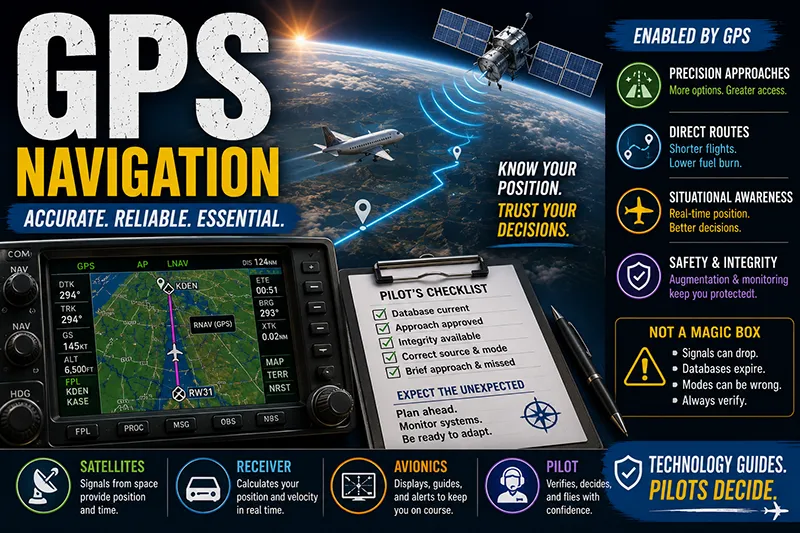
GPS navigation transformed how pilots plan, navigate, and execute flights. From basic position fixes to precision instrument approaches, GPS navigation provides reliable global position data that has reshaped cockpit procedures, training priorities, and route structure for general aviation and commercial operators alike.
This article explains what GPS navigation does, why it matters to pilots and instructors, how to understand the technology in practical terms, common misunderstandings, and concrete best practices you can apply in training and line operations. Whether you fly single-engine trainers, turboprops, or jets, understanding GPS navigation improves situational awareness, safety, and decision-making.
What GPS Navigation Actually Is
Global Positioning System navigation uses signals from a constellation of satellites to determine a receiver's three-dimensional position and time. A GPS receiver calculates latitude, longitude, and often altitude by measuring the time it takes for signals to arrive from several satellites and solving for the receiver's location.
In aviation, GPS navigation is typically integrated with avionics that present position on moving maps, provide lateral guidance (course tracking), and, when supported by augmentations, provide vertical guidance as well. Augmentation systems improve accuracy, availability, and integrity. Examples include satellite-based augmentation and ground-based systems that provide corrections and integrity monitoring to support instrument flight operations.
Why This Matters in Real-World Aviation
GPS navigation changed everyday flying in several practical ways. It expanded the number of precise instrument approaches available at airports without expensive ground infrastructure. It enabled area navigation routes that reduce flight distance and fuel burn by allowing aircraft to fly direct tracks instead of flying from ground navaid to ground navaid. It also made cockpit position awareness much more intuitive, reducing reliance on dead reckoning and pilotage alone.
For flight training, GPS navigation has shifted the emphasis of some lessons. Students still learn fundamental skills such as pilotage, radio navigation, and attitude flying, but they now also must learn database management, how to interpret moving-map displays, and how to verify navigation integrity and system modes. Instructors should ensure students can cross-check GPS-derived information against other sources and understand the limitations of the system in degraded environments.
How Pilots Should Understand GPS Navigation
Think of GPS navigation as a highly capable position and guidance source, not as an infallible automation layer. A modern GPS-equipped avionics stack can provide:
- Position and ground track on a moving map.
- Lateral navigation guidance to fly direct routes, RNAV procedures, or GPS-based approaches.
- Vertical guidance on certain approach types when supported by augmentation and certified avionics.
Key operational concepts pilots should understand include signal availability, integrity monitoring, and database currency. Signal availability depends on satellite geometry and receiver capability. Integrity monitoring is how a system can warn a pilot if positional information is unreliable. Database currency refers to the navigation database that contains waypoints, procedures, and airway data; outdated databases can lead to incorrect guidance or unexpected routing cues.
In practice, pilots should routinely verify the navigation source selected on their flight displays, understand what guidance mode the system is in, and be familiar with how to revert to other navigation methods if GPS is unavailable or unreliable.
Common Mistakes or Misunderstandings
Pilots and operators sometimes develop overreliance on GPS navigation without fully understanding its failure modes. Common mistakes include:
- Assuming the moving map always shows the correct aircraft position without cross-checking raw GPS position or other instruments.
- Neglecting database updates and flying procedures using outdated waypoint coordinates or procedure fixes.
- Failing to confirm the active navigation source and guidance mode prior to and during instrument procedures.
- Not accounting for degraded GPS availability in remote or obstructed environments, which may affect approach capability or enroute navigation choices.
Training gaps also arise when pilots are unfamiliar with integrity monitoring tools available in their avionics, such as loss-of-integrity alerts or predicted outages. Understanding how to interpret advisories and when to revert to alternate navigation is essential for safety.
Practical Example
Imagine a single-pilot IFR flight to a medium-size airport that has multiple RNAV approaches. Before departure, the pilot verifies that the GPS database is current, confirms the aircraft's avionics support the intended approach type, and checks predicted integrity availability for the planned arrival time. During descent, the pilot arms the LNAV guidance and observes the lateral deviation on the display. As the aircraft descends, the approach provides vertical guidance when authorized augmentations are available and when the pilot's equipment supports it. The pilot cross-checks the indicated position against the published step-down fixes, monitors the missed approach path, and is prepared to fly the missed approach using raw GPS guidance or conventional nav aids if required.
This scenario highlights how preflight checks, mode awareness, and readiness to revert to alternate navigation methods keep GPS-based operations safe and predictable.
Best Practices for Pilots
Approach GPS navigation with an emphasis on verification and contingency planning. Useful habits include:
- Keep navigation databases current on the schedule recommended by your avionics or database provider.
- Confirm the active navigation source and guidance mode during critical phases of flight, such as descent and final approach.
- Use available integrity tools and predictions to assess whether a given procedure is appropriate for the planned time and route.
- Maintain proficiency in raw navigation skills: pilotage, dead reckoning, VOR, and ADF use remain useful backups.
- Practice missed approach and lost-signal procedures during training so you can transition smoothly if GPS guidance degrades.
Frequently Asked Questions
How accurate is GPS navigation for everyday flight?
GPS receivers in aviation provide position accuracy sufficient for a wide range of enroute and terminal operations. Augmentation systems and certified avionics further improve accuracy and integrity for precision approaches. The exact performance depends on the installed equipment and any augmentation being used.
What does it mean when an approach is RNAV or RNP?
RNAV denotes area navigation procedures that allow aircraft to fly a desired track without flying directly over ground-based navaids. RNP is a type of RNAV that includes onboard performance monitoring and sometimes tighter navigation accuracy requirements. Specific operational approvals and equipment standards apply to RNP procedures.
Can I fly an RNAV approach with any GPS receiver?
Not all GPS receivers are approved for all types of instrument procedures. Some approaches require certified avionics and specific augmentations for vertical guidance. Pilots should verify their equipment approvals and consult applicable operational guidance before flying an instrument procedure based on GPS navigation.
What should I do if my GPS position disagrees with other instruments?
If GPS position appears inconsistent with other navigation sources, treat the GPS as suspect, cross-check with alternative navigation aids, and consider declaring a missed approach or diverting if you are in IMC and no reliable guidance is available. Promptly follow lost-signal or loss-of-integrity procedures appropriate for your operation.
Key Takeaways
- Practical takeaway: Use GPS navigation as a precise guidance tool but verify mode and database currency before relying on it for instrument procedures.
- Safety takeaway: Maintain cross-checks and contingency plans for GPS outages or integrity warnings; know how to revert to other navigation methods.
- Training and operational takeaway: Train regularly on GPS-based procedure planning, mode awareness, and lost-signal recovery so you can act decisively when guidance degrades.