
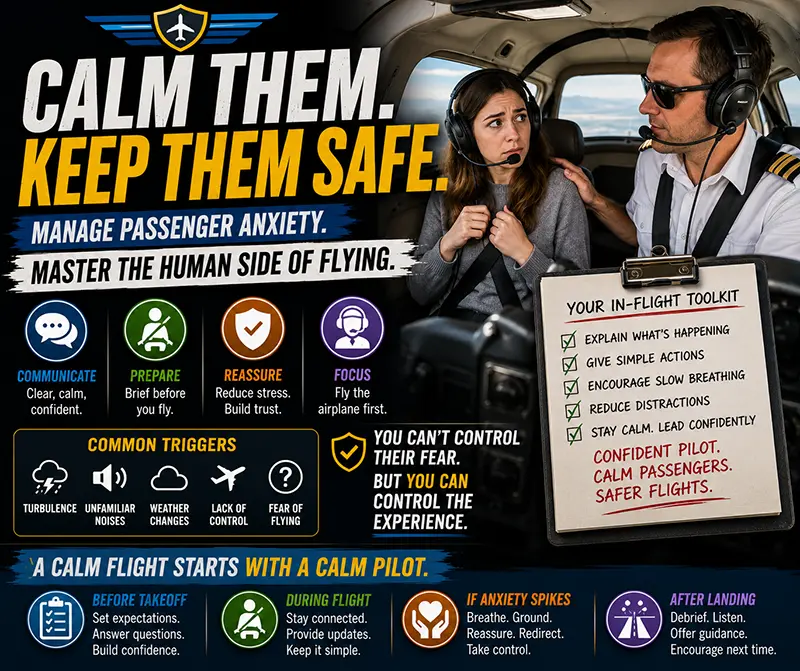
Passenger anxiety is a common, real-world challenge pilots face whenever people fly. For pilots, student pilots, and flight instructors, understanding how to recognize and manage nervous or distressed passengers is as important as handling aircraft systems. The primary keyword passenger anxiety appears naturally in this introduction because calming and managing anxious passengers affects safety, decision-making, and the overall passenger experience.
This article translates human factors into practical cockpit actions. It explains why passenger anxiety matters in training, commercial operations, and private flights. You will get clear operational guidance for preflight briefings, in-flight communication, non-technical skills, and postflight follow-up. The goal is to equip you with techniques you can use immediately and to help instructors teach these skills during lessons and safety rides.
Understanding the Core Idea
Passenger anxiety is a psychological and physiological response to perceived threat. In aviation, that perceived threat can be turbulence, unfamiliar cockpit noise, weather deviations, or simply being inside an aircraft. As a pilot, your role is not to act as a clinician, but to manage the operational environment, communicate effectively, and apply human factors techniques to reduce stress and maintain safety.
Handling passenger anxiety requires several interlocking skills: situational awareness, calm communication, procedural competence, and an ability to read people. These skills keep the flight on-track because anxious passengers can distract pilots, interfere with cockpit procedures, or escalate into medical issues that require diversion. Managing anxiety proactively reduces those downstream risks.
Why This Matters in Real-World Aviation
Passenger anxiety has operational consequences. A highly anxious passenger who interferes with the flightdeck, requires a diversion for medical attention, or distracts the pilot during critical phases of flight creates safety risks. In training, student pilots who learn to manage passenger anxiety become better communicators and crew managers. In commercial and charter operations, customer experience and operational continuity depend on predictable, calm interactions with nervous flyers.
For flight instructors and operators, handling anxiety well preserves trust and reduces the likelihood that a nervous flyer will refuse future flights or file a complaint. For pilots flying single-pilot aircraft, the stakes are practical: an upset passenger in a small cockpit can disrupt checklist flow and distract the pilot at times when focus is essential, such as takeoff, climb, approach, and landing.
How Pilots Should Understand Passenger Anxiety
Think of passenger anxiety as a human factors challenge that sits alongside aeronautical decision making and risk management. It is rarely solved by a single action. The pilot has tools in three domains: the environment, behavior, and communication. Environment changes include seat placement, securing loose items, and adjusting lighting or ventilation. Behavioral actions include slowing operations to a controlled pace and delegating nonflight tasks. Communication covers preflight briefings, in-flight updates, and reassurance techniques.
Operational priorities follow the typical aviation safety hierarchy. First, maintain aircraft control and safe separation. Second, manage the environment to reduce stimuli that aggravate anxiety. Third, communicate clearly with the passenger. Finally, if the passenger’s condition threatens flight safety, consider diversion or requesting medical assistance after landing. All of these decisions must be balanced with flight duties and regulations applicable to the operation type.
Recognizing Signs of Anxiety
Early recognition allows earlier, less disruptive interventions. Signs may be subtle. Look for changes in breathing, pallor, sweating, repetitive questioning, inability to sit still, or hyperfocus on normal aircraft sounds. Passengers may ask repeatedly if the flight is safe or request frequent reassurance.
Observe body language and tone. Some passengers become quiet and withdrawn while others become talkative or insistent. Both can be signs of stress. If a passenger mentions a specific medical condition, allergy, or medication that affects anxiety, note it and ask concise follow-up questions to assess whether additional help might be needed.
Practical Example: Turbulence Scenario
Imagine you are on a 90-minute cross-country flight in a light twin. Midway through, you encounter unexpected moderate turbulence. One passenger becomes visibly anxious, gripping the armrests and breathing fast. You are single-pilot in command and must maintain control while managing the passenger.
First, maintain aircraft control and fly the aircraft. Adjust power, pitch, and heading as appropriate to reduce turbulence exposure where feasible. Second, make a concise announcement: calmly state what is happening, what you are doing, and what you need the passenger to do. For example: "We are experiencing some turbulence. I am adjusting altitude to smooth the ride. Please fasten your seatbelt and put your feet flat on the floor. I will call you when it is smoother." This gives the passenger clear instructions and a sense of predictability.
If the passenger is hyperventilating, coach slow, diaphragmatic breaths quietly. Encourage inhaling through the nose and exhaling slowly. Offer a sip of water if available. Avoid long explanations or entering into a debate about safety. Keep instructions short and procedural so the passenger has a simple follow-the-leader task that helps reduce anxiety.
If the passenger’s condition worsens—fainting, chest pain, loss of responsiveness—follow standard emergency procedures and consider diversion. If you remain uncertain about a medical condition or the passenger requests medical assistance, plan for a precautionary landing at the nearest suitable airport. Maintain command authority and brief any assisting crewmember or passenger to follow simple instructions if you need to divert.
Communication Techniques That Work
Communication is the single most effective tool for reducing anxiety. Effective pilot communication is concise, factual, and reassuring without giving false promises. The three-part approach is: explain, tell, and reassure.
Explain: Briefly describe what is happening in plain language. Avoid technical jargon when talking to a nervous passenger.
Tell: Give specific, actionable instructions. For example, ask them to fasten the seatbelt, put away electronics, or breathe with you.
Reassure: Offer a realistic expectation. For example, say how long the turbulence is likely to last if you have that information, or say you are changing altitude to find a smoother ride. Avoid statements that overpromise like "It will be fine" without context.
Use a calm tone, steady pace, and measured volume. Your voice is a physiological cue. A steady pilot voice reduces the passenger’s adrenergic response. Avoid sarcasm or dismissive comments because those erode trust.
Preflight Briefings and Preparation
Proactive briefings reduce the chance of panic. Before boarding or before engine start, provide a short, clear briefing tailored to the passenger’s experience. Include information about the flight duration, expected weather, basic safety actions, and what sounds or sensations they may notice.
For first-time flyers, emphasize points that reduce perceived uncertainty. Describe the purpose of noises such as flap movement or gear extension, explain that small vibrations are often normal, and demonstrate how to use the seatbelt. Keep the briefing conversational and invite questions. People often feel less anxious when they understand the process and know whom to ask.
In training flights with student pilots carrying a passenger, the instructor should coach the student on the briefing and sometimes step in to model effective communication. Teaching these interpersonal skills is as important as teaching flight maneuvers because they directly affect safety margins during single-pilot operations.
Cockpit Tasks During Passenger Stress
When a passenger becomes anxious during flight, prioritize aviation tasks. Maintain control and stabilize the situation. If workload allows, reduce nonessential tasks and postpone noncritical communications. Use sterile cockpit principles during critical phases of flight to avoid adding burden while addressing the passenger.
If you have a brief pause in workload, perform a calm, structured assessment. Ask two to three closed questions to rapidly evaluate the passenger’s state. If possible, have another adult passenger assist with simple tasks such as fetching water or holding a hand to steady them. Delegate nonflight tasks to free your attention for flying duties.
Non-Technical Skills and Crew Resource Management
Handling passenger anxiety is a human factors and CRM skill. Single-pilot crews must still apply the same principles: task management, situational awareness, workload management, and communication. Identify roles for passengers who can help without interfering with controls. Use brief teaching moments: direct a calm passenger to secure loose items, locate a medical kit, or note the time of symptom onset for later reporting.
In multi-crew or charter operations, brief cabin crewmembers on potential passenger anxiety risks before flight and coordinate responses in the event of an escalation. Maintain consistent messaging across the flightcrew to avoid contradicting statements that can increase passenger distress.
Practical Techniques for Immediate Anxiety Reduction
Here are practical, pilot-friendly techniques that work in-cockpit and in small-cabin operations. Use them in combination rather than relying on a single method.
- Controlled breathing: Guide the passenger to a slow breathing pattern. Count for them if needed. Small tasks that require attention to the body reduce cognitive focus on fear.
- Grounding instructions: Ask the passenger to name five things they can see in the cabin, four things they can touch, three things they can hear. This cognitive grounding reduces panic.
- Water and warmth: Provide a sip of water and, if possible, adjust cabin temperature for comfort. Dehydration and cold can worsen symptoms.
- Seat and posture adjustments: Encourage a forward-facing, upright posture with feet on the floor. A secure posture helps reduce vestibular discomfort.
- Minimize stimuli: Dim bright lights, reduce cabin noise when possible, and secure loose items that may add to anxiety.
When Medical Symptoms Appear
Pilot training does not replace medical diagnosis. If a passenger reports chest pain, difficulty breathing beyond anxiety, loss of consciousness, or other serious symptoms, follow emergency procedures. Communicate with ATC if you require priority handling or an expedited landing. Whenever possible, request ground emergency medical services to meet the aircraft on arrival.
Document the event in your aircraft logbook and any required operational reports. If the passenger’s condition required diversion or on-board medication, note times, actions taken, and who assisted. Operators should review events afterward to identify training needs, SOP revisions, or passenger support improvements.
Common Mistakes or Misunderstandings
Pilots can unintentionally worsen passenger anxiety. Understanding common pitfalls helps avoid them.
Over-reassurance without explanation is one such mistake. Saying simply "everything is fine" can sound dismissive if the passenger perceives danger. Instead, pair reassurance with an action or explanation.
Another error is using technical jargon. Tuning into the passenger’s frame of reference and avoiding acronyms reduces confusion. Also avoid making the passenger feel they are bothering you. Small comments like "I need you to be quiet" are counterproductive. Use neutral, task-focused language instead.
Third, do not create false expectations about outcomes you cannot control. Avoid promising smooth air or that a bump will stop immediately. Give realistic expectations and what you will do to manage the situation.
Training and Practice for Instructors
Flight instructors should incorporate passenger management scenarios into dual flights. Role-play common situations, such as first-time flyers, panic attacks, or medical complaints. Use debriefs to highlight what went well and what could be improved. Focus on communication phrasing, brevity, and task prioritization during high-workload periods.
Simulated turbulence, perhaps with realism in a motion platform for larger programs, can prepare pilots for the sensory and communication challenges. For smaller flight schools, instructors can practice short, scripted interruptions during routine flights to practice calm redirection and cockpit task management.
Operational Policies and Business Considerations
Operators and independent pilots should maintain clear SOPs for passenger briefings, cabin safety, and incident reporting. Policies that support preflight disclosure of passenger medical conditions, when voluntarily provided, help pilots plan. However, respect privacy and avoid pressuring passengers to disclose sensitive medical information.
For commercial operations, standard phraseology for cabin announcements and briefings reduces variability and helps maintain credibility. Ensure that customer service training dovetails with safety training so that passenger comfort measures do not conflict with operational priorities.
Legal, Ethical, and Practical Limits
Pilots are responsible for safe operation of the aircraft. They are not expected to provide medical diagnosis or ongoing therapy. When a situation exceeds what can be managed with briefing, breathing techniques, and situational adjustments, plan for diversion and medical assistance on the ground. Document actions taken and report the event through appropriate channels in your organization.
Avoid prescribing medications or offering medical advice beyond first-aid basics. If medication is available on board and the passenger requests it, ask whether they normally take it and whether a physician prescribed it. If in doubt, prioritize a precautionary landing and professional medical assessment.
Postflight Follow-Up
After landing, debrief the passenger briefly and offer clear next steps. If the passenger requires medical evaluation, coordinate with ground responders. For non-medical anxiety, suggest resources such as informational briefings, introductory flights with instructors, or referral to a healthcare provider if symptoms persist.
For training organizations, use postflight encounters as teaching material. Conduct after-action reviews that include both flight handling and communication. Identify whether additional training or adjustments to preflight briefings could reduce similar occurrences in the future.
Practical Example: Student Pilot with Nervous Passenger
A flight instructor takes a student pilot and a passenger on a local instructional flight. Midway through, the passenger expresses fear during a simulated stall recovery demonstration. The instructor must coach the student, manage the passenger, and maintain safety.
The instructor uses the opportunity to model clear, calm communication. First, the instructor speaks to the passenger: "We are practicing a controlled maneuver. I am with you and the student is under instruction. The maneuver is safe because we are at a planned altitude and configuration." Next, the instructor addresses the student and adjusts the demonstration to a less aggressive profile, showing how to adapt training to the presence of passengers. Finally, the instructor debriefs with both student and passenger to explain the training objective and answer questions. This approach teaches the student how to maintain instructional integrity while respecting passenger comfort.
Best Practices for Pilots
Strong habits reduce the likelihood and impact of passenger anxiety. The following practices are practical and easy to implement.
- Provide a concise, passenger-centered preflight briefing tailored to experience level.
- Use plain language and repeat key points when necessary.
- Maintain a calm voice and steady pacing during in-flight communications.
- Prioritize flight duties and delegate simple nonflight tasks to others when possible.
- Train regularly in human factors, CRM, and simple first-aid responses.
- Document incidents and apply lessons learned to SOPs and briefings.
Frequently Asked Questions
Can pilots give medical advice to an anxious passenger?
Pilots can provide basic first-aid assistance and calm reassurance but should avoid detailed medical advice or diagnosing conditions. If a passenger’s symptoms could indicate a serious medical issue, plan for a precautionary landing and request professional medical assistance on the ground.
What should I say if a passenger asks if the flight is safe during turbulence?
Be honest and concise. Explain that turbulence is common, that you are adjusting altitude to find smoother air if possible, and that their seatbelt should remain fastened. Offer a brief estimate of how long you expect the turbulence to last if you can reasonably estimate that. Avoid minimization or false guarantees.
Are there techniques for dealing with passengers who panic in small cockpits?
Yes. Use short, calm instructions and delegate simple tasks to other passengers. Provide grounding techniques, encourage controlled breathing, and reduce sensory stimuli. If the situation exceeds what you can manage safely, divert to a suitable airport for medical evaluation.
How should flight instructors teach passenger management?
Instructors should include role-play scenarios, structured preflight briefings, and supervised flights with progressively challenging passenger situations. Debrief communication choices and workload management after each flight. Emphasize the importance of brevity and clarity in high-workload moments.
Should I adjust my maneuvering for nervous passengers?
When a maneuver is not essential, consider adjusting flight profiles to improve comfort. For training flights with passengers, brief and scale demonstrations appropriately. Always balance instructional objectives with passenger safety and comfort.
Key Takeaways
- Practical takeaway: Use clear preflight briefings and concise in-flight instructions to reduce uncertainty and build passenger trust.
- Safety takeaway: Maintain aircraft control and workload management first; manage passenger anxiety through environment, behavior, and communication while preserving flight safety.
- Training and decision-making takeaway: Instructors and pilots should practice passenger management as a human factors skill and document incidents to improve SOPs and training.