
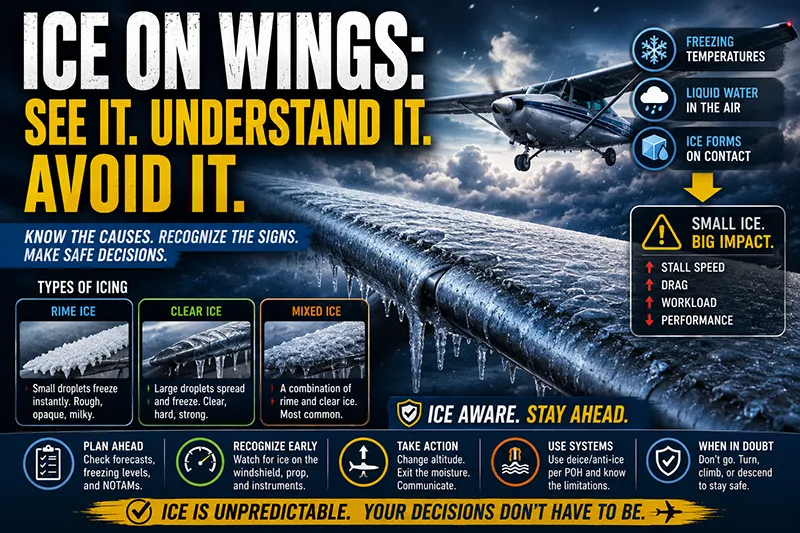
Ice on aircraft wings is a flight hazard that can develop quickly and change aircraft handling, performance, and systems behavior. Understanding how and why ice forms helps pilots make safer decisions in flight, recognize developing conditions early, and use aircraft systems and procedures effectively to manage or avoid icing.
This article explains the physical causes of ice formation on wings, the types of icing a pilot is likely to encounter, and the operational implications for flight training and real-world flying. It includes practical examples, common mistakes, and clear guidance pilots and instructors can use to assess risk and respond appropriately.
How Ice Forms on Aircraft Wings
Ice formation on wings begins when two core ingredients come together: liquid water in visible form and airframe surfaces cold enough for that water to freeze on contact. In flight, the liquid water may be present as cloud droplets, freezing drizzle, rain, or sea spray. When those droplets strike an aircraft surface whose temperature is at or below freezing, they can freeze and adhere to the structure.
Not all water droplets behave the same. Small droplets tend to freeze quickly on contact and build a rough, opaque deposit known as rime ice. Large droplets may spread across the surface before freezing, producing a clear, hard accumulation called clear ice. Many operational icing encounters are a mix of these behaviors, resulting in mixed ice. The character of the ice—its texture, adhesion, and shape—depends on droplet size, liquid water content, air temperature, and airspeed.
Physical Mechanisms: Supercooled Liquid Water and Impact Freezing
Liquid water that exists at temperatures below the normal freezing point is called supercooled liquid water. Supercooled droplets remain liquid until disturbed—they will freeze rapidly when they contact a solid surface. Aircraft wings, landing gear, windshields, pitot tubes, and propeller blades present ideal surfaces for impact freezing because they provide nucleation sites where ice crystals can grow.
When droplets impact, several outcomes are possible. Tiny droplets often form rime ice because they freeze almost immediately on contact, trapping air and creating a rough surface. Larger droplets may spread out, continuing to flow over the surface for some time before freezing, which leads to clear ice. Mixed icing results when a spectrum of droplet sizes is present or when conditions change during an encounter.
Why This Matters in Real-World Aviation
Ice on wings changes the aerodynamic shape the wing relies on to produce lift. Leading-edge roughness, ice horns, and changes in contour can reduce maximum lift, increase drag, raise stall speed, and alter stall behavior. These effects increase workload and can exceed an aircraft’s performance margins, especially in light airplanes and at low altitudes where options are limited.
Beyond aerodynamics, ice accumulation can affect systems. Pitot-static instruments, angle-of-attack sensors, propellers, and engine inlets can be degraded by icing. On transport-category aircraft, icing certification and approved anti-ice or deice systems mitigate many risks, but system limitations and operational procedures must be respected. For small aircraft, the absence of certified anti-ice capabilities often means avoidance is the primary strategy.
How Pilots Should Understand This Topic
Pilots should translate the physical description of icing into practical decision-making. That means recognizing when visible moisture is present, noting outside air temperature and reported cloud layers, and anticipating where supercooled liquid water might exist—within cloud tops and bottoms, in precipitation, or in freezing drizzle. Observing early signs of icing such as visual accumulation on the windscreen, a change in engine instruments, propeller roughness, or changes to control feel should prompt immediate assessment.
Use the aircraft flight manual or pilot operating handbook to understand approved use of deice and anti-ice systems, and incorporate published limitations into planning. Where equipment or certification is absent, treating icing conditions as a no-go is often the safest course. When airborne and encountering ice, priorities are maintaining aircraft control, exiting the icing environment, and communicating intent to ATC if applicable.
Types of Icing and Typical Conditions
There are practical distinctions pilots should know.
- Rime ice: Forms from small droplets that freeze instantly. It creates a rough, milky surface and typically accumulates on leading edges and wing upper surfaces. It is easier to remove mechanically but can still degrade performance.
- Clear ice: Forms from larger droplets that spread and freeze slowly. It adheres strongly, can runback and refreeze in protected areas, and may form horns or irregular shapes that change airflow significantly.
- Mixed ice: A combination of the above, most common in varied cloud or precipitation conditions.
Understanding where these are likely—stratus and stratiform clouds are often associated with widespread small droplets, while convective or frontal areas can contain larger droplets and freezing rain—helps with tactical avoidance.
Common Mistakes or Misunderstandings
Pilots often misunderstand when and where icing can occur. Several recurrent issues appear in training and operational reports:
- Assuming icing happens only in visible clouds. Freezing drizzle or freezing rain can occur outside of dense cloud layers and produce rapid accumulations.
- Relying solely on outside air temperature readings taken in sunlight or after prolonged flight; sensor locations and heating can mask surface temperatures critical for ice formation.
- Believing anti-ice or deice systems make flight through icing benign. Systems reduce risk when used correctly but have limitations based on droplet size, intensity, or aircraft design.
- Waiting for significant accumulation before taking action. Small amounts of ice that cause roughness can have disproportionate aerodynamic effects.
Practical Example
Imagine a single-engine IFR cross-country at cruise when ATC vectors you through an overcast layer to avoid congestion. The ceiling is reported as broken at 4,000 feet and the forecast mentions freezing precipitation at altitude. Soon after entering the cloud deck you notice a film of clear ice forming on the windscreen and the airframe feels slightly rough in roll inputs. Propeller rpm dips slightly during climb power settings.
Practical response in that scenario includes reducing angle-of-attack, increasing airspeed within structural and POH limits to obtain better control margin, declaring the icing encounter to ATC if required, and initiating an immediate plan to exit the moisture—either by changing altitude to a level where temperatures are above freezing or by turning to VMC where you can descend. Activating approved anti-ice systems per the POH and following established emergency or abnormal procedures is appropriate. If the aircraft lacks certified protection, exiting the icing conditions is the primary action.
Best Practices for Pilots
Preventing an icing incident begins in preflight planning and continues through tactical decision-making in flight.
- Plan with weather briefing products that highlight icing potential, freezing levels, and precipitation types. Factor in receiver and onboard weather tools, and brief how you will avoid or exit icing.
- Know your aircraft’s POH/AFM guidance for anti-ice and deice systems. Use those systems proactively when entering known or forecast icing, not retroactively after heavy accumulation.
- Practice recognition and escape maneuvers in training under an instructor’s supervision. Simulate scenarios where the safest action is to descend or climb out of icing instead of attempting prolonged flight through an icing layer.
- Maintain asterisks in decision-making: when in doubt, divert, turn, or descend to leave visible moisture at freezing temperatures. Avoid the mindset of pushing on because destination pressure and time appear marginal.
Frequently Asked Questions
How quickly can ice build up on wings?
Icing rate varies from slow to rapid depending on the intensity of precipitation, liquid water content, and droplet size. Even a thin layer can change wing airflow and handling, so early detection and prompt response are important.
Can ice form outside of clouds?
Yes. Freezing drizzle, freezing rain, and supercooled large droplets can be present in precipitation shafts or virga and do not require you to be inside a dense cloud to accumulate ice.
Does turning on deice boots prevent all ice problems?
Deice boots are effective at removing accumulated ice in many conditions but are not a universal solution. Some ice can form beyond the protected area or in severe icing conditions where boot cycling may be insufficient. Follow your aircraft’s procedures for boot use and combine with avoidance tactics.
Will ice always be visible from the cockpit?
Not always immediately. You may first detect icing by changes in handling, instrument anomalies, or visual clues on the windshield, propeller, or observed changes in performance. Vigilant scanning and awareness of subtle cues are key.
Is flying faster a good way to reduce ice accumulation?
Increasing speed can sometimes reduce buildup by changing impact conditions and shedding smaller droplets, but higher speed also increases dynamic pressure and may worsen structural loads. Always remain within airspeed limits and consider POH guidance.
Key Takeaways
- Practical takeaway: Ice needs visible moisture and surfaces cold enough to freeze; anticipate and avoid those conditions when your aircraft lacks certified protection.
- Safety takeaway: Early detection and exiting the icing environment are often the safest responses—do not rely solely on deice systems to make prolonged flight through icing safe.
- Training and decision-making takeaway: Practice recognition and escape procedures with an instructor, and make conservative go/no-go decisions based on aircraft capability and weather forecasts.