
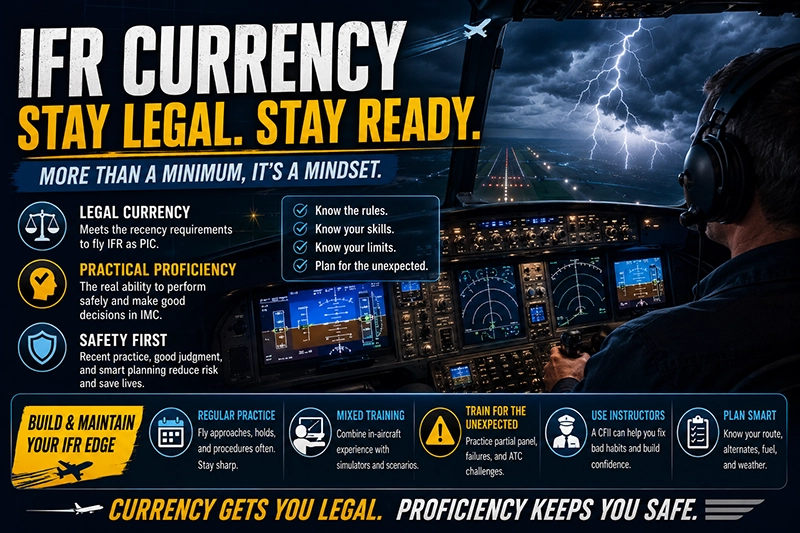
Instrument flight rules (IFR) currency requirements are central to safe, legal instrument flying. Whether you are a newly certificated instrument pilot, an experienced IFR aviator returning to the hood, or an instructor preparing a student for frequent IFR operations, understanding the difference between legal currency and practical proficiency matters every time you brief, plan, or start an engine.
This article explains the concept of IFR currency in operational and training terms, clarifies common misunderstandings, and offers practical steps to maintain or regain instrument readiness. It is written for pilots, instructors, and aviation professionals who want to make sound decisions about instrument flying while staying aligned with regulatory expectations and safety best practices. Consult the appropriate regulations and a qualified instructor for definitive legal requirements and classroom or checkride actions.
What IFR Currency Means and Why It Matters
IFR currency generally refers to the recent experience required for a pilot to act as pilot in command (PIC) under instrument flight rules. Currency is distinct from proficiency. Currency is a legal threshold related to specified tasks and recency: it establishes whether a pilot may legally file and fly under IFR. Proficiency is the pilot's actual ability to perform those tasks safely and consistently. A pilot can be legally current but not proficient, which creates risk when weather, workload, or system failures increase complexity.
Understanding the operational implications helps pilots evaluate risk beyond the minimum legal standard. Currency requirements are intended to reduce pilot error by ensuring recent practice of instrument tasks, but they do not guarantee safe handling under pressure. Effective IFR readiness combines regulatory currency with scheduled recurrent training and personal standards that reflect the pilot's typical mission and environment.
Core Concepts Behind IFR Currency
Three core ideas help pilots view currency practically:
- Recency of skills: Instrument flying uses different visual scanning, aircraft control, and approach procedures than VFR. Regular practice keeps those skills fresh.
- Task-specific experience: Currency is often defined in terms of specific tasks such as approaches, holds, and intercepting/descent procedures. Practicing those tasks in realistic conditions builds competence.
- Regulatory versus practical readiness: Meeting a legal minimum may allow IFR flight, but pilot judgment should always weigh personal proficiency, weather, equipment status, and operational complexity.
Why This Matters in Real-World Aviation
IFR flights carry inherent complexity: instrument approaches, ATC communications, airspace transitions, and the need to manage systems when external visual references are absent. Decision-making under IFR includes route selection, alternates, fuel planning, and contingency planning for weather or equipment failures. Currency has direct effects on these operational tasks because recent, relevant practice reduces cognitive workload and improves automation management and threat-and-error recognition.
For flight instructors and operators, currency considerations affect flight scheduling, training syllabi, and risk management policies. A pilot who operates routinely in busy terminal areas may require a different ongoing training plan than one who flies occasional cross-country IFR trips in simple airspace. The operator’s standardization and training programs should reflect mission complexity and provide recurrent training beyond the legal minimum.
How Pilots Should Understand IFR Currency Practically
Start by separating legal currency from readiness. Legal currency defines whether you may act as PIC under IFR. Readiness defines whether you should. Use a three-step approach before any instrument flight:
- Verify legal standing: Confirm you meet recency items required to fly IFR as PIC. If you are unsure where to find the precise legal text, consult the relevant regulations and discuss with a certificated flight instructor or designated examiner.
- Assess personal proficiency: Ask whether you have recently flown the type of approaches, holds, and instrument procedures you will use. Consider complexity: night, IMC, high-traffic approach plates, or unfamiliar airports increase proficiency demands.
- Plan for risk mitigation: If you feel marginal, schedule a refresher flight with a qualified instrument instructor, plan alternate routing, choose a diversion airport with easier approaches, or delay the flight.
Instrument training devices can be valuable. Simulators and FAA-approved training devices provide focused practice for navigation, partial-panel scenarios, and certain approaches. However, some aspects of actual IMC flight, such as true instrument scan and workload management in real ATC environments, are best practiced in the aircraft with an instructor or safety pilot when conditions permit.
Common Mistakes or Misunderstandings
Pilots and instructors commonly conflate currency and proficiency. A handful of operational pitfalls recur across crews and operations:
- Assuming currency equals proficiency: Meeting a legal minimum does not mean a pilot can safely complete a complex instrument flight in marginal weather.
- Relying solely on simulators: Training devices are excellent for procedures and systems training but may not fully replicate ATC environment, cockpit pressure, or true weather conditions.
- Neglecting partial-panel or failure scenarios: Currency practice focused only on standard approaches can leave a pilot unprepared for unexpected partial panel or avionics failures.
- Delaying refresher training: Many pilots delay remedial training until an operational pressure makes them attempt a marginal flight rather than scheduling periodic practice while decisions are low-pressure.
- Ignoring automation management: Currency practice often emphasizes flying tasks while neglecting the skills needed to monitor and manage automation including GPS, flight director, and autopilot modes.
Practical Example
Imagine a general aviation pilot who usually flies VFR but accepts a cross-country IFR trip to a business meeting. The pilot completed instrument training in the past and meets the legal recency items for basic approaches, but has not flown in IMC for several months. Forecasts show scattered MVFR ceilings and the planned destination includes a complex RNAV approach with vertical guidance and a circling procedure as the alternate.
How should the pilot proceed?
- First, evaluate personal proficiency. Despite legal currency, the pilot may be rusty on vertical guidance and missed-approach procedures. The pilot decides to schedule a 90-minute refresher with a CFII to rehearse the RNAV approach, missed approach, and an emergency partial-panel scenario.
- Second, adjust the flight plan. The pilot chooses an alternate with a simpler approach and files extra fuel to allow for a diversion. The routing is planned to avoid the busiest terminal area at the destination’s peak traffic hours.
- Third, prepare the cockpit and automation. The pilot loads procedures, briefs the approach and missed approach, and rechecks avionics and backup systems. During the flight the pilot uses autopilot coupled approaches when available and practices hand-flying in IMC only when workload allows.
In this scenario, the pilot used training resources, conservative planning, and preflight judgment to manage risk beyond the bare minimum of legality.
Best Practices for Pilots
Maintaining IFR readiness is an ongoing process. The following practices are broadly useful for most instrument-rated pilots:
- Keep a predictable practice schedule. Regular, short instrument flights are often more effective than infrequent, long requalification flights.
- Mix training methods. Combine in-aircraft practice, training device sessions, and scenario-based instruction to cover both task proficiency and decision-making.
- Practice non-routine scenarios. Include partial-panel, alternator or vacuum failures, and communications failure scenarios in recurrent training.
- Use a qualified instructor proactively. A short recurrent session with a CFII can highlight bad habits and rebuild confidence quickly.
- Plan conservatively. When marginal, select simpler approaches and alternates, add fuel reserves, and brief missed-approach and diversion plans before departure.
- Log relevant experience clearly. Maintain detailed entries of approaches, simulated instrument time, and instructional flights so you can assess recency and identify gaps.
- Monitor and manage automation. Know autopilot and GPS modes, and practice both coupled and hand-flown approaches regularly.
Regaining Instrument Readiness
If a pilot discovers they lack recent experience or feel unprepared, several pathways return them to safe instrument flying. A common approach is to schedule targeted instruction with a CFII focusing on approaches, holds, and missed approaches. A flight review with an instructor or a structured instrument proficiency check with an authorized examiner are other options depending on the pilot’s needs and local regulatory pathways. Simulated instrument time in a qualified training device can supplement in-aircraft practice, particularly for procedures and instrument scan technique.
When planning remedial training, focus on areas that present the greatest operational risk: approach and missed approach execution, partial-panel skills, ATC communications in busy airspace, and single-pilot workload management. Practical scenario-based training—where the instructor adds realistic disruptions such as weather changes, system malfunctions, or complex ATC instructions—helps consolidate both skill and judgment.
Common Operational and Safety Risks
Several safety risks link directly to poor IFR currency or overconfidence:
- Task overload: In IMC, pilots unfamiliar with the approach plate or automation can become overloaded, increasing the chance of procedural errors.
- Misinterpretation of automation: Confusion about autopilot or flight director modes can lead to unexpected flight path deviations, particularly during transitions or missed approaches.
- Poor contingency planning: Lack of practice can delay decisions about diversion, alternate selection, or executing a missed approach.
- Complacency: Relying on legal currency alone can produce complacency about necessary preparations for IMC flights.
Frequently Asked Questions
What is the difference between IFR currency and instrument proficiency?
Currency refers to meeting the recency standards that allow a pilot to legally act as PIC under IFR. Proficiency refers to the pilot’s ability to perform instrument flights competently and safely. Proficiency often requires more frequent practice than the legal minimum and includes judgment, workload management, and emergency handling beyond procedural tasks.
Can a simulator or training device count toward instrument experience?
Training devices are useful for procedure practice, system failures, and scenario rehearsal. They can supplement in-aircraft experience for proficiency. Whether simulator time meets legal recency requirements depends on the type of device and local regulations; consult a qualified instructor or regulatory guidance to determine eligibility for specific legal uses.
What should I do if I feel rusty before an IFR flight?
If you feel rusty, schedule a refresher with a qualified instrument instructor, choose simpler approaches, file an alternate with easier procedures, add fuel margins, or delay the flight. Prioritize safety and honest self-assessment over schedule pressures.
How often should I practice IFR flying to stay proficient?
There is no one-size-fits-all schedule. Regular, short practice flights combined with periodic scenario-based training are effective. Adjust frequency to your mission: pilots flying regular IFR cross-country routes will need different maintenance patterns than those who fly infrequently. Err on the side of more frequent practice if you fly single-pilot in complex airspace or at night.
Is an instrument proficiency check necessary to fly IFR again?
An instrument proficiency check or other formal evaluation may be an appropriate pathway to regain confidence and documented competence, especially after an extended hiatus. Whether a formal check is required depends on individual currency status and applicable regulatory processes. Consult an instructor or examiner to determine the appropriate training plan.
Key Takeaways
- Practical takeaway: Separate legal currency from actual proficiency; schedule proactive recurrent training when necessary.
- Safety takeaway: Use conservative planning, including alternates and fuel margins, when recent instrument practice is limited.
- Training/regulatory takeaway: Consult a certificated instrument instructor or examiner to confirm legal recency and to design a targeted refresher or proficiency check.
Maintaining instrument competence is an ongoing commitment that blends legal standing, practical skill, and sound judgment. Use training devices, recurrent instruction, and honest self-assessment to ensure you are both legal and safe the next time you operate in instrument meteorological conditions.