
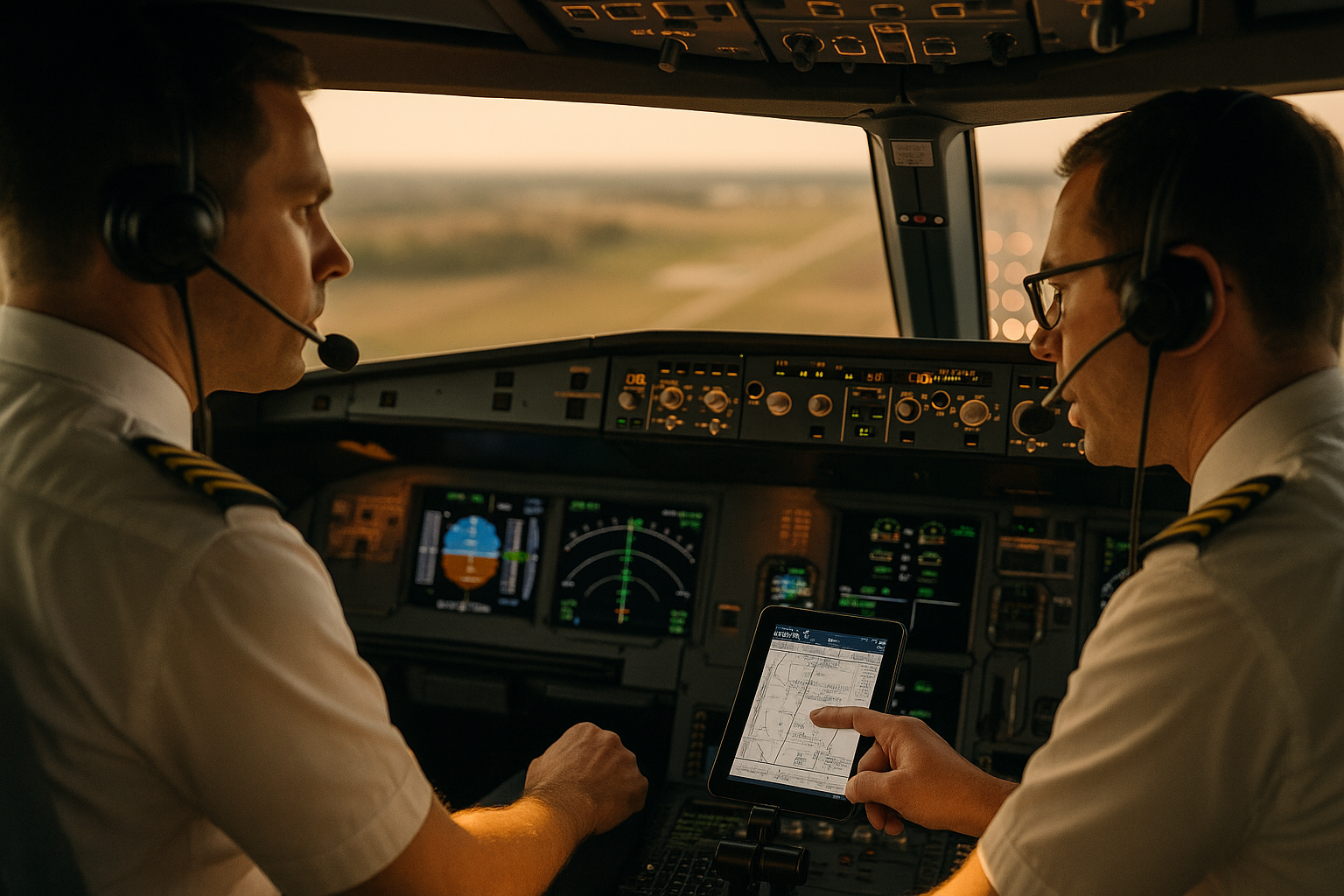
Multi-crew coordination is the set of interpersonal, procedural, and cognitive skills that allow airline flight crews to operate an aircraft safely and efficiently together. For pilots, student pilots transitioning to multi-crew aircraft, flight instructors preparing students for line operations, and aviation professionals responsible for safety, understanding multi-crew coordination is essential. This article uses the term multi-crew coordination to describe how crews share tasks, communicate, maintain shared awareness, and make decisions together.
Good multi-crew coordination reduces error, shortens reaction time in abnormal situations, and helps crews manage workload and automation. It sits at the intersection of human performance, aircraft systems, and operator procedures. Read on to learn practical techniques, real-world examples, common pitfalls, and training-focused takeaways that apply to airline operations and advanced flight training.
What Multi-Crew Coordination Actually Means
At its core, multi-crew coordination is about aligning actions and mental models across the flight deck. That alignment covers who flies the aircraft, who manages systems and checklists, how the crew exchanges information during high workload periods, and how decisions are made and implemented. The most common role split in airline operations is Pilot Flying, who manipulates the controls, and Pilot Monitoring, who manages checklists, monitors systems, and communicates with ATC. Those roles are a foundation, but effective coordination extends well beyond role labels.
Coordination includes these functional elements: communication, task distribution, monitoring and cross-checking, decision making, automation management, and crew briefings. Communication must be precise and closed-loop when appropriate. Task distribution must be clear so that both pilots know who is responsible for critical items at every phase of flight. Monitoring and cross-checking are active processes where the monitoring pilot verifies the flying pilot's actions and calls out deviations. Decision making should incorporate the operating environment, company procedures, and input from both crewmembers. Automation management requires shared expectations about modes, engagement, and how to intervene if automation behaves unexpectedly.
Why Multi-Crew Coordination Matters in Real-World Aviation
Airline operations are complex. Crews must manage departures, arrivals, ATC constraints, changing weather, operational disruptions, and occasional system failures. Without coordinated teamwork, even routine tasks can become error-prone. Multi-crew coordination reduces the chance that a single mistake propagates into an incident. It also improves resilience by enabling crews to recover more quickly from surprises.
From a practical safety perspective, coordination affects runway operations, approach and landing stability, response to abnormal or emergency procedures, and adherence to company procedures. For training organizations and instructors, teaching coordination skills is as important as teaching aircraft systems and procedures. For dispatchers, maintenance, and cabin crews, understanding how flight deck coordination works supports better cross-department collaboration and clearer expectations during irregular operations.
How Pilots Should Understand and Apply Multi-Crew Coordination
Pilots should treat multi-crew coordination as an active, practiced set of behaviors rather than an abstract recommendation. Good coordination follows predictable, repeatable patterns so the crew can focus attention on non-routine problems. That predictability comes from standard operating procedures, briefings, and mutual expectations about communication and monitoring.
Start each flight with a concise briefing that covers role responsibilities, departure and arrival specifics, significant weather or NOTAMs, fuel and runway considerations, and any non-normal flows to anticipate. A briefing sets a shared mental model and reduces ambiguity later. During taxi, approach, and other high workload phases, use sterile cockpit discipline. Keep non-essential conversation and distractions out of critical phases so both pilots can focus on flying, monitoring, and communicating with ATC and cabin crew as needed.
Practice closed-loop communication. When one pilot issues an instruction or request, the recipient repeats or confirms the essential part of that instruction and indicates understanding. That simple behavior prevents misinterpretation during noisy or time-pressured moments. For calls like altitude changes, runway clearances, or configuration commands, repeat back the critical numbers or modes. If you are the monitoring pilot and you notice an ambiguous call, clarify immediately.
Manage automation with clear intent. Before engaging or changing flight director or autopilot modes, announce the intended mode and why you are selecting it. If the flying pilot expects the autopilot to capture a path or follow a lateral navigation, make that expectation explicit. Explicit mode management removes guesswork about what the automation will do next. Teach newer pilots to verbalize mode changes and to scan mode displays consistently.
Adopt effective monitoring techniques. Monitoring is not passive. The monitoring pilot should cross-check the attitude, airspeed, flight path, navigation radios, engines, and system pages as appropriate. Use callouts that are short, standardized, and timely. When a deviation begins, the monitoring pilot should state the observed discrepancy, propose corrective action, and, if necessary, assume control following the operator's procedures.
Common Mistakes and Misunderstandings
Several recurrent issues undermine multi-crew coordination in line operations and training. Recognizing these helps crews prevent them and instructors to target training effectively.
First, unclear role boundaries. When both pilots assume the other will handle a task, the task can be omitted. Conversely, when both try to control the same task, confusion and conflicting inputs can occur. Clear assignment and brief confirmation prevent overlap or gaps.
Second, poor briefings. Vague or incomplete briefings leave gaps in the crew's shared mental model. Missing the plan for a missed approach, for example, can create a high-stakes scramble during an unstable approach. Standardized brief formats reduce this risk.
Third, failing to monitor automation. Excess reliance on automation without active mode awareness leads to surprises when the automation behaves differently from expectations. A simple example is expecting the autopilot to capture a glideslope that is out of service. Monitoring mode annunciations and flight path cues prevents late detection.
Fourth, ineffective communication. Long or ambiguous transmissions, failing to confirm readbacks, or allowing non-essential conversation during critical phases can create confusion. Use concise phraseology and confirm intent for safety-critical items.
Fifth, lack of assertiveness. Less experienced pilots may hesitate to challenge a decision or call out an unsafe action by a senior pilot. Training that reinforces assertive communication, with respect and professionalism, helps correct unsafe trends. Assertiveness is not confrontation. It is focused, factual, and linked to the flight safety concern.
Practical Example: Approach with Unexpected Automation Behavior
Consider a scheduled arrival where the crew briefed an autoland as an option for low visibility. During the approach the first officer, acting as Pilot Monitoring, observes an amber mode annunciation indicating a lateral guidance change as the localizer signal degrades. The Pilot Flying is focused on flying the approach and managing the aircraft state. The monitoring pilot calls, "Localizer lost, switching to raw data, maintain runway heading."
In this situation good multi-crew coordination looks like this. The monitoring pilot states the observation and the immediate consequence. The Pilot Flying acknowledges and confirms the control action. The monitoring pilot cross-checks that the autopilot disengagement or mode change occurred as expected and then calls out changes in airspeed or vertical path. If the approach becomes unstable, the monitoring pilot recommends a go-around and, if the flying pilot concurs, clearly instructs the configuration and thrust changes needed. Finally, the crew communicates with ATC and cabin crew about the change in plan.
This example shows how shared awareness, brief, precise communication, and a default mindset to prioritize safety over staying on the approach combine to avoid a potentially hazardous outcome. The key actions are early detection, explicit communication, and agreed follow-up steps.
Training and Evaluation: How Multi-Crew Coordination Is Taught
Training programs should integrate coordination skills with technical and procedural training. Simulators are the ideal environment for practicing coordination because they allow crews to rehearse high workload and abnormal events in a controlled setting. Scenarios that mix automation surprises, ATC changes, and system failures reveal coordination gaps that may not appear during normal operations.
Instructors should focus on observable behaviors rather than character judgments. For example evaluate whether the candidate gives clear briefings, performs timely callouts, monitors flight path and systems, and follows company procedures for role transfer and challenge-response. Use debriefs to replay critical moments and ask the crew members what they expected, what they noticed, and why they acted as they did. Debriefing factual behavior fosters learning and helps crews internalize better practices.
Line training and line checks are important for translating simulator practice to live operations. Mentors should reinforce consistent briefings, sterile cockpit expectations, and standard callouts. Training that includes both technical difficulty and interpersonal challenges yields more durable coordination skills.
Best Practices for Pilots
Adopt these principles consistently. They are not a checklist but a set of practical habits that improve crew performance.
- Standardize briefings. Use concise templates for departure, approach, and contingency briefings so both pilots share a mental model.
- Practice closed-loop communication. Repeat essential numbers and mode changes to confirm understanding.
- Maintain active monitoring. The monitoring pilot must scan systems and flight path actively and call deviations early.
- Clarify automation intent. Announce intended mode selections and expectations when engaging or changing automation.
- Use assertive professionalism. Encourage respectful challenges and confirmations when safety is at stake.
- Keep the sterile cockpit. Limit non-essential conversation during taxi, takeoff, approach, and other critical periods.
- Practice scenario-based training. Regular simulator time with surprise elements builds coordination resilience.
Managing Threats, Errors, and Undesired States
Multi-crew coordination is a key defense within the threat and error management framework. Threats are external factors such as weather, complex ATC instructions, or maintenance delays. Errors are crew actions that lead to deviation from intended outcomes. Undesired aircraft states are situations where the aircraft is not in a planned or safe condition.
Crews should proactively identify threats during briefings and assign tasks to mitigate them. During the flight, timely cross-checks and callouts aim to catch errors early. When an undesired state emerges, crews follow the operator's procedural flows and use clear commands to recover the aircraft to a safe state. Training should include practice identifying and controlling for threats and a clear debrief to capture lessons learned.
Common Misunderstandings About Coordination
There are several misconceptions that undermine crew performance. One is the idea that coordination is only relevant for emergencies. In fact, poor coordination during routine operations often sets the stage for later problems. Small deviations that go unnoticed can compound and reduce the crew's margin of safety.
Another misunderstanding is that more talk equals better coordination. Excessive or poorly focused communication can be distracting. The goal is effective, timely, and relevant communication. A well-timed short callout is typically more useful than a long explanation during high workload.
Some pilots believe that seniority or rank reduces the need for challenge. Effective crews understand that professional challenge is part of safe operations. Cultural or interpersonal barriers that discourage challenge should be addressed in training and through company safety culture initiatives.
Applying Coordination During Irregular Operations
Irregular operations such as maintenance problems, re-dispatch decisions, or diversions test coordination skills across departments. Flight crews should make early and clear calls to dispatch and maintenance when issues arise. Share concise factual information and state what assistance or decisions you need from the other party. Maintain the crew's internal coordination while managing external communications, and re-brief the plan whenever it changes.
When diverting, quickly assign roles for the new arrival sequence, terrain and airport considerations, and passenger or company communications. Anticipate fuel and equipment needs, and coordinate with cabin crew about passenger preparations. A short, structured re-brief reduces confusion and supports a smooth outcome.
FAQ
What is the difference between Crew Resource Management and multi-crew coordination?
Crew Resource Management is a broader training philosophy that covers interpersonal communication, decision making, leadership, and workload management across all crew members. Multi-crew coordination refers more specifically to the practical, in-flight behaviors and role interactions on the flight deck. Both concepts overlap and support each other.
How do standard operating procedures affect coordination?
Standard operating procedures provide a predictable framework for role assignments, callouts, and procedures. They reduce ambiguity and set common expectations for actions during normal and abnormal conditions. Because operators' SOPs vary, pilots must be current and proficient with their own company's procedures.
How should a monitoring pilot intervene when the flying pilot makes a mistake?
Intervene early and factually. State the observed deviation, recommend corrective action, and, if necessary, take control following company procedures. Use clear language, minimal editorializing, and be prepared to support the recovery actions without delay.
Can automation reduce the need for coordination?
Automation reduces some task workload but increases the need for coordination about mode management and expectations. Automation can introduce complex failure modes that require both pilots to share awareness and a plan for intervention. Treat automation as a tool that requires active supervision.
How do cultural or interpersonal factors influence coordination?
Crew culture, personality differences, and leadership style affect whether team members feel comfortable raising concerns. Positive safety culture and explicit training in assertive communication help reduce barriers to effective coordination. Awareness of these human factors is part of professional crew development.
Key Takeaways
- Practical takeaway: Use standardized briefings and concise closed-loop communication to build shared mental models before high workload phases.
- Safety takeaway: Active monitoring and early, factual challenge prevent small deviations from becoming hazardous situations.
- Training takeaway: Integrate coordination skills into scenario-based simulator training and evaluate observable behaviors, not personalities.
Multi-crew coordination is not a single skill. It is a set of interrelated behaviors that crews build and maintain through disciplined practice, clear procedures, and professional communication. For pilots and instructors, focusing on predictable briefings, closed-loop communication, assertive professionalism, and active monitoring will yield the biggest improvements in everyday safety and performance. Operators and training providers that reinforce these behaviors create crews that are better equipped to manage routine complexity and unexpected events alike.