
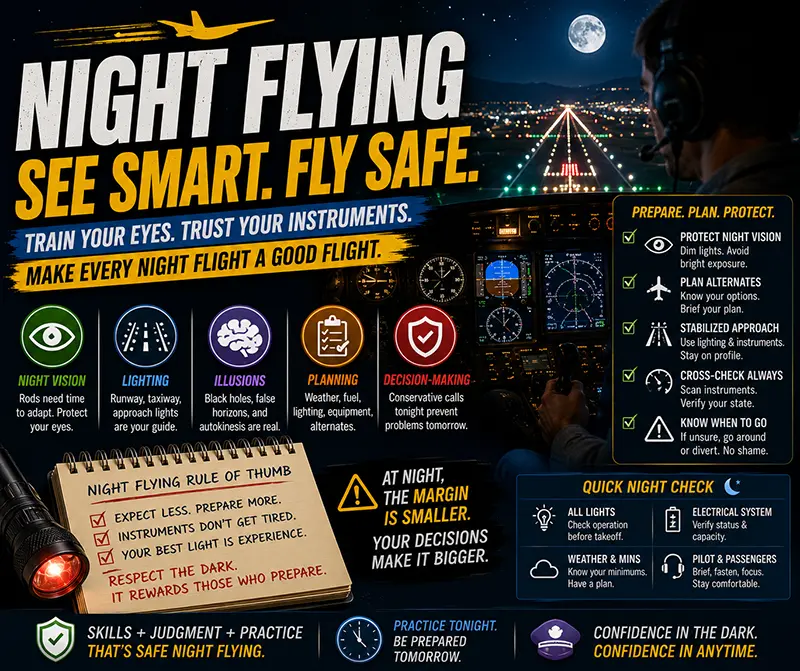
Night flying is a fundamental skill for pilots, and it demands a different mindset than daytime operations. Night Flying introduces unique visual, physiological, and operational challenges that affect navigation, traffic awareness, approach and landing techniques, and decision-making. For student pilots and instructors, mastering these differences improves safety, expands capabilities, and builds confidence for cross-country and local flights after dark.
This article explains practical, aviation-focused night flying advice for student pilots. It covers the human factors of night vision, how to interpret airport lighting and visual cues, common illusions and traps, preflight planning priorities, and in-flight techniques that reduce risk. The goal is to make night operations predictable and manageable without turning the material into a rigid checklist. Wherever regulatory or technical specifics matter, the article explains how to apply them in the cockpit and flags items you should verify with your instructor or official guidance.
Night Flying Fundamentals
Night flying changes how you use your eyes, your instruments, and your planning. Light levels at night are low and uneven. You will often be flying with a mixture of artificial lighting, moonlight, and instrument references. That combination alters depth perception, color recognition, and the ability to detect motion. The practical result is that you rely more on technique and instrument cross-check than on purely visual cues.
Start by recognizing the two complementary domains you operate in at night: external visual references (runways, city lights, horizon cues) and internal cockpit awareness (instruments, annunciators, electrical system status). Understanding how these two interact helps you prioritize tasks—maintain aircraft control and collision avoidance while scanning for the correct visual cues for approach, landing, or pattern work.
Why This Matters in Real-World Aviation
Night operations are common in general aviation for training flights, commuting, business travel, emergency response, and recreational flying. Many accidents that occur at night involve a loss of visual references, misinterpretation of lighting, or an inadequate plan for alternates. For student pilots, the stakes include not only safe handling of the airplane but also achieving the judgment and systems knowledge needed for night cross-country flights.
Learning to fly at night with an instructor under conservative conditions establishes habits that reduce risk later. Those habits include disciplined planning, briefing for contingencies, using available lighting and navigation aids, and recognizing when to go missed or divert. Pilots who practice these behaviors are better prepared for marginal weather, partial panel situations, and unexpected field conditions.
How Pilots Should Understand Night Vision and Human Factors
Night vision depends on two types of photoreceptors in the eye: cones and rods. Cones provide color and high-acuity vision in bright light, while rods are more sensitive to low light and provide peripheral and motion detection but not color. After exposure to bright light, rods take time to regain maximum sensitivity. During this adaptation period, vision is degraded for low-light tasks.
In practical cockpit terms, this means several things. First, avoid sudden bright light inside the cockpit when you need to see outside; use dim or red lighting where appropriate. Second, if you briefly look at a bright source such as a phone screen or a dome light, allow time for your eyes to re-adapt before expecting to detect faint runway or taxiway lights. Third, confirm that medications, alcohol, fatigue, or illness are not affecting night vision before you fly. If you have any doubt, delay the flight or fly with an instructor.
Another common human factor is spatial disorientation. At night, without a clear horizon, the inner ear and vestibular system can provide misleading sensations that suggest the airplane is in a different attitude than it actually is. Relying on the attitude indicator and maintaining disciplined instrument cross-check reduces the risk of inadvertently accepting a perceived attitude that is not supported by instruments.
Dark Adaptation and Practical Rules
Dark adaptation is the process through which the eyes regain sensitivity in low light. Rod sensitivity increases gradually; it is common practice to allow a period of time after exposure to bright light for your eyes to recover. In operations, pilots use strategies such as red cockpit lighting, low-intensity panel settings, and filtered flashlights to protect night vision. If you expose your eyes to bright light, pause your external scan until your vision stabilizes.
Airport Lighting, Visual Cues, and What to Expect
Airport and runway lighting is the primary external reference for night approaches. Familiarize yourself with the lighting you will encounter: runway edge lights, threshold lights, runway end identifier lights, taxiway lights, approach lighting systems, and the visual glide path indicators that might be present. Not all airports have the same lighting systems, and some small fields have minimal or no lighting, which changes the way you execute an approach.
When approaching a lighted airport from a distance, city and ground lighting can mask runway lights, create misleading perspectives, or produce reflections that complicate depth perception. Use navigation aids, GPS position information, and a stabilized approach to ensure you are aligned correctly before relying on visual cues for the final descent.
Identifying Runways and Avoiding Confusion
At night, it is easy to mistake other lights for runway lighting—taxiways, roadways, or commercial lighting can look similar from certain angles. Cross-check runway identifiers using your GPS or published airport diagrams, confirm runway heading with the heading indicator, and identify approach lighting patterns if present. A brief low approach or orbit at a safe altitude to confirm layout can be a safe training exercise with an instructor but should not be attempted close to the runway environment in uncontrolled circumstances without a plan.
Common Night Illusions and How to Counter Them
Several visual illusions occur more frequently at night and are important to recognize:
- Black-hole approaches: When the approach path is over dark terrain with few ground references, the runway may appear closer or higher than it actually is. This can cause an excessively shallow approach and a landing long or dangerously fast. Counter this by using a stabilized approach and instrument references when possible.
- Autokinesis: Fixating on a single bright light in the dark can make it appear to move. Avoid staring; use smooth scanning and cross-reference instruments and other lights.
- False horizons: City lights or sloping terrain can create an artificial horizon line, leading to attitude misperception. Rely on your attitude indicator when the natural horizon is indistinct.
- Relative brightness: Distant runway lights appear smaller and less bright; without context, pilots may change glidepath incorrectly. Maintain a descent profile and use an aim point rather than reacting solely to perceived brightness.
Preflight and Dispatch Considerations for Night Flights
Preflight for a night flight requires attention to both the aircraft and route-specific considerations. Check all exterior lights for proper operation. Verify that inspection and servicing panels are secure; loose objects in the cockpit or baggage may shift and create unexpected distractions if unsecured. Confirm that your checklist covers the lighting checks for position, navigation, landing, and taxi lights, and that spares for portable lights or batteries are available.
Flight planning at night should incorporate alternate airports, fuel reserves, and realistic weather minima. Consider the availability of instrument approaches at the destination and alternates, runway lighting intensity at the alternate, and surface conditions. Night temperatures often differ from daytime temperatures and can affect performance, so use performance charts and allow extra margin if you are operating near aircraft or runway limits.
File a flight plan or activate your VFR/IFR flight plan, and brief passengers on night-specific procedures including lighting, emergency exits, and use of restraints. If you are a student pilot, brief the instructor on any personal concerns about fatigue, vision, or recent medication use.
Instrument Cross-Check and Scanning Techniques
At night, even VFR flights benefit from a disciplined instrument scan. Without a clear horizon, instruments become the definitive source for attitude and performance. Develop a scan that includes attitude, airspeed, altitude, and heading on a regular basis so changes are detected early. Brief any change of scan or unusual readings with your instructor.
Traffic scanning differs slightly from daytime scanning because small, unlit aircraft are harder to see at night. Use a methodical arc scan and avoid quick saccadic movements. Use peripheral vision to detect relative motion and confirm with a focused view. Where available, use traffic advisory systems or ADS-B In displays to supplement visual scanning.
Approach and Landing Techniques Specific to Night
Approaches at night are best flown stabilized—constant descent rate, correct airspeed, and intended power setting. Plan final approach early and avoid last-minute changes. If runway threshold or approach lights give a deceptive vertical cue, rely on your approach profile and instruments for glidepath.
During flare and landing, be aware that depth perception is altered. An aim point and consistent airspeed help prevent floating or hard landings. If you lose visual cues in the flare, initiate a go-around promptly rather than stretching a landing attempt. Practice go-arounds with an instructor in the pattern so the maneuver becomes second nature.
Electrical and Avionics Considerations
Night flying often requires more reliance on electrical systems for lighting, radios, and navigation equipment. Ensure your battery and alternator systems are serviceable, test lights and avionics before departure, and brief a partial-panel scenario with your instructor. Understand how to isolate an electrical failure, switch off nonessential loads, and navigate using remaining equipment or basic pilotage.
Portable devices are common in the cockpit for charts and moving maps. Use a dedicated, dimmable mount and set brightness to a low level. Be mindful of potential distractions from notifications; place devices in airplane mode or use software that supports night-friendly color schemes.
Contingencies: Unlit Fields, Diversions, and Emergencies
Planning for an unlit or minimally lit field is part of good night decision-making. If your intended destination has poor lighting, plan a diversion to a well-lit alternate. When diverting, brief a safe entry to the new airport, obtain ATC or FSS advisories, and set up a stabilized approach before transitioning to visual references.
In the event of an electrical failure at night, maintain aircraft control first and then work system checks. If you must land at a field with limited lighting, consider overflying at a safe altitude to inspect the runway environment from a distance and confirm wind indicators or surface hazards before committing to final.
Common Mistakes or Misunderstandings
Several recurring errors appear in student and transitioning pilot night operations. Understanding these traps helps you avoid them:
- Overreliance on visual cues: At night, visual cues can be misleading. Some pilots fixate on a single light or misjudge distance; cross-check instruments frequently.
- Inadequate preflight lighting checks: Failing to check all exterior lights or forgetting spare batteries for handheld lights can create avoidable problems during taxi and approach.
- Poor planning for alternates: Not identifying or briefing a lit alternate airport can leave you with fewer safe options if the destination is unusable.
- Allowing fatigue or minor medication to impair vision: Stimulants, depressants, and even over-the-counter medications can affect night vision and judgment.
- Late decision to go around or divert: Delaying a go-around when visual cues are lost near the runway increases risk. Practice early and decisive missed approach decisions.
Practical Example: Cross-Country Night Diversion
Imagine a student pilot on a night cross-country with an instructor as PIC. Halfway to the destination, weather begins to lower ceilings and visibility at the planned airport becomes marginal for a VFR arrival. Simultaneously, airport lighting appears dimmer than expected on the approach due to a partial lighting outage reported by ATC.
In this situation, apply conservative decision-making: confirm current fuel status and remaining endurance, request updated weather and lighting information from ATC or Flight Service, and identify the nearest well-lit airport with instrument approach capability as a diversion. Set up the navigation and approach on the GPS, brief the diversion arrival and approach, brief the go-around and missed approach procedures, and reduce workload by configuring the aircraft early. If the instructor is present, delegate specific tasks—pilot flying maintains the aircraft, pilot monitoring communicates and sets radios, and both maintain cross-check for traffic and instruments.
This example highlights key night principles: planning for alternates, effective cockpit communication, using instruments when visual cues are suspect, and executing a diversion without hesitation.
Best Practices for Pilots
Adopt these practical behaviors and habits to improve safety and proficiency at night:
- Practice night takeoffs, approaches, and landings with an instructor until you feel confident. Proficiency is perishable; schedule routine night practice flights.
- Perform thorough preflight lighting checks and carry a reliable, dimmable handheld flashlight with red filter and fresh batteries.
- Use dim, red cockpit lighting to preserve dark adaptation. Set panel brightness to the lowest readable level and avoid white cockpit lights when you need outside visual references.
- Plan alternates that have published lighting, instrument approaches, and services that match your experience level. Brief the alternate arrival early.
- Maintain an instrument scan even on VFR nights; attitude is harder to verify visually when the horizon is indistinct.
- Be conservative with personal minimums. If you are uncomfortable with weather, lighting, or fatigue, postpone or divert the flight.
- Practice go-arounds in the pattern so initiating one at night is instinctive, and brief parameters for when to go missed before each approach.
Frequently Asked Questions
How long does it take to regain full night vision?
Rods in the eye take time to reach peak sensitivity after exposure to bright light. Practical cockpit strategies include avoiding bright white lights before and during critical visual phases, using red lighting inside the cockpit, and allowing time for your eyes to readjust before expecting to see dim lights. If you interrupt your night adaptation with a bright light, pause your external scan until your eyes stabilize.
Can I rely on handheld devices and moving maps at night?
Moving maps and portable devices are valuable situational awareness tools at night but should be used carefully. Keep displays dim, use night-friendly color schemes, and mount devices securely. Do not let device management distract from flying tasks or replace a proper scan for traffic and instruments.
What are the best ways to scan for traffic at night?
Use a methodical arc scan, sweeping slowly and using peripheral vision to detect motion. Avoid fixating on a single point; instead, sweep through the entire sky and cross-check with ADS-B In or traffic systems if equipped. Look for relative motion and changes in light patterns rather than relying on size or color alone.
Is it safe to attempt a landing at an unlit airfield at night?
Landing at an unlit field involves additional risk and should be planned only when you are prepared for the environment. If you must land at an unlit field, overfly at a safe altitude to inspect the runway environment, confirm wind indicators, and ensure no obstacles or hazards exist. A well-lit alternate is generally the preferable option for most student pilots.
Common Training and Operational Takeaways
Night flight training builds skills that translate to safer daytime operations as well. Pilots who practice instrument cross-check, conservative decision-making, and thorough preflight planning at night tend to have better habits overall. In training, emphasize scenario-based practice—diversions, partial-panel work, and go-arounds—so students internalize responses to real-world events.
Key Takeaways
- Practice disciplined instrument cross-check and stabilized approaches; rely on instruments when external references are unreliable.
- Preserve night vision and plan for alternates to reduce the risk of mistaken visual cues and last-minute diversions.
- Prioritize conservative decision-making and recurrent night practice under instructor supervision to build competence and safety margins.
Night flying rewards pilots who prepare and practice deliberately. For student pilots, progressing through well-structured night training under the guidance of an experienced instructor creates the competence and judgment necessary for safe solo or cross-country operations after dark. Use the guidance in this article as a framework for training and operational decisions, and verify any regulatory or procedural specifics with your instructor and official aviation documentation before flight.