
Every takeoff leaves more than a visual impression. It leaves a sound footprint that can carry for miles beyond the runway. For communities near airports, that sound is not occasional. It is constant. Managing that impact without compromising safety is one of the more complex challenges in aviation.
Noise Abatement Departure Profiles, commonly referred to as NADPs, are designed to address that challenge. They provide structured procedures that help reduce aircraft noise in sensitive areas while maintaining safe and predictable aircraft performance. These procedures are not about reducing power or changing flight paths randomly. They are carefully developed techniques that balance environmental concerns with the realities of aircraft performance.
Why Noise Abatement Matters
Airports are often surrounded by growing communities. As air traffic increases, so does the impact of aircraft noise. While modern engines have become quieter, the volume of operations means that noise remains a major concern.
Noise abatement is not simply about reducing sound. It is about managing when and where that sound is concentrated. A slight change in climb profile or thrust setting can shift the noise footprint away from densely populated areas.
- Communities near airports are directly affected by departure noise.
- Regulatory and environmental pressures continue to increase.
- Airports often implement local procedures to minimize impact.
- Pilots play a key role in executing these procedures correctly.
Effective noise abatement depends on consistency. Small deviations in technique can significantly change the outcome on the ground.
Understanding Departure Profiles
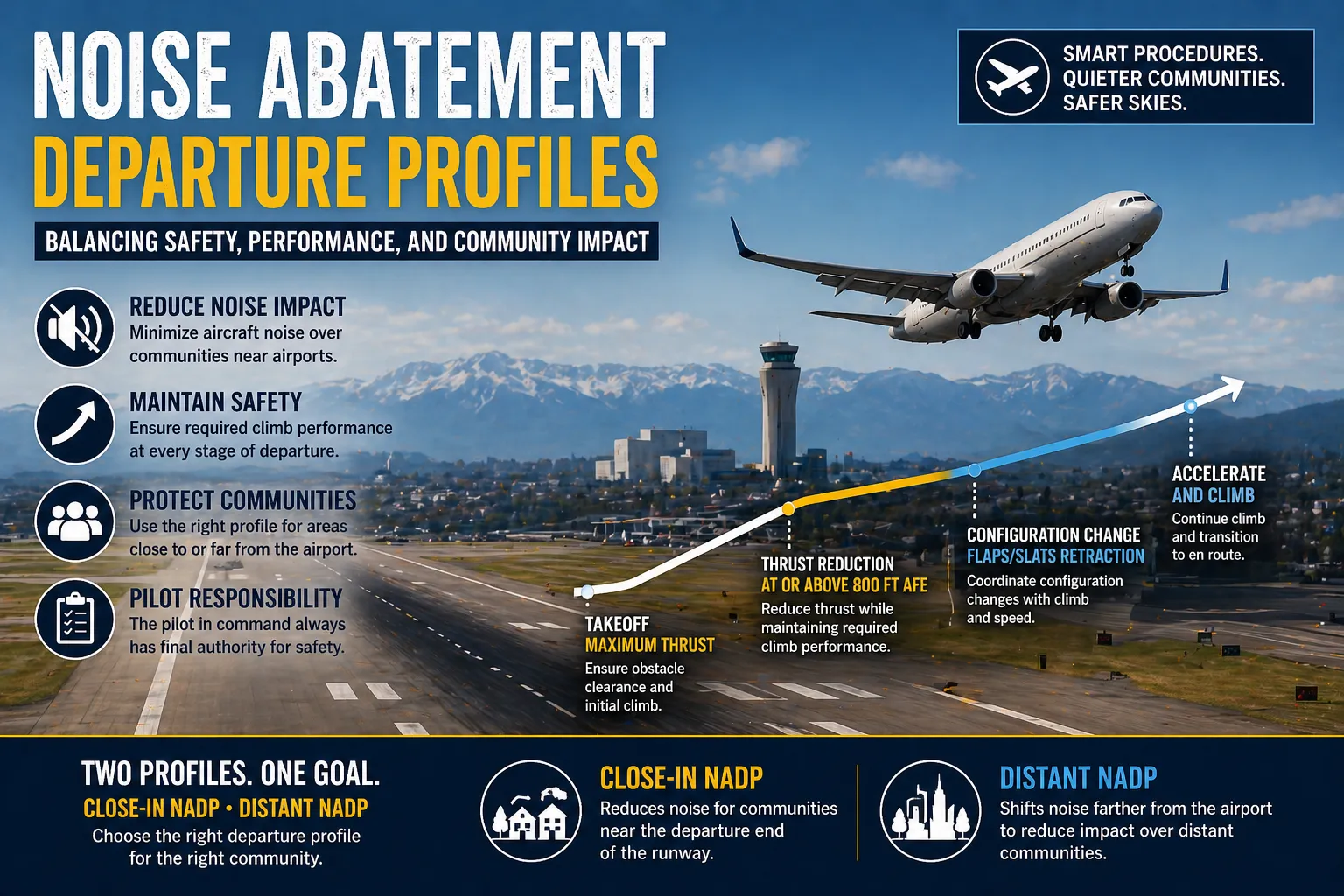
Noise abatement departure profiles are built around how an aircraft climbs after takeoff. The key variables are thrust, speed, and configuration. Adjusting these elements at the right time allows pilots to control how noise is distributed around the airport.
Two primary types of departure profiles are commonly used. Each is designed to protect a different group of communities.
- One profile focuses on reducing noise close to the airport.
- The other shifts the noise footprint farther away from the departure end of the runway.
Both profiles follow a structured sequence. They begin with maximum performance for safety, followed by a controlled transition that reduces noise impact without compromising climb performance.
What Happens After Takeoff
Immediately after takeoff, the aircraft climbs using takeoff thrust. This phase is critical for obstacle clearance and engine-out performance. Once a safe altitude is reached, adjustments begin.
At a defined altitude above the runway, thrust is reduced and the aircraft transitions into a different climb profile. This change reduces engine noise but must be carefully managed to maintain safe speed and climb performance.
- Thrust reduction is typically initiated after reaching a safe altitude.
- Pitch is adjusted to allow the aircraft to accelerate or maintain speed.
- Configuration changes, such as flap retraction, are coordinated with the climb.
- The aircraft continues climbing until transitioning to normal en route procedures.
This sequence is not arbitrary. It is designed to ensure that noise reduction does not interfere with safety-critical performance requirements.
Close-In vs Distant Noise Reduction
The difference between departure profiles comes down to where noise reduction is prioritized.
In some cases, communities are located very close to the airport. In others, the concern is with areas farther away along the departure path. The chosen profile determines how thrust and configuration changes are timed.
- Close-in profiles reduce thrust earlier to protect areas near the runway.
- Distant profiles maintain higher thrust longer, shifting noise farther away.
- Both profiles are designed to maintain required climb performance.
The key is that neither profile is inherently better. Each is selected based on the specific environment around the airport.
Pilot Workload and Simplicity
One of the challenges with noise abatement procedures is complexity. Highly customized profiles may offer marginal noise benefits, but they can also increase pilot workload at a critical phase of flight.
During departure, pilots are managing aircraft performance, monitoring systems, communicating with air traffic control, and maintaining situational awareness. Adding overly complex procedures can reduce focus where it matters most.
For this reason, standardized profiles are encouraged. Limiting the number of variations helps pilots execute procedures consistently and safely.
- Simplified procedures reduce the risk of error.
- Consistency improves both safety and environmental outcomes.
- Overly complex profiles can distract from primary flight duties.
The Role of the Pilot in Command
While noise abatement procedures are important, they do not override the pilot’s responsibility for safety. The pilot in command always has the authority to deviate from these procedures if conditions require it.
Weather, traffic, aircraft performance, and operational considerations all play a role in decision-making. Noise abatement is part of the operation, but it is not the priority over safety.
This balance is central to how these procedures are applied. They are tools, not strict rules.
Why It Matters
Noise abatement departure profiles represent a compromise between two important goals. On one side is the need to operate aircraft safely and efficiently. On the other is the need to minimize the impact of aviation on surrounding communities.
When applied correctly, these procedures can significantly reduce noise exposure without affecting safety. When applied incorrectly, they can introduce unnecessary risk or fail to achieve their intended benefit.
- They help reduce community noise impact around airports.
- They maintain compliance with operational and environmental expectations.
- They require disciplined execution to be effective.
- They reinforce the importance of balancing safety with environmental responsibility.
Noise abatement is not just a procedural requirement. It reflects the broader relationship between aviation and the communities it serves.
Key Takeaways
- Noise abatement departure profiles are designed to reduce aircraft noise without compromising safety.
- Different profiles shift noise impact to protect specific areas around an airport.
- Thrust, speed, and configuration changes must be carefully coordinated during climb.
- Simplicity and consistency are critical for safe execution.
- The pilot in command always retains authority to prioritize safety over procedures.