
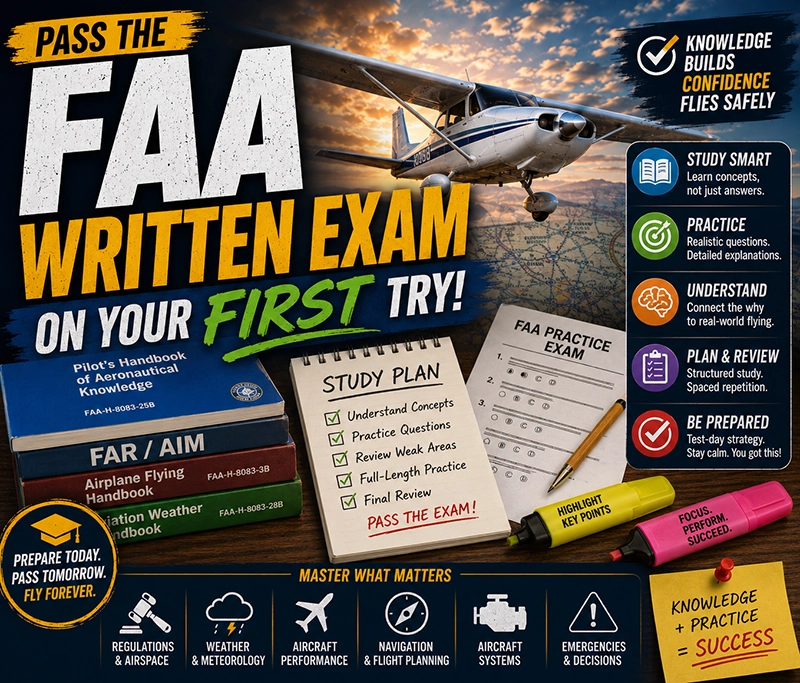
Passing the FAA written exam on your first try is a realistic goal with the right preparation, study habits, and test-day strategy. Whether you are pursuing a private pilot certificate, instrument rating, commercial certificate, or an additional FAA knowledge test, the written exam evaluates your mastery of regulations, aeronautical knowledge, weather, navigation, aircraft systems, and decision-making skills. This article focuses on practical study techniques, how to approach the exam itself, and how to translate ground knowledge into safe, competent flying.
Read on to learn structured study approaches, common pitfalls to avoid, how to apply technical concepts in flight training, and real-world examples that show how knowledge from the written exam improves operational decision-making. The strategies here are aimed at student pilots, flight instructors, and aviation professionals who want to maximize the likelihood of first-time success without sacrificing the deeper learning that supports safety and proficiency.
How the FAA Written Exam Fits into Pilot Certification
The FAA written exam, often called the knowledge test, is a foundational step in most certificate or rating paths. It verifies that you understand the aeronautical knowledge required for a given certificate or rating. In practical terms, the written exam ensures you can read and interpret regulations and technical material, apply aerodynamic and weather concepts, plan flights, and make risk-informed decisions before you demonstrate those skills in the aircraft.
Beyond certification, the process of preparing for the knowledge test strengthens judgment and situational awareness. A well-prepared pilot understands the 'why' behind procedures and limitations instead of memorizing answers. That depth of knowledge prevents common in-flight errors and supports safe operational decisions.
Core Study Principles for First-Time Success
Successful preparation balances depth with targeted practice. Here are core principles that guide an efficient study plan.
1. Learn conceptually, not just by memorizing answers. When confronted with a new topic such as weight-and-balance, airspace classifications, or weather theory, aim to understand the underlying concept. Conceptual understanding lets you handle unfamiliar question wording and adapt knowledge in the cockpit.
2. Use authoritative publications. Primary sources for foundational topics include FAA handbooks and advisory circulars, manufacturer documentation, and the Airman Certification Standards for the certificate or rating you are pursuing. These publications explain regulatory context, aerodynamics, systems, and procedures in technical detail that supports sound judgment.
3. Practice with realistic question banks. Use reputable FAA-style question banks to become familiar with how questions are phrased, typical distractors, and common areas of emphasis. Practice questions should include detailed explanations so you can learn from mistakes rather than only tracking right-or-wrong answers.
4. Build incremental mastery. Break study topics into manageable blocks and cycle back with spaced repetition. Concepts studied once are unlikely to stick; spaced review—returning to topics after increasing intervals—improves retention.
5. Simulate test conditions. Take full-length practice exams under timed, uninterrupted conditions to build stamina and test discipline. Simulations teach time management and help reduce test-day anxiety.
Study Plan Structure: A Practical Roadmap
A structured study plan converts principles into actionable steps. The example plan below is adaptable for any knowledge test and intentionally focuses on learning rather than rote memorization.
Phase 1: Assessment and planning — Start by identifying the test topic areas and your current strengths and gaps. Take an untimed diagnostic practice test to reveal areas that need focused study. Use that diagnostic to build a prioritized study schedule.
Phase 2: Core learning — Work through authoritative material for each major topic area. Read the relevant FAA handbooks, Airman Certification Standards, and any aircraft-specific material you will be tested on. After each subject, complete practice questions that target that topic and review explanations thoroughly.
Phase 3: Reinforcement and integration — After covering all subject areas, shift to mixed-topic practice tests and deeper review of frequent error areas. Use spaced repetition flashcards or summary notes to consolidate key facts, formulas, and procedures.
Phase 4: Performance preparation — In the final weeks, take full-length timed practice exams. Practice with the same materials allowed on test day and learn how to monitor time and read questions carefully. Taper study intensity in the last 48 hours to allow consolidation and rest.
Why This Matters in Real-World Aviation
Knowledge tested on the written exam is not abstract. It shapes in-flight decisions: whether to depart in marginal weather, how to interpret an engine instrument trend, or when to divert. Ground knowledge influences risk assessment, adherence to regulations, and the ability to plan a safe flight. Instructors often see that students who truly understand the theory behind procedures perform better during flight training, especially in cross-country planning, navigation, and emergency handling.
Beyond individual flights, strong aeronautical knowledge benefits safety culture. Pilots who learn to analyze weather information, understand airspace, and calculate performance limits contribute to safer operations and clearer crew communication. The written exam is a checkpoint that ensures a baseline of knowledge before practical evaluation.
How Pilots Should Understand Key Topic Areas
The FAA written exam covers a broad set of topics. Rather than treating each as an isolated item, think about how topics interconnect and influence practical decisions.
Regulations and airspace. Understanding why regulations exist helps you apply them practically. Airspace knowledge is about both identification and risk management. Know how different classes affect communications, minimum altitudes, and equipment requirements, and be prepared to plan around controlled or restricted airspace.
Weather and meteorology. Weather theory underpins practical weather decision-making. Instead of memorizing thresholds, focus on interpreting weather products—METARs, TAFs, and area forecasts—and on how phenomena like fronts, convective activity, and low-level wind shear affect flight. Translate weather understanding into go/no-go decisions and contingency planning.
Aircraft performance and limitations. Learn how weight, balance, density altitude, and configuration affect climb, takeoff, and landing performance. Understand trends rather than precise numbers so you can make conservative judgments when conditions or aircraft loading vary.
Navigation and flight planning. Integrate map skills, pilotage, dead reckoning, and basic instrument navigation. Practice cross-country planning that includes fuel planning, alternates, and diversion options. Treat navigation as an exercise in risk management and situational awareness rather than just following headings.
Systems and emergencies. Knowing how common systems work—fuel, electrical, engine induction—and likely failure modes will make emergency procedures intuitive. Emphasize diagnosis steps and safe priorities: maintain aircraft control, analyze the situation, and execute appropriate checklists or diversions.
Common Mistakes or Misunderstandings
Many candidates miss the mark not because they lack intelligence but due to poor study habits or misconceptions about the test. Knowing these common pitfalls can prevent wasted time and repeated attempts.
Relying only on question memorization. Memorizing answers without understanding leaves you vulnerable to reworded questions or application-style problems. Focus on learning why an answer is correct.
Ignoring underlying publications and standards. Skipping FAA handbooks or the Airman Certification Standards can create gaps in conceptual understanding. These documents explain regulatory intent and technical background important for practical flying.
Poor time management during the exam. Not pacing yourself can lead to rushed mistakes or incomplete sections. Practice full-length tests and develop a pacing strategy that leaves time for review.
Overlooking units and conversions. Aviation questions often require attention to units—knots versus statute miles per hour, feet versus meters, gallons versus liters. Simple unit errors lead to incorrect answers even when the conceptual approach is correct.
Underestimating weather and performance integration. Treating weather and performance as separate topics can cause operational blind spots. For example, failing to account for density altitude effects when planning a high-altitude airport departure can lead to poor takeoff performance calculations.
Practical Example: Planning and Testing for a Cross-Country
Consider a student pilot preparing for the private pilot knowledge test and a planned cross-country training flight. The student begins with a diagnostic practice test and discovers weaknesses in airspace, cross-country planning, and weather interpretation. They create a four-week study plan: week one focuses on regulations and airspace, using FAA handbooks and targeted practice questions; week two covers weather and aerodynamics, with an emphasis on METAR/TAF interpretation; week three integrates navigation and performance planning using real-world flight planning exercises; the final week is reserved for mixed-topic practice exams and review.
On the cross-country, the student applies test study directly: using METARs and TAFs to choose the safest route, adjusting fuel reserves and alternates based on forecast winds, and calculating weight-and-balance to ensure performance margins. During the flight, the student practices diversions and radio communications, demonstrating that the knowledge learned for the written test improves real-world decision-making and aircraft control.
Best Practices for Pilots Preparing for the FAA Written Exam
Below are practical, evidence-driven habits that help consolidate knowledge and increase the likelihood of passing on the first attempt.
- Start early and study consistently. Short daily study sessions beat marathon cramming.
- Use a variety of study materials: FAA handbooks, reputable question banks, instructor-led review, and peer study groups.
- Practice questions with explanations, not just answer keys. Understand the reasoning behind both correct and incorrect options.
- Keep a single, organized set of notes for formulas, airspace rules, and common procedures. Review these regularly with spaced repetition.
- Simulate exam conditions with full-length, timed tests to build pacing and mental endurance.
- Work with an instructor to address conceptual weaknesses. Instructors can help translate written knowledge into practical cockpit techniques.
- Prioritize rest before the exam. Cognitive performance declines with sleep deprivation and stress.
Test Day Strategy and Question-Reading Tips
How you approach questions on test day matters. Read each question carefully, identify the key concept, and eliminate unlikely distractors. Watch for qualifiers such as "most likely," "least," or "except," and for unit-specific wording. If a question involves a calculation, write down the steps and units before computing to avoid conversion errors.
When encountering a question that seems unfamiliar, slow down and translate it to a concept you understand. Often, unfamiliar wording hides a common principle. If stuck, mark the question, move on, and return later with fresh focus. Managing time across the test is as important as accuracy—reserving time for review can catch careless mistakes.
How Instructors Can Support First-Time Success
Flight instructors play a pivotal role. Align ground lessons with knowledge test content, and use the test as an opportunity to reinforce safe operational practices. Encourage students to explain concepts in their own words during preflight briefings and to apply them in flight exercises. Tailor study plans to student learning styles, and focus on weaknesses revealed by practice tests.
Instructors should also emphasize higher-order thinking. For example, rather than simply telling a student the meaning of a weather code, walk through interpreting a METAR and assessing its impact on a planned flight. Practical application cements knowledge and builds the judgment needed for both the knowledge test and safe flying.
Common Misconceptions to Avoid
Several myths circulate among test candidates. Addressing them reduces wasted effort and anxiety.
Myth: Memorizing the question bank guarantees success. Question banks change and practice items are paraphrased. Memorization does not replace conceptual understanding and leaves you exposed to novel question phrasing.
Myth: You only need to know facts, not how to apply them. Many questions test application—how you use facts to choose safe outcomes. Train to apply concepts to scenarios similar to those encountered in flight.
Myth: Stress will ruin performance and there's nothing to do about it. Practice under simulated conditions reduces stress by increasing familiarity. Breathing techniques, adequate sleep, and good pacing during the exam further mitigate anxiety.
Preparing for Regulatory and Content Updates
Aviation regulations, test content, and recommended practices evolve. Stay current by consulting FAA publications, advisory circulars, and official testing program materials. When in doubt about regulatory details or test administration rules, verify with a certificated flight instructor, the testing service, or FAA guidance to ensure your preparation aligns with the latest standards.
Frequently Asked Questions
How long should I study before taking the FAA written exam?
Study time varies by individual, prior knowledge, and the complexity of the certificate or rating. Plan a study schedule that allows concept learning, practice questions, and several full-length practice exams. Starting several weeks before your planned test date and spacing sessions over that time tends to produce better retention than last-minute cramming.
Are online question banks enough to pass the test?
Question banks are a valuable tool for familiarizing yourself with question styles and for targeted practice, but they are most effective when combined with primary FAA publications, instructor guidance, and conceptual study. Use question banks for practice, but rely on authoritative sources to develop foundational understanding.
What is the best way to study weather for the written exam?
Focus on interpreting actual weather products—METARs, TAFs, area forecasts—and on understanding weather processes such as fronts, convection, and stability. Practice translating forecasts into operational decisions: route selection, minimums, and alternates. Work with an instructor or experienced pilot to discuss how weather trends influence real flights.
How should I handle calculation questions during the exam?
Write down known values, check units, and follow clear calculation steps. Use a stepwise approach: identify the formula, substitute values with units, calculate, and verify the result for plausibility. Keep a reference sheet of common formulas and unit conversions during study so they become second nature before test day.
Can flight instructors help me prepare for the written exam?
Yes. Instructors can explain complex topics, correct misunderstandings, guide practice test review, and connect written knowledge to in-flight techniques. They can also help create realistic study plans and coach you through full-length practice exams under test-like conditions.
Key Takeaways
- Practical takeaway: Study conceptually and practice application with realistic question banks and flight-planning scenarios.
- Safety takeaway: Strong aeronautical knowledge improves in-flight decision-making, weather assessment, and performance planning.
- Training/regulatory takeaway: Use FAA handbooks and the Airman Certification Standards to guide study and verify current testing policies with a certificated instructor or official FAA guidance.
Passing the FAA written exam on your first attempt is about structured preparation, conceptual understanding, and realistic practice. Use authoritative resources, work with instructors, and practice under simulated conditions. Above all, treat the written exam as a foundation for safe flying. The knowledge you gain will serve you during training and throughout your flying career.