
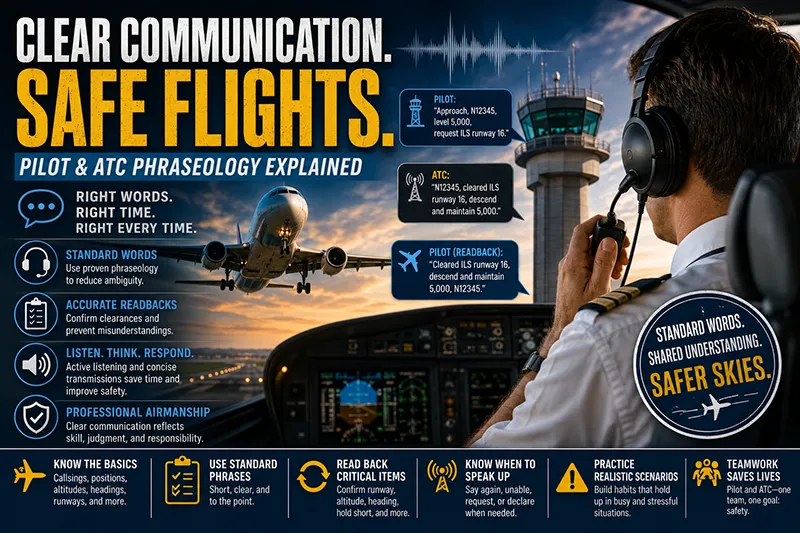
Clear aviation communication is a foundational skill for pilots, student pilots, instructors, and air traffic controllers. Pilot and ATC phraseology provides a standardized set of words and structures that reduces ambiguity, improves efficiency, and supports safety in every phase of flight. Understanding standard phraseology helps you listen critically, speak succinctly, and confirm that instructions are understood and correctly executed.
This article explains the core principles of pilot and ATC phraseology, how that language is used in real-world operations, common misunderstandings that create risk, and practical steps you can take in training and everyday flying to communicate more effectively. Examples in this article reflect widely used FAA phraseology patterns; verify precise wording against the current Pilot/Controller Glossary and the Aeronautical Information Manual during study or before exams.
What Is Standard Phraseology?
Standard phraseology is a concise, predetermined set of words and sentence structures used by pilots and air traffic controllers to exchange operational information. It replaces conversational language with short, constrained phrases so that meaning is clear despite radio noise, accents, or limited bandwidth. Phraseology covers everything from initial calls and position reports to clearances, traffic advisories, surface movement instructions, and emergency communications.
Why This Matters in Real-World Aviation
In a high-workload or time-critical situation, a single ambiguous word can create confusion or delay. On an instrument approach, a misheard altitude or runway assignment can lead to a deviation. On the ground, unclear taxi instructions can contribute to runway incursions. Standard phraseology minimizes these risks by limiting variations in how instructions are issued and how pilots respond. For trainers and examiners, mastery of phraseology demonstrates both operational competence and professional airmanship.
How Pilots Should Understand Phraseology
Pilot and ATC phraseology is best learned in two linked ways: by memorizing the standard phrases and by practicing their practical application in realistic scenarios. Memorization gives you the vocabulary; scenario practice gives you the timing, prioritization, and cadence needed to apply that vocabulary when workload is high.
Key elements pilots should master:
- Callsigns and position identification: Use the correct callsign format and include position or intent when initiating contact. Correct use of the full callsign reduces misidentification.
- Acknowledgement and readback: Repeat critical elements of clearances such as taxi routing, altitudes, headings, and runway assignments. Accurate readbacks confirm mutual understanding.
- Short, precise transmissions: Keep transmissions brief but complete. Use standard terms like cleared, contact, standby, request, and say intentions when needed.
- Proper use of phraseology elements: Words like ‘‘affirmative,’’ ‘‘negative,’’ ‘‘wilco,’’ and ‘‘say again’’ have distinct meanings; use them carefully to avoid misunderstanding.
Common Phraseology Categories
Understanding the categories helps structure your radio calls and responses. Categories include:
- Initial contact and position reports
- Clearances and instructions (movement and airborne)
- Taxi and ground movement
- Approach and departure clearances
- Emergency and abnormal situations
- Traffic advisories and safety alerts
Common Mistakes or Misunderstandings
Even experienced pilots make communication errors. Some frequent problems include:
- Incomplete readbacks: Failing to read back all critical elements of a clearance leaves room for error. Read back the runway number, departure or approach clearance limit, initial altitude, and assigned heading when provided.
- Using conversational language: Phrases like "I think" or "maybe" are ambiguous. Replace them with clear options or requests, for example, "request runway 27" or "unable" plus a brief reason if necessary.
- Incorrect use of standard words: Saying "roger" instead of repeating an altitude or heading can omit essential confirmation. Know when a word like "wilco" (I will comply) is appropriate and when a full readback is required.
- Crossed communications and stepping on transmissions: Transmitting at the same time as ATC or another aircraft can mask a clearance. If you miss an instruction, use "say again" or request the clearance to be repeated; avoid guessing.
- Poor phraseology during abnormal/emergency events: Under stress, pilots sometimes revert to non-standard language. For emergencies, use the standard terms to quickly convey the situation, such as MAYDAY for distress or PAN-PAN for urgency, then provide a concise description.
Practical Example
Scenario: You are departing a controlled airport with tower service. After startup and taxi you contact ground as follows. The example demonstrates probable phraseology and readbacks in a simple VFR departure.
Pilot: "[Airport name] Ground, Cessna 123AB, taxi with information Alpha, request VFR departure to the north."
Ground: "Cessna 123AB, taxi to Runway 27 via taxiway Alpha, hold short of Runway 27."
Pilot (readback): "Taxi to Runway 27 via Alpha, hold short Runway 27, Cessna 123AB."
After lining up and waiting for takeoff clearance, tower issues departure clearance:
Tower: "Cessna 123AB, runway 27, cleared for takeoff, fly heading 360 after departure, maintain VFR and contact Departure on 119.3."
Pilot (readback): "Cleared for takeoff runway 27, fly heading 360 after departure, contact Departure 119.3, Cessna 123AB."
This interaction shows standard elements: identification, concise request, explicit taxi instructions, readbacks of critical elements, and acceptance of clearance. The pattern reduces opportunities for misunderstanding and provides clear evidence of pilot comprehension.
Best Practices for Pilots
Adopt these habits to improve your radio communication:
- Prepare before you transmit: Know your callsign, position, clearance elements, and the frequencies you will use. Brief any nonstandard requests before contacting ATC.
- Listen actively: Monitor the frequency before transmitting so you do not interrupt a controller or another pilot, and so you know the context for your call.
- Read back critical items: Always read back runway assignments, altitudes, headings, and any hold short instructions. If you are unsure, ask for clarification immediately.
- Keep transmissions short and structured: Open with the station you are calling, then your callsign, then the message. Example: "Approach, N12345, level 5,000, request ILS runway 16."
- Use proper phonetics and numbers: Be especially careful with similar sounding callsigns, runway numbers, or headings. Use the NATO phonetic alphabet when necessary to prevent confusion.
- Practice phraseology in training flights and simulators: Simulate busy frequencies and unexpected events so phraseology becomes second nature under stress.
How Phraseology Applies to Safety and Decision-Making
Phraseology is more than words. It supports shared situational awareness between pilots and controllers. When you use clear phraseology and accurate readbacks, you create a reliable chain of communication that can prevent wrong-runway departures, altitude deviations, and runway incursions. Instructors should integrate phraseology practice into scenario-based training so students learn to prioritize tasks and transmit accurately while flying the aircraft.
When Standard Phraseology Doesn’t Fit
There are times when you cannot comply with an instruction or when a situation is rapidly evolving. In those cases, be direct and concise. Use "unable" followed by a short reason, or request an alternative. For example, "Unable assigned heading, request vectors to intercept final" explains both the inability and the desired outcome. Controllers are trained to work alternatives when a pilot reports an inability.
Frequently Asked Questions
What is the difference between MAYDAY and PAN-PAN?
MAYDAY indicates a distress situation involving grave and imminent danger to life or the aircraft; it takes priority over all other transmissions. PAN-PAN indicates an urgent situation that is not immediately life-threatening, such as a mechanical issue requiring priority handling but not immediate distress. Use the term that accurately reflects the severity of your problem and then provide concise details.
When should a pilot read back an ATC instruction?
Read back all clearances and any elements that affect the safety of flight, especially runway assignments, taxi clearances that include hold-short instructions, altitude and heading assignments, and any instruction prefaced with "hold" or "maintain." If you miss part of an instruction, request a repeat with "say again."
Is it acceptable to use plain English instead of standard phraseology?
Plain language can be useful in nonstandard situations, but in routine operations standard phraseology is preferred. It reduces ambiguity and improves controller workload. If you must deviate from standard wording due to an unusual circumstance, be concise and explicit so the controller clearly understands your needs.
How do I handle similar-sounding callsigns on frequency?
If another callsign is similar to yours and confusion is possible, use full callsign repetitions and request confirmation. Controllers will often add additional identifiers or use position/location information to disambiguate. If safety is at risk, assertively clarify the intended recipient before complying with instructions.
What should I do if I don’t understand an instruction because of static or accent?
Politely request the controller to repeat the instruction using "say again" and specify the element you missed, for example, "Say again altitude assignment." If the frequency is noisy, request a frequency change or ask for the instruction to be relayed by another facility when appropriate.
Key Takeaways
- Practical takeaway: Learn and practice standard phraseology until it becomes automatic during high workload situations.
- Safety takeaway: Always read back critical clearance elements to confirm shared understanding and reduce the risk of errors.
- Training takeaway: Integrate realistic radio work into flight training so students can apply phraseology under workload and stress.