
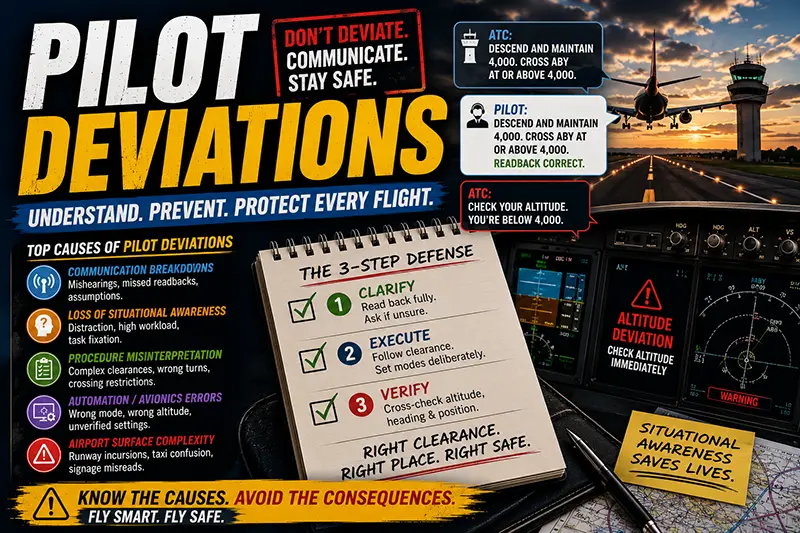
Pilot deviations are a practical safety concern for every pilot, instructor, and operator. At its core, a pilot deviation occurs when a pilot departs from an ATC clearance, a published procedure, or an applicable rule while operating an aircraft. Understanding why pilot deviations happen, and how to prevent them, is essential for safe flight operations and for keeping the system of air traffic control working as intended.
This article explains the common causes of pilot deviations, translates the concepts into cockpit actions and training priorities, and provides operational strategies you can apply in single-pilot and crewed operations. The primary keyword "pilot deviations" appears early because preventing deviations is a common search intent for pilots who want clear, practical guidance that improves safety and reduces the risk of loss of separation, runway incursions, and airspace violations.
What Drives Pilot Deviations: The Core Causes
Pilot deviations stem from a mix of human factors, environmental pressures, procedural complexity, and system limitations. Grouping the causes helps identify targeted prevention strategies.
1. Communication Breakdowns
Miscommunications are a leading contributor to pilot deviations. These can include garbled transmissions, similar-sounding call signs, missed readbacks, and assumptions made when a pilot believes they heard a clearance. A missed or incorrect readback reduces the mutual awareness between pilot and controller and increases the chance that the aircraft will not be where ATC expects.
2. Situational Awareness Loss
Situational awareness includes knowing your aircraft's position, altitude, the intended clearance, nearby traffic, and the state of the flight plan. Loss of awareness can result from distraction, workload overload, or fixation on a single task. Under high workload, pilots sometimes prioritize a task like programming flight management equipment and lose track of the current clearance or assigned altitude.
3. Procedure and Clearance Misinterpretation
Clearances and published procedures have specific constraints. Misinterpreting an intersection departure, a hold clearance, a crossing restriction, or a low-altitude vector can cause a pilot to deviate from the expected track or altitude. Complexity in phraseology or in layered procedures at busy airports can increase the risk.
4. Inadequate Preflight and In-Flight Planning
Poor planning increases the odds of deviation. Examples include not briefing taxi routes at unfamiliar airports, failing to review complex arrival and departure procedures, or not confirming fuel and alternate planning which can lead to last-minute decisions that cause deviations.
5. Automation and Avionics Issues
Automation mode confusion and avionics misconfiguration can lead to the aircraft not following the intended clearance. Examples include having the autopilot in the wrong vertical mode, flight director guidance that conflicts with the cleared altitude, or incorrect waypoint sequencing. Reliance on automation without crosschecking basic instrumentation can mask a developing deviation.
6. Human Performance Factors
Fatigue, stress, distraction, medication effects, and complacency all degrade performance and increase the likelihood of a deviation. Expectation bias, where a pilot anticipates a routine clearance and acts prematurely, can be particularly dangerous when the actual clearance differs.
7. Airport Surface Complexity and Runway Incursions
Taxiway layouts, nonstandard holding points, and rushed taxi flows at complex airports increase pilot workload and the chance of mis-taxiing or entering an active runway without clearance. Surface signage and markings help, but pilot scan, map review, and readiness to stop remain essential.
8. Weather and Unforeseen Operational Pressures
Low visibility, strong winds, and rapidly changing conditions increase workload. In some cases pilots alter clearances or procedures to cope with weather-related demands, which can lead to deviations if not coordinated with ATC. Emergency situations or urgent passenger needs can create pressures that prompt pilots to prioritize perceived immediate needs over strict compliance without coordination.
Why Pilot Deviations Matter in Real-World Aviation
Pilot deviations matter because the air traffic system depends on predictable aircraft behavior. When one aircraft departs from an expected route or altitude, it can reduce separation margins, increase controller workload, and create hazardous conflicts. On the surface, deviations increase the potential for runway incursions and ground collisions. In the air, they increase the risk of loss of separation and midair conflicts.
Beyond immediate safety implications, pilot deviations have operational costs. They can trigger expedited traffic management responses, disrupt flows at busy airports, and require time-consuming investigations. From a training and organizational perspective, repeated deviations often reveal gaps in pilot training, SOPs, or airport familiarization programs.
How Pilots Should Understand Pilot Deviations in Practical Terms
Think of a pilot deviation as a breakdown in the integrated chain that links clearance, comprehension, action, and monitoring. Each link offers an opportunity to detect and correct an error before it becomes a deviation. The practical approach focuses on three tasks: clarify, execute, and verify.
Clarify: Before acting, verify the clearance in full. When a clearance contains constraints - such as an altitude, crossing restriction, or specific routing - read it back and, if unclear, ask for clarification. Use standard phraseology where practical and avoid assumptions.
Execute: Implement the clearance deliberately. Program avionics or set the autopilot with intention, not by rote. If a maneuver will significantly change your flight path or workload, brief crewmembers and set clear roles. Single-pilot operators should verbalize steps aloud when workload allows to maintain a cognitive trace of actions.
Verify: After action, crosscheck the aircraft state against the clearance. Confirm altitude, heading, and transponder codes; monitor navigation displays; and compare expected fix/time information from the clearance against the aircraft instruments. If the aircraft is not where ATC expects, request correction or report noncompliance immediately.
Common Mistakes and Misunderstandings
Pilots commonly make a handful of predictable errors that lead to deviations. Knowing these patterns helps shape training and SOPs.
Assuming rather than confirming. When a clearance sounds routine, pilots sometimes act on expectation rather than what was actually said. Expectation bias is particularly common during busy phases like departure and approach.
Poor taxi briefing. At unfamiliar or complex airports, failing to brief the taxi route and hold-short points increases the chance of wrong turns and runway incursions.
Incomplete readbacks. A partial or incorrect readback leaves the controller unaware that the pilot did not copy the clearance correctly. A complete, accurate readback reduces ambiguity.
Automation mode confusion. Pilots may inadvertently leave the autopilot in an undesired mode or arm a mode without verifying engagement. The aircraft can then fly a path inconsistent with the clearance.
Task fixation. Concentrating on one task, like troubleshooting a system or programming the GPS, can cause pilots to miss radio calls or cross-checks that would catch a clearance mismatch.
Practical Example: A Realistic In-Flight Scenario
Scenario: You are on an instrument arrival into a busy metropolitan airport shortly after takeoff from a neighboring field. ATC issues a descent and vectors for the approach and assigns a crossing restriction: "Cross ABY at or above 4,000, maintain 4,000 until established." You acknowledge and begin a descent. While programming the arrival into the flight management system, you glance outside and notice another aircraft positioned close. You begin the descent and, once established, inadvertently allow the autopilot to capture a lower altitude before ATC confirms you are established. The aircraft levels at 3,000 feet briefly before you realize the error.
How an error occurred: High workload during approach, combined with automation mode selection and the distraction of nearby traffic, led to a loss of verification. A partial expectation that the aircraft would be cleared lower soon reinforced the descent.
How to recover and prevent: Immediately notify ATC of the deviation, climb back to the assigned altitude if clear and safe, and evaluate whether the autopilot or flight director had been incorrectly set. In training contexts, use the scenario to emphasize crosschecking autopilot modes, verbal callouts when capturing altitudes, and brief crew actions for altitude deviation recovery. Practice interrupted approach flows with simulated distractions to build resilience.
Best Practices for Pilots to Prevent Deviations
Preflight and briefing
- Brief the taxi route and hold-short points at unfamiliar airports. Carry an airport diagram where you can see it during taxi.
- Review complex arrival and departure procedures before engine start. Note altitudes, crossing restrictions, and expected frequencies.
- Establish a sterile cockpit for critical phases to minimize nonessential conversation and reduce distraction.
Communication and phraseology
- Read back all critical elements of ATC clearances, including altitudes, headings, and holding instructions. If a clearance is ambiguous, request clarification immediately.
- Use standard phraseology and avoid conversational shortcuts that might alter meaning.
Automation and avionics management
- When engaging or changing autopilot or flight director modes, verbalize the intended mode and verify the actual mode. For example, announce and confirm altitude capture settings.
- Crosscheck navigation sources. If your FMS and GPS disagree, determine which source you will use and monitor for anomalies.
Workload management and monitoring
- Prioritize tasks. When workload increases, stabilize the aircraft first and postpone nonessential tasks until workload reduces.
- Use a simple verbal or written flow to confirm the aircraft state after executing a clearance - for example, "Cleared to 6,000, autopilot vertical mode set, transponder 1200."
Training and recurrent practice
- Include deviation scenarios in simulator sessions or dual instruction flights, focusing on communication errors, readback failures, and automation surprises.
- Practice go-arounds, missed approach transitions, and rapid re-clearing to ensure crews can recover cleanly from unplanned deviations.
Surface operations
- Before taxi, brief the route and identify critical intersections and runway crossings. Confirm which frequency and lighting are in use and where you will hold short if needed.
- Keep head-up scanning to match signage and markings with your planned route. If unsure, stop and ask ATC for progressive taxi assistance or clarification.
When a Deviation Happens: Immediate Actions
If you suspect or recognize a deviation, take prompt, measured action. The first priority is to restore safe separation and return to the cleared clearance if doing so is safe. Then inform ATC as soon as practicable, using concise language. Controllers can help resolve conflicts if they know your actual aircraft state.
After the flight, document the event and discuss it in a safety or training setting. Use the incident as a learning opportunity to modify briefings, SOPs, or training syllabi to prevent recurrence.
Organizational and Training Implications
For flight schools, operators, and instructors, pilot deviations are training signals. Repeated deviations highlight specific gaps: weaknesses in phraseology practice, inconsistent sterile cockpit discipline, inadequate automation training, or poor surface movement procedures. Address these through scenario-based training, line-oriented flight training, and deliberate practice of critical readbacks and taxi flows.
Instructors should craft tests and flights that intentionally include realistic distractions and complex clearances so students learn to maintain the clarify-execute-verify loop under stress. Debrief each deviation with a focus on decision-making and error traps rather than on blame.
Frequently Asked Questions
What exactly is a pilot deviation?
A pilot deviation is an instance where the pilot's actions do not conform to an issued ATC clearance, published procedure, or applicable rule while operating an aircraft. In practical terms, it means the aircraft is not where it is supposed to be according to the clearance or procedure.
What should I do if ATC tells me I have deviated?
Remain calm and respond clearly. Confirm your aircraft's position and altitude, correct the deviation if it is safe to do so, and provide ATC with your intentions if necessary. After the flight, record the event and review the associated circumstances to prevent recurrence.
Will a pilot deviation always result in enforcement action?
Not necessarily. Outcomes vary depending on the nature of the deviation, whether it created a safety risk, and organizational processes. The priority should be to resolve the immediate safety issue, then to use the event for learning and corrective action.
How can single-pilot operators reduce the risk of deviations?
Single-pilot operators should emphasize planning, briefings, and simple verbal flows. Use written notes for clearances and crossing restrictions, hand-fly the aircraft during high workload if needed, and verbalize mode changes when engaging automation.
Are there reporting options after a deviation for safety improvement?
Yes. Confidential or voluntary safety reporting systems exist to capture incidents and near misses for safety analysis. Reporting an event can help identify systemic issues and prevent future deviations. Consult your organization or local reporting mechanisms for guidance on how to report while protecting confidentiality where applicable.
Key Takeaways
- Practical takeaway: Use the clarify-execute-verify loop for every ATC clearance to catch errors early and ensure the aircraft follows the intended clearance.
- Safety takeaway: Loss of situational awareness and communication breakdowns are common roots of pilot deviations; prioritize communication and crosschecks during high workload phases.
- Training takeaway: Integrate realistic distraction and automation-failure scenarios into recurrent training to reduce the likelihood of deviations in operational flights.
Pilot deviations are not simply compliance failures. They are opportunities to improve the way pilots plan, communicate, manage automation, and monitor aircraft state. By understanding the common causes and practicing clear, verifiable actions, pilots and instructors can reduce the frequency and severity of deviations and keep the airspace safer for everyone.