
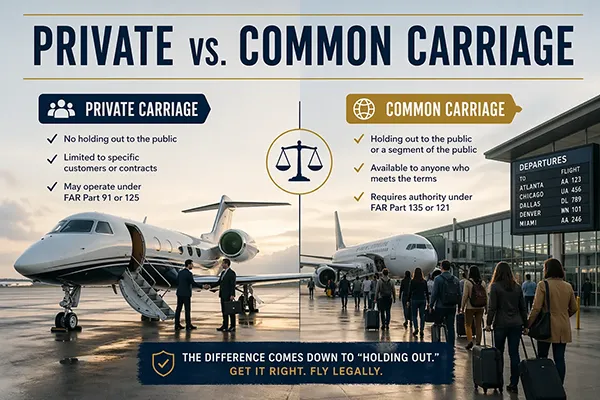
In aviation, some of the most important regulatory boundaries are not defined by aircraft size or routes. They are defined by intent. The distinction between private carriage and common carriage comes down to a simple but powerful question: who are you willing to fly, and how is that willingness understood by others? The answer determines whether an operator is simply using an aircraft as a business tool or operating as an air carrier.
This distinction has shaped enforcement actions, grounded operations, and forced companies to rethink their business models. At the center of it is a concept that sounds informal but carries serious legal weight: holding out.
Concept A: Common Carriage
- Exists when an operator presents itself, directly or indirectly, as willing to transport the public or a segment of it.
- Built on four elements: holding out, transportation, movement from place to place, and compensation.
- Holding out can take many forms, including advertising, websites, brokers, or a reputation for being available.
- Refusing some customers or using contracts does not prevent an operation from being considered common carriage.
- Specialized services such as cargo-only or charter-only operations can still fall into this category if they are broadly accessible.
Concept B: Private Carriage
- Defined by the absence of holding out to the public.
- Typically limited to a small number of selected clients.
- Often based on long-term relationships rather than open access.
- Services may be tailored, but customization alone does not determine classification.
- The operation must remain intentionally exclusive, since growth in the number of clients can change how it is viewed.
Key Differences
- Public vs. Private: Common carriage invites demand, while private carriage controls access.
- Perception: What matters is not only what the operator does, but how the operation appears to others.
- Access: If someone outside the current client base can reasonably expect to book a flight, the operation may be considered common carriage.
- Scale: As operations grow, it becomes harder to maintain true exclusivity.
- Regulatory Identity: Common carriage places the operator in the category of an air carrier.
How-To / Process
- Consider how new customers learn about the operation and whether that visibility suggests openness.
- Examine the client base to determine if it is limited and controlled or open to expansion.
- Review how the service is described externally, including any marketing or third-party involvement.
- Identify whether brokers, agents, or memberships are offering access to the aircraft.
- Ask whether an outside party could reasonably gain access with effort.
- Ensure the operation aligns with the correct regulatory framework before expanding or generating revenue.
Why It Matters
The difference between private and common carriage determines which regulatory framework applies. The FAA focuses on how an operation actually functions, not how it is described. Misjudging that distinction can lead to immediate and serious consequences.
- Common carriage requires compliance with FAR Parts 121 or 135.
- Private carriage may operate under Part 91 or Part 125.
- Incorrect classification can result in enforcement action and disruption of operations.
- Decisions such as using brokers or expanding contracts can shift an operation into common carriage.
Key Takeaways
- Holding out is based on perception as well as intent.
- An operator can be considered a common carrier without traditional advertising.
- Private carriage depends on maintaining a limited and controlled client base.
- Growth, visibility, and access tend to move operations toward common carriage.
- Regulators evaluate real-world behavior rather than labels.