
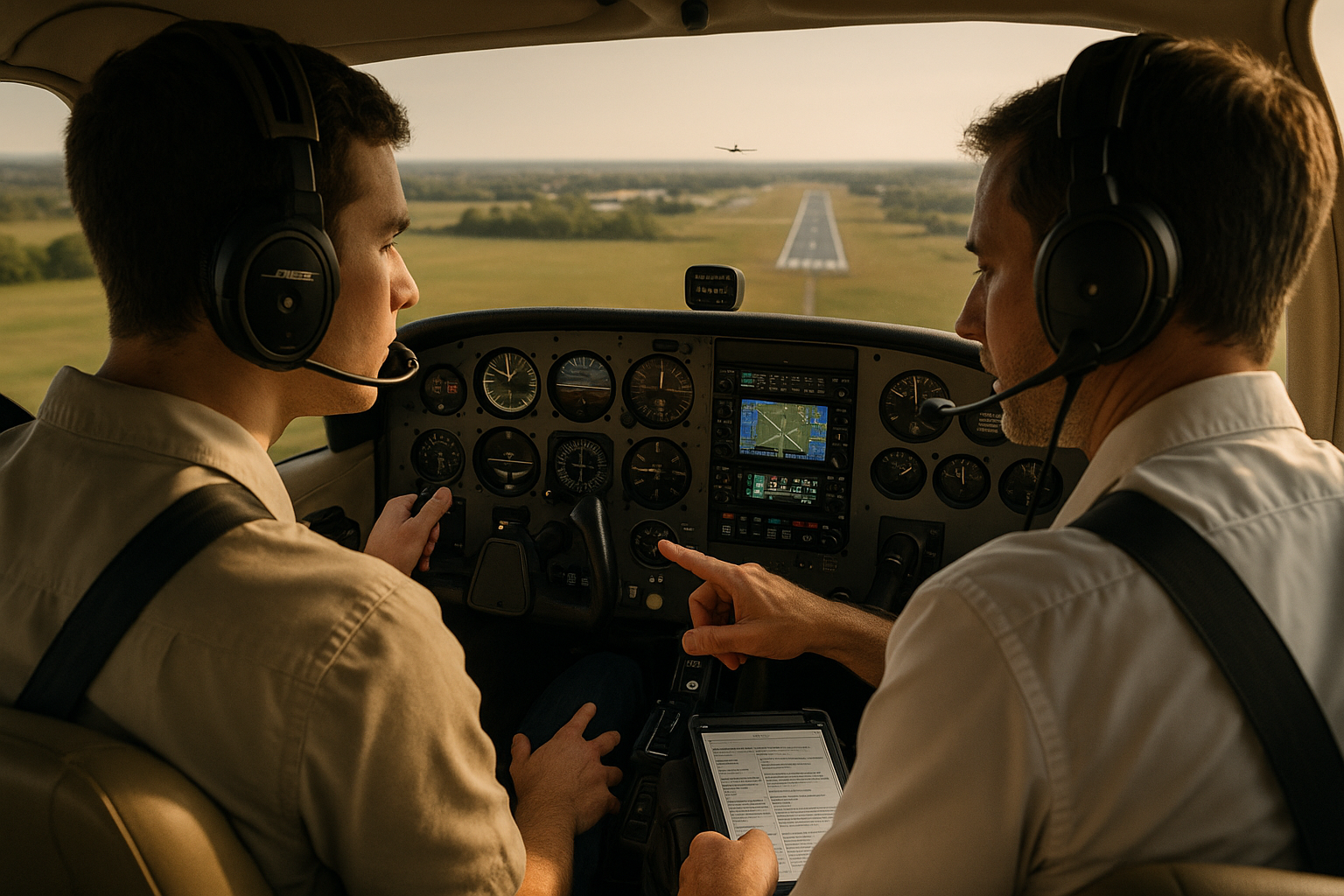
Reduce stress during flight training is essential for learning, safety, and retention. Stress is a normal human response to challenge, but in the cockpit it can narrow attention, slow decision-making, and degrade flying skills. For student pilots and instructors, learning to manage stress early improves performance, reduces training time lost to anxiety, and builds habits that carry into every phase of a flying career.
This article explains practical, evidence-informed approaches pilots and instructors can use to reduce stress during flight training. It focuses on operational techniques you can apply in preflight planning, in-flight, and during debriefs. Readers will find guidance on mental preparation, cockpit workload management, instructor-student dynamics, simulator use, and common pitfalls that increase stress. The primary keyword appears early to help you locate the main idea quickly.
Understanding Stress in Flight Training
Stress during flight training is not a single thing. It includes cognitive load from learning new procedures, emotional responses to evaluation or fear of making mistakes, physiological reactions like increased heart rate, and environmental stressors such as weather, traffic, or maintenance issues. All of these influence how a student pilot perceives tasks and how the instructor designs training.
From an operational perspective, stress is a performance factor. Instructors should view stress both as a training cue and as a hazard. Moderate stress can sharpen focus and motivation when managed; excessive stress reduces situational awareness and increases error probability. The instructor's role includes adjusting the training environment so that challenge fosters learning rather than overwhelm.
Why Reducing Stress Matters in Real-World Aviation
Flight training is the foundation of pilot judgment and skill. How a student experiences stress during training influences their future decision-making under pressure. Stress-induced errors in training can become habits. For example, skipping a briefing because of time pressure or reacting to an unexpected engine indication with rushed actions are behaviors that may persist.
Operationally, stress interacts with safety factors such as workload, time pressure, and environmental hazards. A pilot who learns to manage stress effectively is better at prioritizing tasks, communicating clearly, and recognizing when to go-around, divert, or terminate an approach. Instructors and training organizations that incorporate stress management into the syllabus contribute to safer, more resilient pilots.
How Pilots Should Understand Stress: Practical Concepts
Three practical concepts help pilots and instructors convert the idea of stress into training actions: workload management, threat and error management, and recovery training.
Workload management is about controlling the amount of attention and manual work required at any one time. It includes planning, simple task sequencing, and using automation appropriately. Threat and error management is the mindset of anticipating sources of stress or error and designing responses. Recovery training is practicing how to recover from mistakes or degraded performance under stress so responses become automatic and safe.
Applying those concepts in training means teaching students to anticipate likely stressors for each lesson, to simplify the cockpit environment when learning new tasks, and to rehearse responses in a way that reduces cognitive surprise. For instructors this often means breaking tasks into smaller components, using a graduated exposure approach, and emphasizing repetition under realistic but controlled conditions.
Common Mistakes and Misunderstandings
Many training environments unintentionally increase stress. Common mistakes include overloading a novice with too many simultaneous tasks, using high-stakes evaluation too early, and neglecting basic human factors such as fatigue, hydration, and adequate briefing. Another frequent error is treating stress as a purely psychological issue rather than an operational variable that can be engineered.
Misunderstandings also occur around automation. Some students assume automation eliminates all workload and therefore do not develop fundamental manual skills. Others treat automation as a backup to compensate for poor planning. Both approaches lead to stress when automation is unavailable or behaves differently than expected.
Finally, instructors sometimes conflate constructive pressure with punitive stress. A well-designed challenge motivates learning. A training environment that relies on humiliation, unpredictable failure, or unclear standards increases avoidance behavior and slows progress.
Practical Example: Crosswind Approach Lesson
Consider a typical crosswind approach lesson in a single-engine trainer. Crosswind landings are technically demanding and commonly trigger stress for students. A practical, stepwise way to reduce stress while preserving learning value includes the following components.
Preflight: The instructor reviews the day's plan and sets clear objectives. They brief the student on the specific skills to practice, expected environmental conditions, and safety margins. The briefing includes explicit go-around criteria and who will fly in different parts of the approach and landing.
Modulate difficulty: Begin in light crosswinds and practice the core elements: crab or wing-low control, coordinated rudder use, and speed control on final. Use demonstrated approaches where the instructor shows correct techniques before letting the student attempt. Pause between attempts to allow the student to reflect.
Workload management: During the first practice approaches, minimize other tasks. Call traffic, radios, and navigation configuration are kept simple. This allows the student to focus on primary flying tasks. As proficiency improves, layer in additional tasks such as radio calls or briefed distractions to build resilience.
Use recovery practice: Introduce an unexpected element, such as a gust or simulated engine roughness, only after the student handles baseline approaches reliably. Practicing controlled recovery from a destabilized approach reduces surprise and builds confidence.
Debrief and reflection: An immediate, focused debrief reinforces what went well, what needs work, and a specific action plan for the next lesson. The instructor emphasizes a single improvement target rather than a long list of faults.
Best Practices for Pilots and Instructors
These best practices apply across training areas and aircraft types. They focus on reducing unnecessary stress while preserving the pedagogic value of challenge and evaluation.
- Plan with margin: Use conservative safety margins during training flights. Plan fuel, weather, and go-around options so the student can practice without high consequences for small errors.
- Use graduated exposure: Introduce difficulty in small steps. Master one element before adding another.
- Standardize briefings: A concise, consistent briefing reduces cognitive surprise. Include objectives, risks, and explicit abort criteria.
- Teach task prioritization: Emphasize the aviation priorities of fly the aircraft, navigate, and communicate. Use simple rule-based prompts initially, then reduce prompts as skills stabilize.
- Normalize error: Frame mistakes as learning opportunities. Use structured debriefs to convert errors into targeted practice.
- Train under realistic but controlled stress: Use simulators for early exposure to high-workload or emergency scenarios before practicing in the aircraft when safe.
- Monitor physiological factors: Encourage proper sleep, hydration, nutrition, and avoidance of stimulants that may worsen anxiety.
- Use cognitive aids: Teach students to use checklists, brief cards, and simple mnemonics to reduce memory load under stress.
Techniques You Can Apply Right Now
Several immediate techniques help reduce stress during a lesson. They are quick to learn and can be practiced in the airplane, in the sim, or on the ground.
- Box breathing: A controlled breathing pattern can help regain composure. Inhale four seconds, hold four, exhale four, hold four. Use it on the ground or taxi when you feel tension rising.
- Preflight mental rehearsal: Mentally walk through the flight, including briefed contingencies. Mental rehearsal primes procedural memory and reduces surprise.
- Chunk tasks: Break complex tasks into chunks. For example, on approach: stabilize configuration first, then stabilize speed, then fine-tune alignment. Teach students to announce the chunk they are working on.
- Use simple callouts: Standard callouts reduce ambiguity between instructor and student. Use short, predictable phrases for key events.
- Timeout rule: Establish a simple timeout phrase the student can use if they feel overwhelmed. The instructor then takes control and resets the learning environment.
Training Tools: Simulators, Briefings, and Scenarios
Simulators are powerful for stress management because they allow repetition of high-workload scenarios without real-world consequences. Use the sim to practice emergency checklists, unusual attitudes, or complex airspace procedures. Sim sessions should focus on repetition, immediate feedback, and building automatic responses.
Briefings are equally important. A short, explicit briefing establishes expectations and reduces uncertainty. A good briefing answers three questions: what will we do, why it matters, and what to do if things go wrong. Keep briefings consistent and student-centered.
Scenario-based training integrates technical flying skills with decision-making and communication. For example, a cross-country lesson can include an unscheduled diversion to practice workload management and ATC communication. Scenarios should be structured with clear learning objectives and safety margins.
Instructor Strategies to Reduce Student Stress
Instructor behavior heavily influences a student's stress level. Effective instructors manage the learning environment, set clear expectations, and adapt pace to the student's current capacity.
Start with psychological safety. Students learn best when they feel safe to attempt, fail, and try again. Avoid public criticism and focus feedback on specific behaviors. Use praise strategically to reinforce correct responses and decisions.
Adapt the level of challenge to the student. If the student struggles with basic aircraft control, postpone advanced tasks and return to fundamentals. Conversely, avoid over-skilling students by keeping every task too easy. The goal is productive challenge.
Finally, model calmness. Students mimic affective states. If the instructor remains composed during an unexpected event, the student is more likely to regain control quickly.
Common Training Scenarios That Trigger Stress and How to Handle Them
Certain training moments reliably increase stress. Recognizing and preparing for these can reduce their impact.
First solo. The first solo flight has emotional intensity. Prepare the student with repeated, successful takeoffs and landings, a clear solo brief, and a conservative environment with light traffic and good weather.
Checkrides. Evaluations are stressful because they are high stakes. Familiarize students with the checkride format, practice under exam-like conditions, and debrief mistakes as learning points rather than failures.
Unplanned system failures. Use the simulator to rehearse common failures. In the airplane, practice the flow of initial actions as a scripted routine. Scripted responses reduce cognitive load during real events.
Practical Applications for Different Pilot Types
Private pilot students, commercial applicants, and instrument students face different stress profiles. Private students often confront basic control and traffic management. Instrument students face sensory deprivation and high-cognitive workloads. Commercial applicants have performance pressure and complex operations. Tailor stress management techniques to these profiles.
For instrument students, emphasize procedural discipline and automation management. For commercial applicants, include resource management and multi-crew communication drills. For recreational students, focus on building confidence through predictable, successful practice and human factors education.
How to Measure Progress: Training Metrics that Matter
Progress in stress management is not measured solely by grades. Useful measures include consistency of performance under mild disturbance, reduction in instructor interventions over time, and student's speed of recovery after an upset. Objective metrics include stabilized approach parameters, repeatability of maneuvers, and time to complete procedural flows under timed conditions.
Keep debriefs focused on one or two measurable goals for the next session, such as maintaining airspeed within a narrow band on final or completing the before-landing checklist by a fixed landmark. Measuring small, specific improvements builds confidence and reduces anxiety about vague expectations.
Common Mistakes and How to Avoid Them
Several recurring errors increase stress in training. Avoid these by design.
- Overloading lessons: Teaching too many skills in one flight overwhelms students. Structure lessons around one primary objective and one secondary objective.
- Punitive debriefs: Criticism without constructive guidance increases avoidance. Use the debrief to set one actionable improvement for the next flight.
- Neglecting basic physiology: Fatigue, hunger, and dehydration worsen stress responses. Ensure students treat basic human needs as part of flight planning.
- Failing to normalize simulator training: Students sometimes view sim performance as less real. Instructors should grade simulator sessions and emphasize their direct relevance to the airplane.
- Ignoring communication skills: Poor radio technique or unclear cockpit communication increases cognitive load and stress. Practice crisp, standard phraseology early.
Frequently Asked Questions
How quickly can a student learn to manage stress during training?
There is no single timeline. Many students show measurable improvement within a few weeks when instructors deliberately teach stress management, use graduated exposure, and emphasize debriefing. Regular, structured practice speeds adaptation more than informal exposure alone.
Should instructors simulate high-stress emergencies early in training?
Not usually. Early exposure to uncontrollable stress can overwhelm students and reduce learning. Use a graduated approach: introduce challenging scenarios in the simulator first, then apply similar but controlled practice in the airplane once fundamentals are stable.
What role does the simulator play in reducing stress during actual flights?
Simulators let students practice rare or high-workload events without risk. Repetition in a simulator builds procedural memory and reduces surprise, which transfers to calmer, more competent responses in the airplane.
How can a student cope with anxiety before a test flight or checkride?
Preparation is the best antidote. Use focused rehearsal, run briefings that outline pass/fail criteria, and practice under exam-like conditions. Techniques such as controlled breathing, preflight routines, and visualization also reduce acute anxiety.
Is it okay for instructors to intentionally increase stress to test students?
Constructive challenge is necessary for growth, but it must be controlled and accompanied by clear objectives and safety margins. Intentionally creating unnecessary anxiety or humiliation is counterproductive and unsafe.
Key Takeaways
- Practical takeaway: Use graduated exposure and structured briefings to reduce surprise and manage workload during lessons.
- Safety takeaway: Design training with conservative safety margins and clear go-around or abort criteria to minimize risk during high-stress scenarios.
- Training takeaway: Use simulators for initial exposure to high-workload events, then transition to aircraft practice once fundamentals are stable.
Reducing stress during flight training is an operational skill that benefits both students and instructors. It improves learning efficiency, builds safer habits, and produces pilots who are better prepared to manage the pressures of real-world flying. By integrating simple techniques such as planning with margin, using consistent briefings, practicing recovery routines, and leveraging simulators, instructors can create training environments where challenge leads to competence rather than anxiety. Students who adopt breathing techniques, mental rehearsal, and task-chunking will feel more in control and learn more effectively.
Apply these strategies deliberately. Make stress management an explicit training objective, not an afterthought. Over time, the habits formed in training reduce risk, improve decision-making, and create pilots who can perform reliably when it matters most.