Aviation Training Experts™

RNAV Operations in U.S. Airspace: A Complete Guide to FAA RNAV 1 and RNAV 2 Navigation

Learn how RNAV works in U.S. airspace, including RNAV 1 and RNAV 2 requirements, pilot procedures, system capabilities, and real-world flying applications.

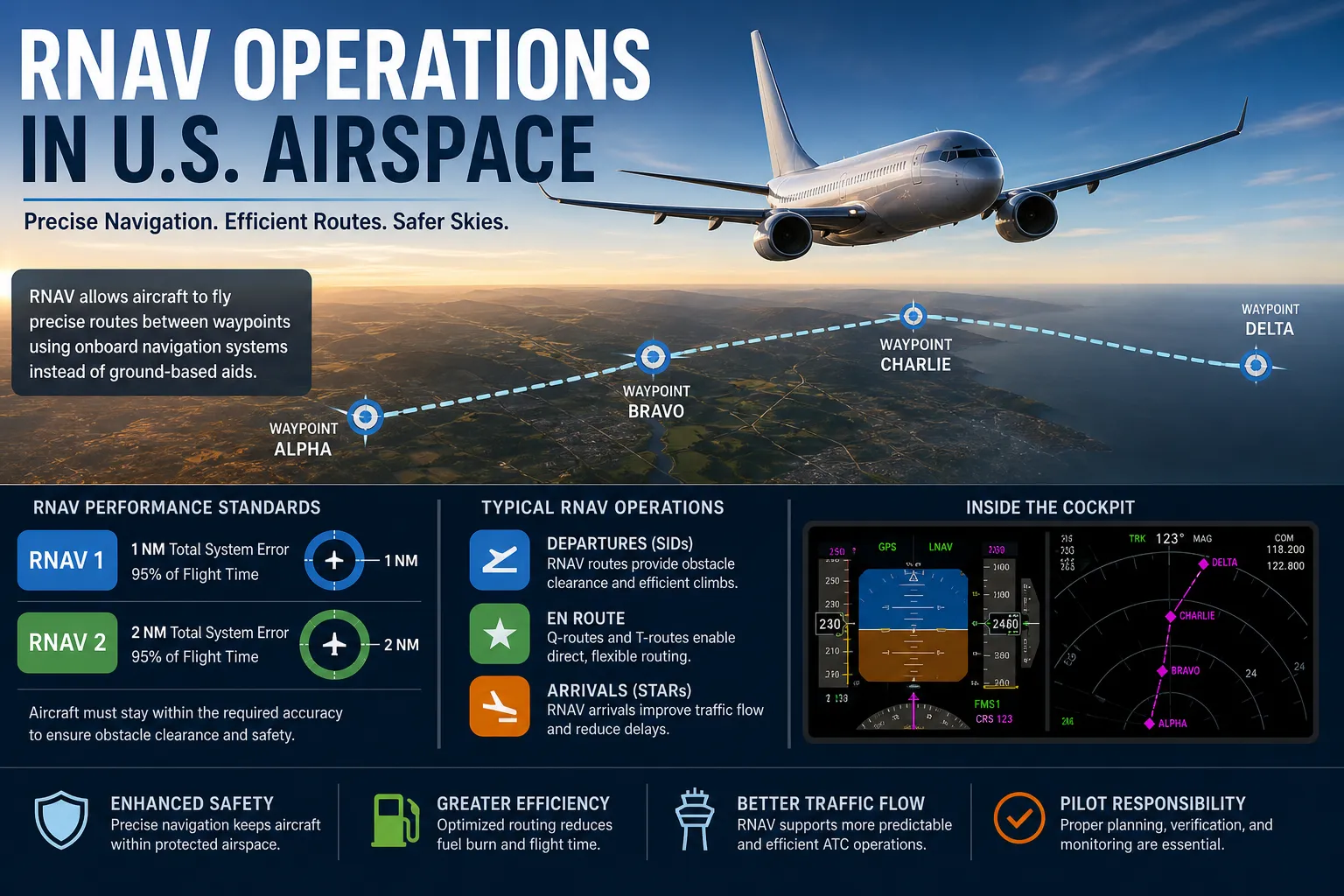
Commercial aircraft following RNAV route with modern GPS navigation in U.S. airspace
RNAV allows aircraft to fly precise, efficient routes using onboard navigation systems instead of ground-based aids.

RNAV Operations in U.S. Airspace: A Practical, In-Depth Guide to RNAV 1 and RNAV 2 for Pilots

Area Navigation (RNAV) is now a fundamental part of flying in the United States. Whether departing a busy Class B airport, cruising on an en route airway, or arriving into a complex terminal environment, RNAV procedures are everywhere. For pilots, this means that understanding RNAV is no longer optional. It is a core skill that directly affects safety, efficiency, and compliance with air traffic control.

RNAV operations allow aircraft to fly precise, optimized flight paths using onboard navigation systems instead of relying strictly on ground-based navigation aids. While this capability has significantly improved the efficiency of the National Airspace System, it has also introduced new responsibilities for pilots. Proper setup, verification, and monitoring of RNAV systems are critical to ensuring the aircraft stays within protected airspace and follows the intended procedure.

This guide goes beyond basic definitions to explain how RNAV actually works in real-world flying. It connects system capability, FAA expectations, and pilot technique into a practical understanding you can use in the cockpit.

What RNAV Really Means for Pilots

RNAV allows an aircraft to navigate along any desired flight path within the limits of its onboard navigation system. Instead of flying directly from one ground-based station to another, the aircraft follows a series of waypoints that define a precise route through the airspace.

This capability is what enables modern departure procedures, curved arrivals, optimized descents, and efficient en route routing. RNAV is not just about navigation accuracy. It is about enabling the entire air traffic system to operate more smoothly and predictably.

Most RNAV operations today rely on satellite-based navigation such as GPS, but aircraft may also use DME/DME or inertial systems depending on their equipment. Regardless of the source, the key requirement is that the aircraft meets a defined level of navigation accuracy.

RNAV Routes, Departures, and Arrivals

RNAV is used across all phases of IFR flight. In the en route environment, pilots may fly Q-routes or T-routes that are defined by waypoints instead of ground stations. In terminal areas, RNAV procedures are used for departures and arrivals, often with complex routing designed to manage traffic flow and terrain clearance.

Standard Instrument Departures (SIDs) and Standard Terminal Arrival Routes (STARs) are where RNAV becomes most demanding. These procedures often include multiple waypoints, altitude restrictions, and tight turns, all of which depend on accurate navigation and proper system management.

For pilots, this means RNAV is not just about following a magenta line. It is about understanding what that line represents and ensuring the aircraft stays within the expected path.

Understanding RNAV 1 and RNAV 2 in Practice

RNAV performance is defined by how accurately the aircraft must remain on its intended path. RNAV 1 means the aircraft must stay within 1 nautical mile of the desired track for at least 95 percent of the flight time. RNAV 2 allows up to 2 nautical miles of error under the same conditions.

In practice, pilots are expected to do much better than these limits. During normal operations, cross-track error should typically be held to about half of the allowed tolerance. That means about 0.5 nautical mile for RNAV 1 procedures and 1 nautical mile for RNAV 2 routes.

This becomes especially important in terminal airspace, where obstacle clearance and traffic separation are based on these performance standards. A small navigation error may not seem significant, but it can quickly place the aircraft outside protected airspace if not corrected.

Why RNAV Matters in Real-World Flying

RNAV has changed how aircraft move through the system. Instead of flying inefficient zig-zag routes between ground stations, aircraft can fly direct paths, continuous descents, and predictable arrival flows. This improves fuel efficiency, reduces delays, and allows air traffic control to handle more aircraft safely.

From a pilot’s perspective, RNAV reduces workload in some areas while increasing it in others. The system handles navigation calculations, but the pilot must manage automation, verify routes, and monitor performance. The result is a shift from manual navigation to system management.

This shift is where many errors occur, especially for pilots who are new to advanced avionics or transitioning from traditional navigation methods.

How Pilots Should Think About RNAV Systems

An RNAV system is only as reliable as the data and inputs it receives. The navigation database defines the route, the sensors determine position, and the flight management system calculates the path. If any part of that chain is incorrect, the aircraft may not follow the intended route.

Pilots should approach RNAV with a mindset of verification. Every procedure must be checked against the chart. Every route must be confirmed. Every transition must be understood before execution.

Automation is a powerful tool, but it does not replace pilot awareness. The pilot must always know where the aircraft is, where it is going, and whether the system is doing what it is supposed to do.

Common Mistakes and Operational Risks

Many RNAV-related errors are not technical failures but human factors issues. One of the most common mistakes is failing to verify the loaded procedure. Selecting the wrong runway or transition can result in a completely different flight path.

Another frequent issue is overreliance on automation. Pilots may assume the system is correct without cross-checking the route or monitoring deviations. This can lead to navigation errors that go unnoticed until ATC intervenes.

Improper handling of route changes is also a risk. When ATC issues a direct-to clearance or modifies the route, the pilot must correctly update the system and verify the new path before executing it.

Even small details, such as misunderstanding waypoint sequencing or failing to notice a route discontinuity, can create significant problems during RNAV operations.

Practical Example: RNAV Departure in Busy Airspace

Consider a departure from a major airport using an RNAV SID. The procedure includes an immediate turn after takeoff, followed by several altitude restrictions and waypoint transitions.

Before departure, the pilot loads the SID into the flight management system and verifies the runway and transition. During the takeoff roll, the system is already initialized and ready to provide guidance.

After liftoff, the pilot engages lateral navigation and begins tracking the RNAV path. The aircraft follows the programmed route, but the pilot continues to monitor the navigation display and verify that the aircraft remains on course.

As the flight progresses, ATC issues a modification to the route. The pilot updates the system, confirms the change, and ensures the aircraft transitions smoothly to the new path.

This scenario highlights the importance of preparation, verification, and continuous monitoring during RNAV operations.

Best Practices for Safe RNAV Operations

Effective RNAV flying comes down to disciplined habits and strong system understanding. Pilots should:

  • Verify the navigation database is current before every flight
  • Cross-check all loaded procedures against published charts
  • Use automation appropriately, but never blindly
  • Monitor cross-track error and maintain tight course control
  • Be ready to notify ATC immediately if RNAV capability is degraded or lost

These practices help ensure that the aircraft remains within protected airspace and that the pilot stays ahead of the system.

Frequently Asked Questions

Do all RNAV operations require GPS?

No. While GPS is the most common method, some aircraft can use DME/DME or DME/DME/IRU systems if they meet performance requirements.

Why is RNAV accuracy so important?

Procedure design and obstacle clearance are based on the aircraft meeting specific navigation accuracy. Deviating beyond those limits can compromise safety.

Can pilots manually enter RNAV procedures?

Published procedures must be loaded from the navigation database. Manual entry is not permitted for these procedures.

What happens if the navigation database is outdated?

The procedure should not be used. Pilots must ensure the database reflects current information before relying on it.

How should pilots handle RNAV system failures?

They should notify ATC immediately and request alternate instructions, such as radar vectors or a different route.

Key Takeaways

  • RNAV enables precise, efficient navigation but requires strict accuracy and proper system management.
  • Most RNAV errors are caused by pilot setup or monitoring issues, not system failure.
  • Strong verification habits and active monitoring are essential for safe RNAV operations.

Test Your Knowledge: RNAV Quiz

1. What does RNAV allow an aircraft to do?

2. What is the required accuracy for RNAV 1?

3. Where is RNAV 1 typically used?

4. What should a pilot do if RNAV capability is lost?

5. How should RNAV procedures be loaded?

Rate this article

No ratings yet.