
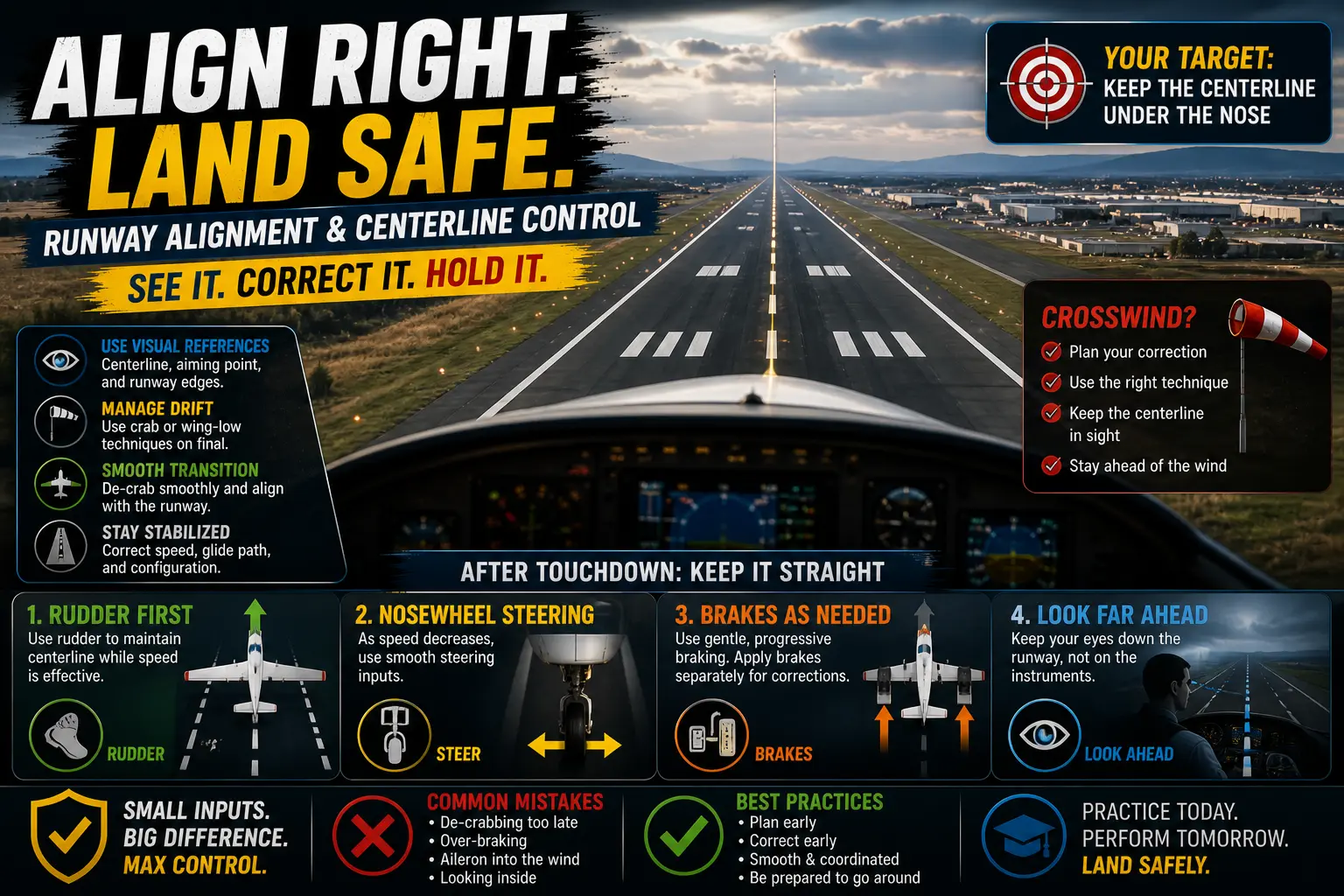
Runway alignment and centerline control are fundamental for safe landings and rollouts. Whether you are a student pilot learning to control drift or an instructor refining crosswind technique, precise alignment with the runway centerline reduces the risk of runway excursions, uneven wear on tires and brakes, and directional control issues after touchdown.
This article explains visual references, drift correction, and methods to maintain directional control after touchdown. You will find practical explanations of the aerodynamic forces involved, common pilot errors, a realistic scenario, and clear takeaways that you can apply in training flights and everyday operations.
Understanding the Core Concepts
Runway alignment means keeping the aircraft longitudinal axis aligned with the runway centerline from final approach through touchdown and the rollout. Centerline control is the pilot’s continuous task of maintaining that alignment despite wind, gusts, runway slope, and other disturbances.
Two aerodynamic issues are central: drift and heading/yaw. Drift occurs when the aircraft’s track over the ground is not parallel to its longitudinal axis. Heading is where the nose points, and yaw is rotation about the vertical axis. On approach a pilot manages drift with a combination of crab, wing-low (sideslip), or a transitional maneuver into the landing attitude. After touchdown the emphasis shifts to rudder, differential braking, and nosewheel steering to preserve directional control along the centerline.
Visual References That Work
Pilots rely on visual cues to judge alignment and drift. Primary visual references include runway markings, the runway edge contrast with surrounding terrain, and the perspective of the runway’s vanishing point. On final, use the runway aiming point (the pair of rectangular markings), the centerline stripes, and the alignment of taxiway or threshold markings to confirm you are lined up.
At low altitude, aim to align the aircraft so that the runway centerline runs straight down the fuselage center. For high-wing aircraft, the top of the nose and the wing strut geometry will change how the centerline appears; train to recognize your aircraft’s unique sight picture. Night and low-visibility operations require attention to runway lights and approach light systems. When visual references are degraded, reduce approach speed and increase reliance on stabilized approach techniques and instrument guidance if available.
Drift Correction Techniques
There are two common methods to correct for drift on final approach: the crab method and the wing-low side-slip method. Each has advantages and tradeoffs.
Crab method: Turn the aircraft’s nose into the wind so the aircraft tracks the runway centerline even though the nose is pointed off runway heading. Before touchdown execute a de-crab maneuver, transitioning to alignment with the runway using rudder and, if appropriate for the aircraft, a small wing-low input. This method reduces side loads on the landing gear if properly coordinated, but the timing and coordination of the de-crab matter.
Wing-low method: Lower the upwind wing and apply opposite rudder so the aircraft’s longitudinal axis points down the runway while the lateral drift is neutralized. This side-slip requires precise control inputs and may increase descent rate; monitor airspeed and glide path carefully.
Choice of method depends on the aircraft type, wind strength, training, and operator guidance. For many light airplanes, a controlled de-crab into a slight wing-low touchdown is a common technique. For some transport-category airplanes, pilots use specific de-crab procedures defined in the aircraft flight manual or company SOPs.
Maintaining Directional Control After Touchdown
Once the wheels touch the runway the primary job is to keep the airplane tracking the centerline. Directional control tools include aerodynamic surfaces, nosewheel steering, and brakes.
Rudder effectiveness increases with speed. Immediately after touchdown, use the rudder to correct small deviations while keeping a firm, but not rigid, hold on the yoke or sidestick. Avoid abrupt or large control inputs that can induce oscillations. As speed decreases and rudder authority diminishes, transition to using nosewheel steering and differential braking as needed.
Apply brakes smoothly and progressively. Sudden, heavy braking can lead to loss of control, especially on contaminated runways. If the aircraft has anti-skid systems, understand their behavior: anti-skid allows firm braking without wheel lockup but it does not improve directional control. Differential braking and toe brakes are effective for small corrections at low speed, while reverse thrust, if available, should be used per aircraft procedures and kept symmetric unless there is an emergency requiring asymmetric thrust.
Why This Matters in Real-World Aviation
Runway excursions remain a significant operational hazard. Effective alignment and centerline control prevent runway edge excursions, ensure proper use of runway length, and reduce wear on landing gear systems. In busy airports or short-field operations, accurate alignment shortens rollout distance and improves clearance for turning off at taxiways.
Training programs and operators benefit from structured practice of alignment and post-touchdown control to reduce the likelihood of incidents. The same principles apply to all categories of aircraft; differences are in scale and specific procedures defined by manufacturers and operators.
How Pilots Should Understand and Practice These Techniques
Think of runway alignment as a continuous process that begins well before final approach and ends when the aircraft is clear of the active runway. Work on the following in training and currency flights:
- Recognize your aircraft’s visual sight picture relative to the runway centerline from pattern altitude through short final.
- Practice both crab and wing-low methods in a safe training environment so you can use the technique best suited to conditions and aircraft type.
- Train touch-and-go and full-stop landings with emphasis on controlled de-crab and smooth rudder application after touchdown.
During approach, fly a stabilized approach: correct glide path and airspeed deviations early so you arrive over the threshold with available control margin to manage drift. If visual references deteriorate, go around and reconfigure for another attempt rather than force an unstable landing.
Common Mistakes and Misunderstandings
Pilots sometimes misunderstand how and when to transition from aerodynamic control to mechanical control such as nosewheel steering and brakes. Frequent mistakes include:
- De-crabbing too late or too abruptly, creating excessive yaw or side load at touchdown.
- Over-reliance on brakes instead of correcting alignment while aerodynamic controls are still effective.
- Applying excessive aileron into the wind after touchdown, which can increase the risk of wingtip or propeller strikes in low-wing or taildragger aircraft.
- Not anticipating changes in crosswind strength during rollout, leading to delayed or inadequate corrections.
Training gaps often show up as poor visual recognition of alignment cues and inadequate practice of transitional control techniques. Address these in structured training sessions with a qualified instructor.
Practical Example
Scenario: You are flying a single-engine, high-wing airplane on a gusty afternoon into a 45-knot crosswind component at a municipal airport. On final you establish a crab to track the runway centerline. At about 50 feet above ground you begin a smooth de-crab using rudder to align the nose with the runway heading and a slight wing-low input to neutralize drift. Touchdown is on the upwind main gear first with the nosewheel coming down smoothly as speed decreases. You maintain a positive rudder input and keep eyes looking down the runway to judge any developing drift. As rudder effectiveness fades below taxi speed, you use small, alternating toe-brake inputs to keep the aircraft centered until you can taxi clear onto the shoulder or a taxiway.
This example illustrates timing, gradual control changes, and the staged use of aerodynamic and mechanical controls. Practice similar scenarios in the traffic pattern with an instructor before attempting gusty or strong crosswind landings solo.
Best Practices for Pilots
Adopt these habits to improve runway alignment and centerline control:
- Plan your approach early: select reference points, brief crosswind correction method, and set target speeds.
- Use small, smooth control inputs. Anticipate wind changes and correct early rather than waiting for large deviations.
- Train both de-crab and wing-low techniques; know which is preferred by your operator or aircraft flight manual.
- Practice transitions from rudder to nosewheel steering and braking in controlled training flights.
- If unstable or unsure about alignment, go around and re-establish a stabilized approach.
Frequently Asked Questions
When should I de-crab on final?
De-crab at a height and distance that allows a smooth transition to runway alignment without inducing excessive sink rate. For many light airplanes this is done just above the flare height so you can touch down aligned. Practice the timing in training; aircraft and conditions vary.
Is it better to use crab or wing-low in a strong crosswind?
Both methods are valid. The wing-low method aligns the nose with the runway before touchdown but can increase descent rate. The crab method reduces drift until the last moment and requires a controlled de-crab into touchdown. Follow manufacturer guidance and your training background when choosing the technique.
How do I maintain control if the rudder becomes ineffective after touchdown?
As rudder effectiveness decreases with speed, transition to nosewheel steering if available and to differential braking. Use progressive, coordinated inputs rather than abrupt corrections. If you cannot maintain centerline control, consider a controlled stop and request runway inspection if the surface is contaminated.
Key Takeaways
- Practical takeaway: Practice both crab and wing-low methods and perfect the timing of the de-crab to reduce side loads at touchdown.
- Safety takeaway: Maintain a stabilized approach and be prepared to go around rather than forcing an unstable landing that compromises centerline control.
- Training/decision-making takeaway: Train transitions from aerodynamic control to nosewheel and braking control in your aircraft type and follow manufacturer or operator procedures.