
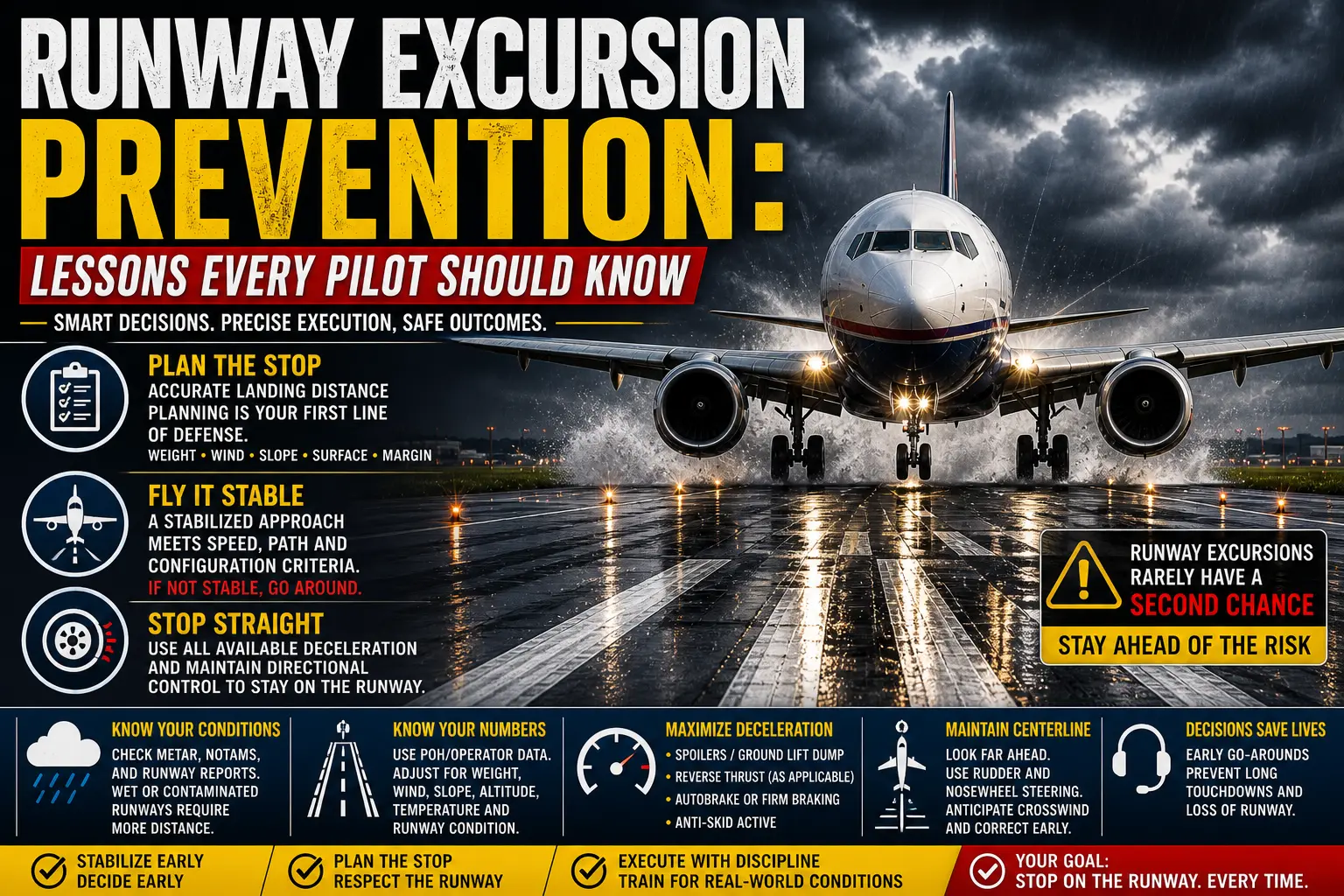
Runway excursion prevention is essential knowledge for every pilot. A runway excursion occurs when an aircraft veers off or overruns the prepared runway surface during landing or takeoff. Preventing excursions depends on awareness of the leading causes, accurate landing distance planning, and disciplined braking and rollout techniques. This article uses clear operational language to explain the underlying principles and give practical guidance pilots can apply in training and line operations.
Read on to learn how approach stability, environmental factors, aircraft performance, and pilot technique combine to determine whether a landing ends safely on the runway. The primary keyword "runway excursion prevention" appears early because understanding this topic reduces risk and improves decision-making for students, instructors, and professional pilots.
What Causes Runway Excursions
Understanding common causal threads helps pilots focus training and risk controls. The leading causes of runway excursions are rarely a single failure; instead they are combinations of environmental, procedural, aircraft, and human factors.
Key contributors include:
- Unstable approaches. High energy, excessive speed, or improper configuration at flare make long touchdowns or bounced landings more likely.
- Misjudged or inadequate landing distance. Not accounting for runway surface condition, wind, slope, or aircraft weight can leave insufficient runway to stop.
- Adverse runway conditions. Wet, contaminated, or grooved surfaces change braking and directional control characteristics.
- Poor directional control on rollout. Crosswind, asymmetric braking, or delayed corrective inputs can cause veer-off.
- Late decisions and delayed go-arounds. Continuing unstable approaches increases the chance of unsafe touchdowns.
Why This Matters in Real-World Aviation
Runway excursions result in damage, injuries, operational disruption, and significant cost. For flight training and airline operations alike, preventing excursions protects lives and assets. The operational environment is complex: airports vary in length, elevation, and surface condition; airports can experience abrupt wind shifts; and pilots must integrate aircraft performance data with live weather and airport information.
For training programs and operators, runway excursion prevention links to crew resource management, standard operating procedures, and dispatch planning. For individual pilots, it is a blend of preflight performance planning, in-flight energy management, and precise execution on touchdown and rollout.
How Pilots Should Understand This Topic
Think about runway excursion prevention as three interacting layers: approach management, landing distance awareness, and rollout discipline.
Approach management covers stabilization criteria. A stabilized approach has the correct speed, descent rate, configuration, and alignment well before the runway threshold. If the approach is not stabilized by the prescribed gate for your aircraft or operator, a go-around is the safe option.
Landing distance awareness means using the aircraft performance information in the pilot operating handbook, company performance data, and any applicable airport runway reports to determine whether landing is feasible. Performance calculations must account for weight, wind, runway slope, elevation, temperature, and surface condition. Pilots should be familiar with how the aircraft manufacturer quantifies landing distances and how to apply adjustments for contaminants and wind.
Rollout discipline begins at the point of touchdown. Touchdown location, use of aerodynamic deceleration (flaps, spoilers), timely autobrake or manual braking, reverse thrust where appropriate, and active directional control are all part of a disciplined rollout. The goal is to apply the available stopping capability without sacrificing directional control.
Landing Distance Awareness: Practical Considerations
Landing distance guidance in the aircraft documentation provides a baseline, but pilots must translate published numbers into operational decisions. Important practical considerations include:
- Know how your aircraft reports landing distance and what assumptions are built into those figures. Manufacturer data are normally based on specific touchdown points, dry runways, and specific flap settings.
- Adjust for runway condition. Wet or contaminated runways can significantly increase required stopping distance and reduce directional control margins.
- Account for wind and slope. A tailwind increases distance required; a headwind reduces it. Uphill slope helps stop; downhill slope increases stopping distance.
- Include a safety margin. Use operator SOPs or POH guidance to add an appropriate margin to the calculated landing distance to account for uncertainties and human factors.
Operationally, if the calculated landing distance plus margin approaches available runway length, pilots should consider lighter weight, different flap settings where allowed, a different runway, or a diversion. Avoid squeezing a landing into marginal runway length; the safest decision may be a go-around or diversion.
Braking and Rollout Discipline
Braking strategy must match the aircraft type and runway conditions. For light airplanes and many turboprops, wheel brakes combined with aerodynamic drag and reverse thrust are the primary tools. For jets, spoilers and reversers are critical. Key elements of braking discipline include:
- Confirm spoiler/ground lift dump activation on touchdown to transfer lift off the wings and load the wheels for effective braking.
- Use autobrake systems per SOP when available. Autobrake can provide consistent deceleration and free up the pilot to monitor directional control during rollout.
- On wet or contaminated surfaces, apply progressive braking to avoid wheel lockup. Do not manually pump brakes if the aircraft has an anti-skid system; that system is designed to modulate brake pressure.
- Maintain runway centerline and look well ahead. Anticipate crosswind corrections and use rudder and nosewheel steering inputs as required.
Discipline also means being decisive. If braking effectiveness is lower than expected or directional control deteriorates, call for and execute a rejected landing if appropriate, or bring the aircraft to a controlled stop and request assistance. Hesitation can convert a recoverable situation into an excursion.
Common Mistakes or Misunderstandings
Pilots can fall into several common traps related to runway excursions:
- Relying solely on experience instead of current performance calculations. Conditions change; published numbers and situational awareness are essential.
- Continuing unstable approaches because of perceived time pressure or desire to salvage the landing. This increases the probability of long touchdown and loss of stopping margin.
- Underestimating contaminant effects on braking and directional control. A runway that looks merely wet can sometimes support close-to-normal braking, but mixed contaminants like standing water, snow, or slush often reduce braking sharply.
- Incorrect brake technique for the aircraft. For example, attempting to pump brakes on a plane with an anti-skid system can reduce deceleration effectiveness.
Practical Example
Scenario: A single-pilot turboprop on a scheduled short-haul route approaches a 5,000-foot runway with a light tailwind and light rain. The aircraft is near maximum landing weight. The pilot crosses the threshold slightly high and fast, and touchdown occurs near the first third of the runway. The runway is wet with pooling in the touchdown zone.
Analysis: This scenario combines marginal landing distance with adverse surface condition and a late touchdown. The pilot's options before touchdown included: execute a stabilized approach, reduce weight earlier, select another runway with a headwind component, or perform a go-around when the approach became unstable. After touchdown, the pilot must apply spoilers, engage maximum available deceleration (reverse where appropriate), and use firm, coordinated braking while maintaining directional control. If braking is ineffective and stopping distance is likely to be exceeded, a controlled exit off the runway surface away from obstacles may be safer than attempting to stop at all costs.
Training takeaway: Practice go-arounds for unstable approaches, rehearse wet-runway landings in simulators where available, and review landing distance calculations for the aircraft and common airports.
Best Practices for Pilots
Strong habits reduce the chance of runway excursions. The following best practices emphasize decision-making and technique without becoming a procedural checklist.
- Plan every landing using current performance data and include an operator-recommended safety margin.
- Apply stabilized approach criteria rigorously. When in doubt, go around early.
- Brief the expected touchdown point and rollout plan during the approach. Communicate with the other pilot or ATC if any deviation occurs.
- Use aircraft systems appropriately: spoilers, autobrake, anti-skid, and reverse thrust where available and authorized.
- Practice crosswind touchdown and rollout control in training to build skill in maintaining the centerline under braking.
- Monitor runway condition reports and NOTAMs that may affect braking action assessments.
Frequently Asked Questions
How should I adjust landing distance for wet or contaminated runways?
Adjust landing distance using the manufacturer guidance and your operator's SOP. Published figures often include dry-runway assumptions. Apply the recommended corrections for contaminants, add the SOP safety margin, and make a conservative operational decision if the available runway is close to the calculated requirement.
When is a go-around the correct response to an unstable approach?
Execute a go-around whenever the approach fails to meet your stabilized approach criteria by the required gate or when you identify a significant deviation that jeopardizes a safe landing. A timely go-around is a risk-control action, not a failure.
Should I rely on autobrake systems to prevent excursions?
Autobrake systems reduce pilot workload and can improve consistency, but pilots must still monitor braking effectiveness, be ready to take manual control, and understand limitations of autobrake and anti-skid systems in contaminated conditions.
What is the best braking technique in a small GA airplane on a wet runway?
Use spoilers or speed-reducing configuration as available, apply firm and progressive braking, and maintain directional control with rudder and, as needed, differential braking. If the aircraft has an anti-skid system, allow it to operate rather than pumping the brakes. Consult the POH for aircraft-specific recommendations.
Key Takeaways
- Practical takeaway: Use accurate landing distance planning, include a safety margin, and make early go-around decisions for unstable approaches.
- Safety takeaway: Effective runway excursion prevention combines stable approaches, proper braking techniques, and timely decision-making under changing conditions.
- Training & operational takeaway: Regular simulator or supervised practice of wet-runway landings, crosswind rollout control, and go-arounds builds the skills needed to prevent excursions.