
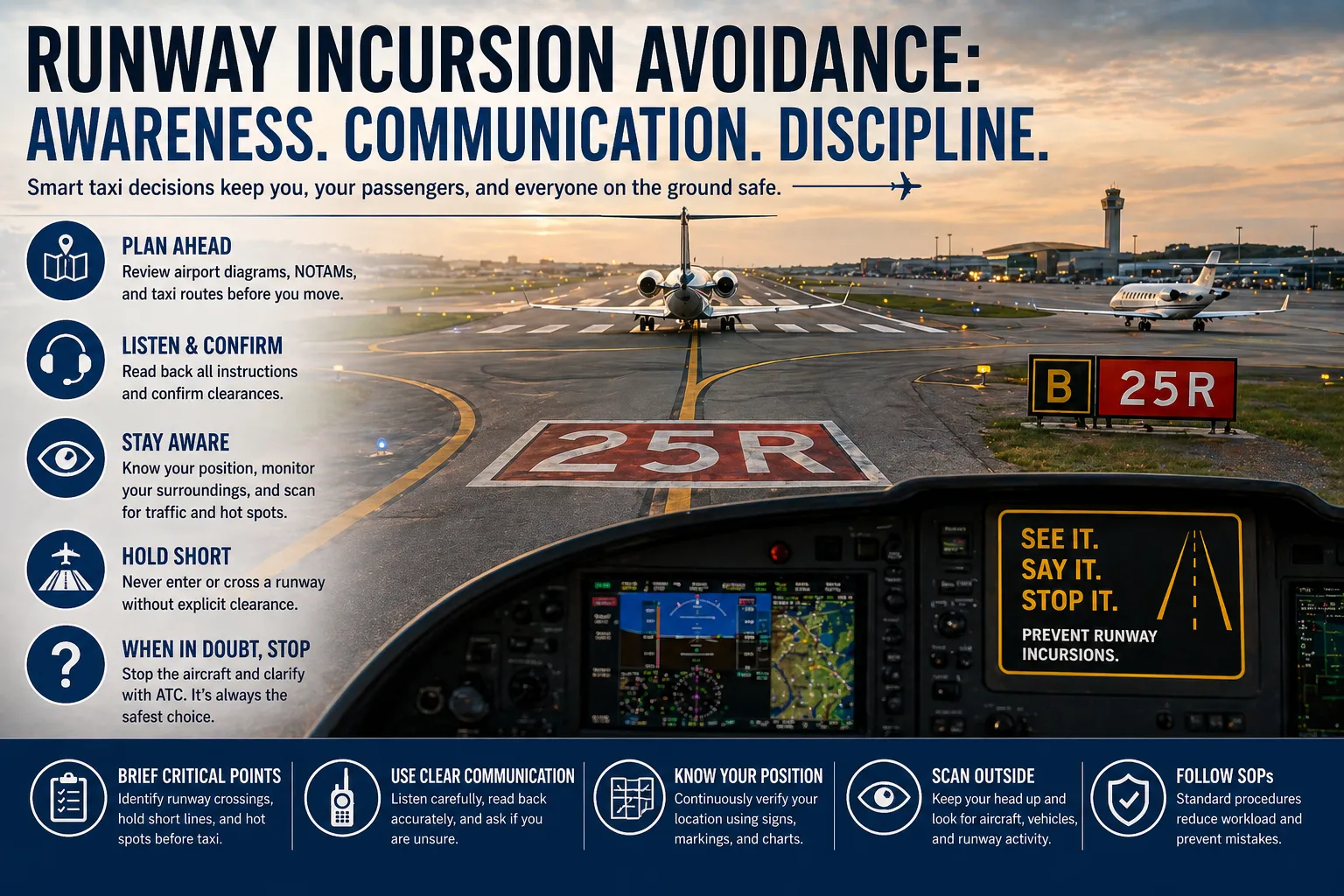
Some of the most dangerous moments in aviation do not happen at altitude. They happen on the ground, at low speed, in environments that feel routine. A runway incursion, defined as the incorrect presence of an aircraft, vehicle, or person on a runway, can unfold in seconds with little time to recover.
Taxiing is often treated as a transition phase between “real flying” segments of the flight. In reality, it is one of the most complex and high-risk phases, especially at busy or unfamiliar airports. Increasing traffic, more complex layouts, and higher pilot workload have made surface operations a growing safety concern.
The FAA’s guidance does not treat runway incursion avoidance as a single technique. It treats it as a system built on planning, awareness, communication, and discipline. When those elements break down, even briefly, the results can be serious.
Concept A: Why Runway Incursions Still Happen
Runway incursions are rarely caused by one obvious mistake. They usually develop from small errors that compound under pressure. A missed instruction, a distraction, or a moment of assumption can place an aircraft where it should not be.
Modern airports contribute to this challenge. Expanded taxiway systems, intersecting runways, and complex routing increase the cognitive load on pilots. At the same time, the busiest moments of flight often occur during taxi, when pilots are configuring the aircraft, running checklists, and communicating with ATC.
- Taxi routes can involve multiple turns, runway crossings, and hold short points.
- Pilots may divide attention between cockpit tasks and outside scanning.
- Expecting a clearance instead of confirming it is a common error.
- Distractions, even brief ones, can lead to loss of positional awareness.
The FAA emphasizes that reducing these risks requires more than awareness. It requires structured procedures that reduce workload and keep attention focused on the environment.
Concept B: Situational Awareness as a Continuous Process
Situational awareness during taxi is not something a pilot establishes once. It must be maintained continuously. The FAA describes this as a loop: knowing your current position, anticipating the next critical point, and actively monitoring for conflicts.
This means that taxiing is not passive movement. It is active navigation across a dynamic environment where other aircraft, vehicles, and instructions are constantly changing.
- Use an airport diagram and track progress in real time, not just before taxi.
- Identify hot spots and complex intersections before reaching them.
- Scan not only taxiways, but runways and approach paths.
- Pay close attention to aircraft with similar call signs on frequency.
- Stay mentally ahead of the aircraft by anticipating the next action.
One of the most important habits is simple: if you are unsure where you are, stop. Movement without certainty is where most runway incursions begin.
Key Differences
- Expectation vs. Reality: Pilots often expect a clearance based on experience, but only the actual clearance matters.
- Routine vs. Complexity: Taxiing feels routine, but the environment is often highly complex.
- Speed vs. Precision: Moving quickly on the ground increases risk; accuracy is more important than efficiency.
- Inside vs. Outside Focus: Time spent heads-down in the cockpit reduces awareness of external hazards.
- Movement vs. Decision-Making: Every taxi action should be deliberate, not automatic.
How-To / Process
- Plan the taxi route as part of overall flight planning, including NOTAMs and airport diagrams.
- Brief expected taxi routes, runway crossings, and known hot spots before movement.
- Complete as many cockpit tasks as possible before taxi to reduce workload.
- Maintain a sterile cockpit during taxi to eliminate unnecessary distractions.
- Write down or mentally map taxi instructions, especially at complex airports.
- Read back all hold short instructions clearly and verify understanding.
- Continuously monitor position using visual references and the airport diagram.
- Before entering or crossing any runway, confirm clearance and visually check for traffic.
- If disoriented, stop immediately and request assistance from ATC.
Why It Matters
Runway incursions remain a major focus of aviation safety because they can escalate quickly. Unlike many in-flight issues, there is often no time to recover once two aircraft are on the same runway.
The FAA has invested heavily in signage, lighting systems, and pilot education to reduce these risks. But technology alone cannot solve the problem. The most effective defense is disciplined pilot behavior.
- Most runway incursions are preventable with proper procedures.
- Human factors, not mechanical failures, are the primary cause.
- Clear communication with ATC is essential for safe surface movement.
- Maintaining awareness is the pilot’s most important responsibility during taxi.
Taxi operations may seem simple, but they demand precision. Treating them casually is what allows small mistakes to grow into serious incidents.
Key Takeaways
- Runway incursions often result from small, preventable errors.
- Taxi planning and briefing are critical parts of flight preparation.
- Situational awareness must be actively maintained at all times.
- Never enter or cross a runway without explicit clearance and visual confirmation.
- When in doubt, stop and ask. Stopping is always safer than guessing.