
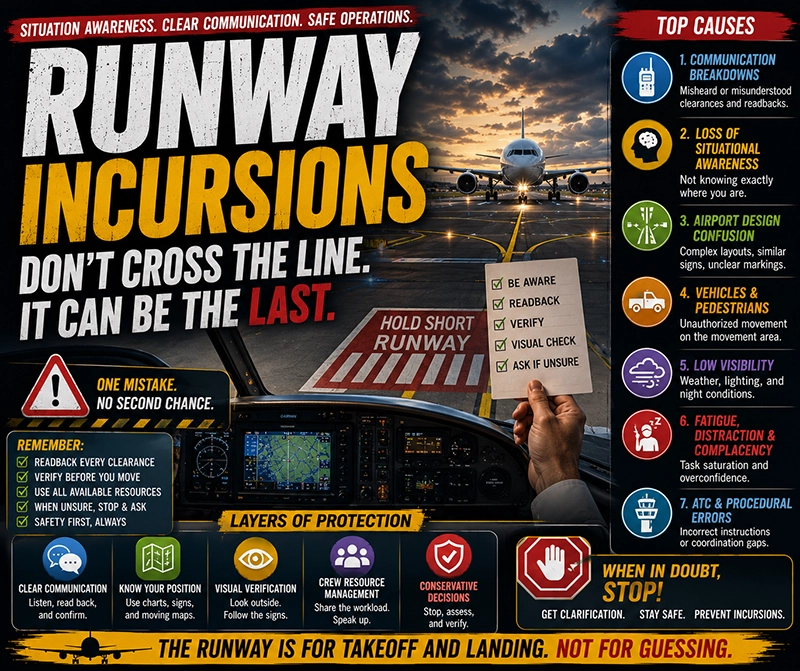
Runway incursions remain one of the most serious ground safety risks for pilots, air traffic controllers, ground vehicles, and airport operators. A runway incursion happens when an unauthorized aircraft, vehicle, or person is on a runway surface where they may conflict with a landing or departing aircraft. Because operations on the runway occur at high speeds and with little margin for error, even small mistakes can rapidly escalate into a hazardous situation.
This article explains the most common causes of runway incursions, describes how pilots and instructors should interpret and apply the information in practical flying environments, and offers clear, operationally focused strategies to reduce the risk of entering or blocking a runway unintentionally. The goal is to improve situational awareness, communication, and decision making so pilots can operate safely at controlled and uncontrolled airports.
Understanding the Core Causes of Runway Incursions
Runway incursions are rarely caused by a single factor. They typically result from a combination of human performance limitations, environmental conditions, airport design complexity, and procedural breakdowns. The most common contributing categories are communication failures, loss of situational awareness, airport surface layout confusion, vehicle or pedestrian movement, and operational pressures such as time constraints or distractions.
Each category contains specific, recurring themes. Understanding those themes and how they interact is the first step to preventing incursions in routine and non-routine operations.
Top Causes and Practical Explanations
1. Communication Breakdowns
Pilots and controllers depend on clear, unambiguous radio communication to manage ground movements. Communication breakdowns happen when readbacks are incomplete or incorrect, when transmissions are missed due to frequency congestion or poor radio technique, or when nonstandard phraseology causes misinterpretation.
Practical impact: A missed hold-short instruction or an incorrect taxi clearance can place an aircraft on a runway without appropriate sequencing or separation.
2. Loss of Situational Awareness
Situational awareness on the airport surface means knowing exactly where your aircraft is relative to taxiways, runways, hot spots, and other traffic. Loss of situational awareness occurs when crews become task-saturated during taxi, rely too heavily on memory, or fail to cross-check position with charts or airport diagrams.
Practical impact: Pilots may follow the wrong taxi route, miss a mandatory hold-short line, or inadvertently cross an active runway during complex taxi routing.
3. Airport Design and Marking Confusion
Some airports have complex layouts, closely spaced parallel taxiways, similar signage, or unusual runway intersections. Inadequate signage, ambiguous lighting, and confusing taxiway geometry can mislead crews who are unfamiliar with the field.
Practical impact: Ambiguous markings or similar-looking taxiways can cause crews to taxi onto a runway or into an area where they expected to be elsewhere.
4. Vehicle and Pedestrian Incursions
Ground vehicles, maintenance equipment, and pedestrians occasionally enter movement areas without proper clearance or by failing to observe hold-short points. Drivers unfamiliar with airport procedures, lack of training, or poor coordination with airport operations can create runway conflicts.
Practical impact: An unexpected vehicle on the runway forces flight crews or controllers to execute evasive actions, and the reaction time can be minimal.
5. Low Visibility and Night Operations
Reduced visibility due to weather, runway or taxiway lighting failures, or low ambient light at night increases the difficulty of identifying signs, markings, and other aircraft. Depth perception and spatial orientation can be degraded, placing higher demands on navigation aids and pilot verification practices.
Practical impact: Pilots may be unable to identify a hold-short line or the correct exit, increasing the probability of an incursion.
6. Human Factors: Fatigue, Distraction, and Complacency
Fatigue reduces vigilance and slows cognitive processing. Distractions such as non-essential conversations, complex cockpit tasks, or last-minute changes can disrupt normal taxi procedures. Overfamiliarity with an airport—complacency—can also lead crews to skip standard cross-checks.
Practical impact: Critical readbacks get missed and visual verification steps are skipped, increasing the chance of entering a runway without clearance.
7. ATC and Procedural Errors
Air traffic control errors, including issuing incorrect taxi instructions or clearing an aircraft onto a runway while another is still landing, factor into some incursions. Procedural gaps or miscoordination between tower and ground units can also create conflicts.
Practical impact: Even well-prepared crews can be placed in jeopardy if ATC clears movements that conflict or fails to coordinate sequencing properly.
Why This Matters in Real-World Aviation
Runway incursions can affect everyone in the flight environment: student pilots, flight instructors, corporate operators, air carriers, and ground personnel. The consequences range from minor operational disruptions to catastrophic accidents. For pilots, the primary concern is ensuring that every movement on the airport surface is deliberate, verified, and coordinated.
Instructors should build strong ground-operation habits in trainees, not only teaching taxi procedures but also practicing communication discipline, airport diagram usage, and crew resource management on the surface. For operators and flight departments, standard operating procedures that emphasize verification and conservative decision-making during taxi reduce exposure to incursion risk.
How Pilots Should Understand Runway Incursions Practically
Pilots should treat the airport surface as a dynamic environment where conditions, traffic, and instructions change rapidly. Practical understanding means applying layered defenses: procedural (clearances and readbacks), technical (moving maps and charts), visual (signage and markings), and human (briefings and crosschecks).
Important elements to internalize include: verify your position on an airport diagram whenever cleared to taxi; read back hold-short instructions exactly and listen for a proper readback confirmation from ATC; use cockpit tools such as airport moving maps judiciously while maintaining outside-the-window scanning; and keep non-essential conversations to a minimum during taxi.
Common Mistakes or Misunderstandings
Pilots frequently overestimate how well they know an airport, especially at home fields. This overconfidence leads to shortcuts: skipping a full review of the airport diagram, failing to brief the taxi route, or relying on a memory of the field layout rather than a current chart.
Another common misunderstanding is assuming that a cleared taxi route implicitly authorizes runway entry. While ATC taxi clearances include movement instructions, runway crossings and entries often require explicit clearance or a hold-short instruction. Treat the absence of an explicit runway crossing clearance as a red flag and verify before moving forward.
Misinterpreting signage and lighting is also a frequent problem. Pilots sometimes mistake runway guard lights, taxiway edge lights, or in-pavement stop bars for noncritical cues. Knowing the meaning and significance of common surface markings and lights, and double-checking your position when uncertain, reduces mistakes.
Practical Example
Consider a single-pilot pilot-in-command taxiing at a medium-sized airport at night with reduced visibility due to fog. The pilot is unfamiliar with the field and following a rushed departure schedule. On taxi the pilot is instructed to taxi via taxiways A, B, and hold short of runway 27. While making a turn onto taxiway B, the pilot becomes task-saturated troubleshooting a radio issue and misses the hold-short line. The pilot proceeds across the runway holding position, unaware that a departing jet is lined up on the opposite end.
How this situation should be handled and taught: the pilot should have briefed the taxi route before engine start, cross-checked position against the airport diagram and the cockpit moving map, and maintained sterile cockpit discipline during taxi. If any uncertainty appears—failing to see a hold-short marking, radio problems, or uncertainty about position—the pilot should stop the aircraft, notify ATC, and request progressive taxi or verification rather than continuing. Crew or single-pilot verbal callouts at key taxiway intersections and a firm policy to pause and confirm the clearance when unclear create decisive opportunities to prevent an incursion.
Best Practices for Pilots
Preventing runway incursions requires consistent habits. Below are practical actions that improve safety on the ground.
- Brief the taxi route before moving the aircraft. Even a short verbal run-through reduces navigational errors.
- Use airport diagrams and moving maps together. Cross-reference both to confirm your location while taxiing.
- Read back clearances verbatim where appropriate and listen for corrections. Accurate readbacks reduce miscommunication.
- Maintain sterile cockpit during taxi and ground operations. Postpone nonessential tasks and conversation until parked or on the ramp.
- If unsure, stop and ask. Request progressive taxi or ask ATC to confirm your position. Stopping to confirm is preferable to guessing.
- Use external visual cues. Confirm hold-short lines, runway markings, and signage before crossing a runway boundary.
- Plan for low-visibility operations. Increase crew crosschecks and rely on ATC guidance or follow-on lead vehicles if needed.
- Practice standard callouts and position reporting in multi-crew environments. Clear role assignments reduce confusion.
Training and Procedural Considerations
Flight training organizations and operators should emphasize surface operations in their syllabi and recurrent training. Simulated taxi exercises, scenario-based briefings, and use of airport diagrams during preflight briefings help trainees internalize safe habits. Instructors should create realistic taxi scenarios that include distractions, multiple clearances, and degraded lighting to help students practice stopping to verify position and repeating readbacks under stress.
Organizational procedures should define how and when to use moving maps, how to manage non-normal communications, and what constitutes an acceptable conservative decision to hold position and seek clarification. Where operations involve vehicles or contractors on the movement area, joint training and clear communication channels between airside stakeholders reduce cross-domain errors.
Technology and Tools That Help
Modern avionics offer tools that can reduce incursion risk when used properly. Electronic airport moving maps, traffic displays, and head-up guidance systems increase positional awareness, especially at complex airports. However, technology is not infallible. Pilots should verify electronic displays against visual cues and charts. Know the limitations of any intrusion-detection or situational-awareness tool and confirm its currency and configuration before relying on it during taxi.
Human Factors: Mitigating Fatigue and Distraction
Pilot fatigue and distraction are underlying contributors to many ground incidents. Managing duty time, ensuring adequate rest, and enforcing sterile cockpit rules during taxi and ground operations reduce the cognitive load and improve attention to critical visual and radio cues. Use simple, repeatable callouts at intersections, and make position confirmations a normal part of taxi—for example, announcing taxiway intersections and hold-short points out loud until your route is positively confirmed.
Common Misunderstandings and How to Correct Them
One widespread misunderstanding is that brief or routine taxi routes require less vigilance. On the contrary, routine operations breed complacency. Training and SOPs should treat every taxi as if it involves potential conflicts and require the same standard of verification.
Another misconception is that moving-map technology eliminates the need to study the airport diagram. While helpful, moving maps can obscure important details like temporary taxiway closures or NOTAMs. Cross-reference your electronic displays with current charts and NOTAMs when they are relevant.
Frequently Asked Questions
What exactly defines a runway incursion?
A runway incursion occurs when an unauthorized aircraft, vehicle, or person is on a runway surface that is intended for use by aircraft for takeoffs or landings. The defining factor is the presence in a protected runway area that creates potential for conflict with active runway operations.
How should I respond if I realize I may have crossed a hold-short line by mistake?
Stop as soon as it is safe to do so. Notify ATC immediately, clearly state your position, and follow any instructions. If you cannot contact ATC, remain stopped and attempt to reestablish communication. Avoid making additional uncoordinated movements.
Are electronic moving maps sufficient to prevent incursions?
Electronic moving maps are valuable for situational awareness but should not be used as the sole means of navigation on the surface. Always cross-check against the airport diagram, signage, and ATC instructions. Understand the limitations and possible latency or database currency issues that can affect electronic displays.
What should I brief with a student to emphasize surface safety?
Emphasize taxi route identification, critical hold-short points, communications discipline, sterile cockpit rules, and when to stop and ask for clarification. Role-play common taxi clearances and practice readbacks to reinforce clear radio technique.
How do I handle an unexpected vehicle on the runway while I am on final approach?
Controllers are primarily responsible for runway incursion prevention, but if you see a vehicle on final approach, execute any appropriate missed approach or go-around procedure for your flight. Once safely airborne or stabilized, report the sighting to ATC. Avoid aggressive last-minute maneuvers that could compromise aircraft control.
Key Takeaways
- Include one clear practical takeaway: Verify your position on an airport diagram and brief the taxi route before leaving the ramp.
- Include one safety or operational takeaway: If in doubt about a hold-short or runway crossing, stop, notify ATC, and request clarification rather than guessing.
- Include one training, regulatory, or decision-making takeaway: Incorporate surface operations into training and recurrent practice, emphasizing communication discipline, sterile cockpit rules, and crew crosschecks.
Key Takeaways
- Practical: Brief and confirm your taxi route before moving and use both charts and moving maps to confirm position.
- Safety: Stop and get clarification if you are unsure about a hold-short or runway crossing; it is the safest option.
- Training/Decision-making: Regularly practice surface scenarios in training and maintain conservative decision-making under pressure.