
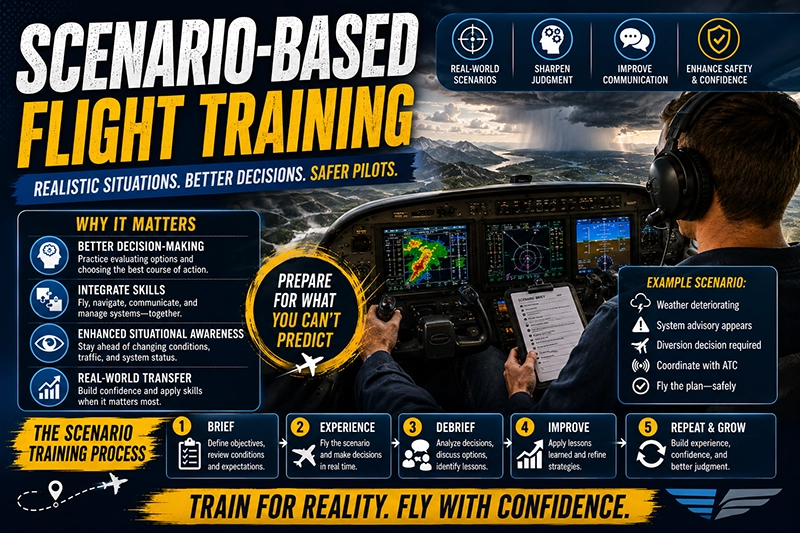
Scenario-based flight training is a learner-centered approach that uses realistic flight scenarios to teach aeronautical decision-making, risk management, and practical flying skills. For student pilots, certificated pilots, flight instructors, and training organizations, scenario-based training connects technical procedures to real-world contexts so pilots can practice judgment, communications, and systems management together rather than in isolation. This article explains why scenario-based flight training matters, how it differs from traditional procedural instruction, and how pilots can apply it safely and effectively.
Read on to learn how scenario-based training improves retention, situational awareness, and decision-making. The guidance here focuses on practical application in flight lessons, simulators, and briefings while highlighting common pitfalls and offering clear examples instructors and pilots can use in everyday training.
What is Scenario-Based Flight Training?
Scenario-based flight training places the student in a coherent, realistic situation that imitates operational flying. A scenario typically includes mission objectives, environmental conditions, traffic and airspace considerations, and one or more challenges or threats that require pilot judgment. Unlike drills that focus solely on procedure repetition, scenarios integrate technical flying tasks with decision-making, communication, and threat-and-error management.
Key elements of a high-quality scenario include a clear training objective, realistic constraints, evolving conditions, and a debrief structure that emphasizes decision rationale and learning points. Scenarios can be flown in the airplane, in approved simulators, or worked through as tabletop briefings. The emphasis is on creating context so that pilots see how procedures and checklists fit within broader operational demands.
Why This Matters in Real-World Aviation
Pilots operate in dynamic environments where weather, traffic, systems anomalies, and human factors interact. Scenario-based flight training builds skills that matter for safety and operational effectiveness:
- Improved decision-making: Scenarios challenge pilots to evaluate options, consider consequences, and choose actions under realistic time pressure.
- Better integration of tasks: Pilots learn to manage priorities when multiple tasks compete for attention, such as flying the airplane while troubleshooting a minor systems issue and communicating with ATC.
- Enhanced situational awareness: Working through scenarios helps pilots maintain awareness of traffic, airspace, fuel, and changing weather.
- Transfer to real operations: Training in context helps pilots apply learned responses in unexpected real-world situations more readily than isolated skill practice.
These outcomes are important for single-pilot operators, commercial operators, flight instructors, and students preparing for initial or advanced certificates. Scenario-based training fosters the judgment and adaptability that written tests and simple procedural drills cannot adequately measure.
How Pilots Should Understand This Topic
Think of scenario-based training as purposeful storytelling for aviation skills. A good scenario creates a narrative that immerses the pilot in operational decision points: where to go, when to divert, how to prioritize tasks, and whom to call for help. It should challenge habits and assumptions so the pilot practices effective strategies for recognizing threats and managing errors.
Scenarios are not a replacement for procedural mastery. Pilots must still learn and internalize aircraft limitations, emergency procedures, and radio phraseology. Scenario-based training complements that foundation by providing context to apply those procedures under realistic pressures. A pilot who knows the checklist well but cannot prioritize tasks under stress will struggle in real operations. Scenario-based training tightens that gap.
Common Mistakes or Misunderstandings
Adopting scenario-based training brings clear benefits, but there are common pitfalls instructors and students should avoid:
- Overcomplicating scenarios: Adding too many simultaneous challenges can overwhelm a student and prevent learning. Start with a single objective and introduce complexity progressively.
- Using scenarios without clear objectives: A scenario without defined learning goals becomes busywork. Always identify the target skill, judgment point, or decision skill before flying.
- Skipping structured debriefs: Without guided reflection, the value of a scenario fades. Debrief to uncover decision points, alternative actions, and mental models.
- Focusing only on successful outcomes: Practicing recovery and safe alternatives after errors is as valuable as practicing ideal flows. Controlled errors during scenarios reveal gaps that need training.
- Treating scenarios as checklists: The goal is applied judgment, not rote completion. Encourage students to explain why they choose actions rather than simply following steps.
Practical Example
Scenario: A cross-country in a single-engine airplane with marginal VFR conditions developing en route. The objective is to practice diversion decision-making and single-pilot workload management.
Briefing: The instructor sets the scene. The planned route passes through airspace with a scheduled fuel stop. Weather reports indicate a shallow front moving in, with a broken ceiling forecast to lower during the flight. A minor electrical bus warning could appear later to introduce a systems-management element.
During the flight, the student monitors weather and fuel, receives updated ATIS indicating lowered ceilings at the destination, and notices the predicted time when conditions are expected to deteriorate. The instructor introduces a simulated electrical advisory that requires the student to decide whether to continue, divert, or return. The student must communicate with ATC, select an alternate airport if necessary, manage descent and approach, and fly safe pattern work while coordinating with the instructor.
Debrief: Discuss the decision timeline: when the student recognized the threat, what alternatives were considered, what factors were weighed (fuel, airspace, airport facilities), and whether communications were timely and clear. Highlight the importance of timely diversion planning and maintaining flying priorities under workload.
This realistic practice reinforces the habit of continuous en route risk assessment and prepares the pilot to make safer choices when conditions change in real operations.
Best Practices for Pilots
Implementing scenario-based training effectively requires thought and discipline. Consider these practical habits:
- Define clear learning objectives before each scenario. Know what judgment, skill, or procedure you are trying to develop.
- Start simple and increase complexity. Begin with one decision point or system failure, then layer in traffic, weather, or ATC complexity.
- Use a formal brief-debrief structure. A concise briefing sets roles and success criteria. A structured debrief identifies decision triggers, alternative options, and corrective actions.
- Emphasize threat and error management. Teach students to anticipate threats, detect deviations, and mitigate consequences through timely action and cross-checking.
- Practice communication as part of the scenario. Include ATC, passengers, and dispatch interactions so pilots rehearse concise, prioritized information exchange.
- Record or document scenarios when possible. Flight data, audio recordings, or instructor notes improve debrief quality and track progress.
- Adapt scenarios to aircraft and operation. Tailor complexity to the aircraft’s systems and the pilot’s experience level. What is appropriate in a glass-cockpit complex airplane differs from a basic trainer.
How to Design an Effective Scenario
Designing an effective scenario blends realism with pedagogical clarity. A useful template is:
- Training objective: Define what the learner should demonstrate by the end.
- Initial conditions: Fuel, weight and balance, weather, alternate airports, airspace, and traffic considerations.
- Trigger events: Planned events that introduce the decision point, such as weather deterioration, ANTI-ICE advisory, minor system failure, or passenger medical issue.
- Constraints: Time pressure, communications limitations, or diverted priorities to simulate workload.
- Success criteria: Measurable outcomes, such as timely diversion planning, correct emergency checklist execution, or effective crew/passenger communication.
- Debrief points: Questions to explore the student’s thought process, alternatives, and lessons learned.
Keep scenarios credible and proportional to the student’s competence. The best scenarios challenge without overwhelming and end with actionable learning points.
Integrating Scenario-Based Training Across Programs
Flight schools, university programs, and operators can integrate scenario-based training at multiple levels. For initial instruction, short scenarios that reinforce crosswind landings, radios, and traffic patterns can solidify fundamentals. For advanced training, scenarios can simulate weather diversions, system failures, night operations, and complex airspace navigation.
Simulators and flight training devices are valuable because they allow repeated exposure to hazardous conditions without real-world risk. However, in-aircraft scenarios add the sensory cues and workload unique to actual flight. An effective program blends both modalities.
Training organizations should codify scenario objectives in syllabi, train instructors on debrief techniques, and assess student performance against decision-making metrics in addition to procedural checklists.
Common Safety Risks and How Scenarios Reduce Them
Many accidents and incidents have roots in poor judgment, task saturation, or failure to react to changing conditions. Scenario-based training addresses these risks by creating controlled exposures to the same human factors that contribute to accidents.
By practicing diversion planning, go/no-go decision-making, and single-pilot resource management in realistic contexts, pilots learn to identify early warning signs and choose safer options. Scenarios also build resilience for dealing with distractions, unreliable automation, and ambiguous information by reinforcing prioritization and verification habits.
Implementation Tips for Flight Instructors
Flight instructors who integrate scenario-based training should focus on teaching mental frameworks as much as flying skills. Useful frameworks include:
- Plan-Do-Check: outline options, execute decisions, and continuously reassess.
- Threat and Error Management: identify threats, anticipate possible errors, and apply mitigation.
- SARAH or CRM-style briefings: succinctly share responsibilities and expected actions for common scenarios.
During debriefs, ask open-ended questions: What did you think were the critical cues? What choices did you dismiss and why? What would you do differently with more fuel or alternate airport options? These questions encourage metacognitive learning and help the student internalize lessons.
Measuring Progress and Assessment
Assessment should include both technical performance and decision-making quality. Objective criteria can include adherence to aircraft control parameters, checklist completions, communication clarity, and timeliness of decisions. Subjective assessments should document how the student weighed options, recognized threats, and managed workload.
Keep records of scenarios and debrief findings so instructors can track recurring weaknesses and tailor subsequent training. This practice supports both individual development and program-level quality improvement.
Frequently Asked Questions
How often should scenario-based training be used during lessons?
Use scenario-based elements regularly but proportionately. Early lessons benefit from short, focused scenarios that support a single learning objective. As proficiency grows, extend scenario complexity. For recurrent training, plan at least one substantial scenario per session to practice integrated skills.
Can scenario-based training be used in simulators only?
Simulators are excellent for high-risk or complex scenarios because they allow safe rehearsal. However, in-aircraft scenarios offer different sensory and workload experiences. Best practice blends simulator sessions with in-aircraft scenarios when practical and safe for the student’s experience level.
How do I keep scenarios realistic without introducing unsafe risk?
Control risk by setting clear limits, such as minimum safe altitudes, fuel reserves, weather minimums, and instructor intervention points. Use simulated failures where possible, and brief predefined escape actions. Ensure that every scenario has a safe, preplanned termination point.
Should scenario outcomes be graded strictly pass/fail?
Focus assessment on learning rather than punitive grading. Use outcome-based measures for certification milestones but treat most scenarios as formative opportunities. A graded scenario can follow several practice attempts and a coaching cycle.
How can instructors avoid bias in debriefs?
Use structured debrief frameworks and objective data when available. Encourage the student to self-assess first, then compare observations. Document decision points and alternatives to avoid retrospective bias about what was predictable or obvious.
Key Takeaways
- Practical takeaway: Use realistic, objective-focused scenarios to train judgment and task management alongside procedures.
- Safety takeaway: Scenarios reduce risk by rehearsing diversions, communications, and threat mitigation under controlled conditions.
- Training takeaway: Structure scenarios with clear objectives and formal debriefs to maximize learning and measurable progress.
Scenario-based flight training is an evidence-informed practice for developing the integrated skills pilots need in real operations. When designed and executed thoughtfully, scenarios enhance retention, sharpen decision-making, and improve safety margins. Instructors and operators who invest in scenario design, instructor development, and structured debriefing will see trainees make better choices and demonstrate stronger single-pilot resource management in the air.