
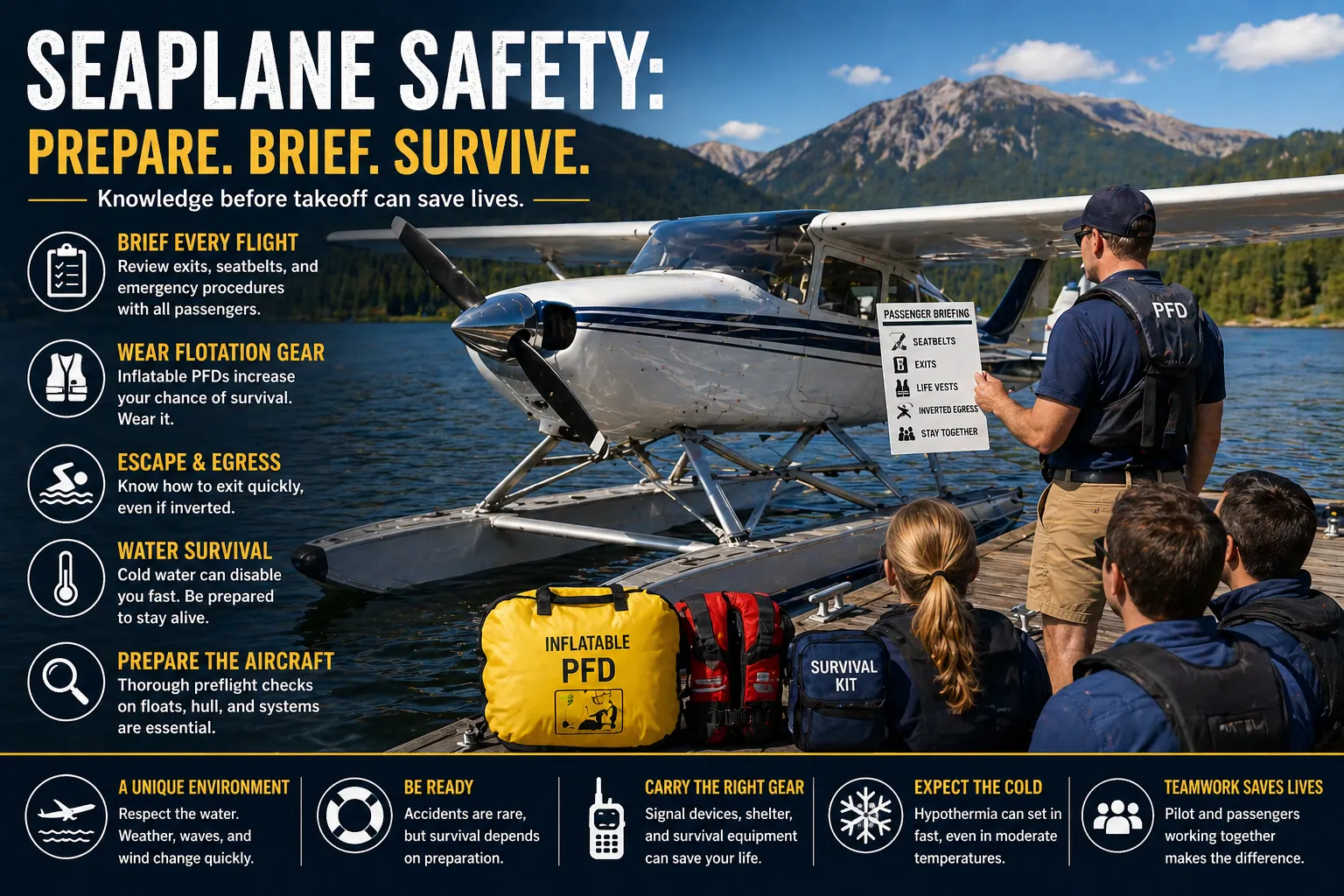
Seaplanes open the door to a different kind of flying. Lakes, rivers, and coastal waters become runways, allowing access to places no traditional aircraft can reach. But this freedom comes with risks that do not exist in land-based operations.
The FAA emphasizes an important reality. Many seaplane accidents are survivable on impact, but become fatal afterward. The real danger often begins once the aircraft is in the water. Survival depends on preparation, awareness, and the ability to exit the aircraft quickly.
Seaplane safety is not just about flying skill. It is about understanding the environment, preparing passengers, and planning for what happens if things go wrong.
The Unique Risks of Seaplane Operations
Seaplanes operate in an environment that is constantly changing. Water is not a fixed surface, and even small changes in conditions can affect safety.
- Waves, currents, and wind can impact takeoff and landing performance.
- Floating debris and obstacles are not always visible.
- Aircraft may capsize or invert during accidents.
- Remote operations can delay rescue efforts.
Once on the water, a seaplane is also considered a vessel and must follow navigation rules. This adds another layer of responsibility that pilots must be prepared for.
Passenger Briefings: The Most Critical Safety Tool
The FAA places strong emphasis on passenger briefings for one reason. In many seaplane accidents, passengers must act on their own. The pilot may be unable to help, and there is little time to react.
A proper briefing should go beyond basic seatbelt instructions. It should prepare passengers for a worst-case scenario.
- Show how to locate and operate all exits.
- Demonstrate how to fasten and release seatbelts without looking.
- Explain how to maintain orientation if the aircraft is upside down.
- Review flotation gear and when to inflate it.
- Emphasize leaving all personal items behind during evacuation.
Accident history shows that passengers who are not briefed often become disoriented and unable to escape, even when the impact itself is survivable.
Escaping the Aircraft After an Accident
One of the most dangerous aspects of seaplane accidents is the possibility of the aircraft coming to rest inverted in the water. This creates a disorienting and time-critical situation.
Passengers may find themselves upside down, submerged, and unable to see clearly. In these moments, simple actions become difficult.
- Seatbelts must be released quickly and correctly.
- Exits may be blocked or difficult to open due to water pressure.
- Disorientation can make it hard to determine direction.
- Panic can prevent effective movement toward an exit.
The FAA stresses that preparation is what makes the difference. Passengers who understand what to expect are far more likely to escape successfully.
Flotation Gear and Survival Equipment
Flotation gear is one of the most important pieces of safety equipment in a seaplane. However, it must be used correctly to be effective.
- Inflatable flotation devices should be worn, not stored.
- They should only be inflated after exiting the aircraft.
- Bulky flotation devices can make exiting more difficult.
- Survival kits should include signaling, shelter, and emergency supplies.
The FAA recommends that flotation gear be readily available for every occupant and that pilots brief passengers on its use before every flight.
Water Survival and Hypothermia
Escaping the aircraft is only the first step. Survival in the water introduces another set of challenges, especially in colder environments.
Cold water can quickly reduce body temperature, leading to hypothermia. Even a small drop in core temperature can impair judgment and physical ability.
- Water removes heat from the body much faster than air.
- Hypothermia can develop in minutes in cold conditions.
- Flotation devices help conserve energy and body heat.
- Proper positioning in the water can reduce heat loss.
Pilots should plan for these conditions and consider survival equipment based on the environment they are operating in.
Why It Matters
Seaplane accidents often follow a predictable pattern. The impact may be survivable, but the outcome depends on what happens next. Preparation before the flight determines survival after the accident.
- Many fatalities occur because occupants cannot exit the aircraft.
- Lack of passenger preparation is a common factor.
- Cold water exposure significantly increases risk.
- Proper use of equipment can make the difference between life and death.
Seaplane safety is not about reacting in the moment. It is about preparing for the moment before it happens.
Key Takeaways
- Seaplane safety depends on preparation, not just flying skill.
- Passenger briefings are critical and should never be skipped.
- Always be prepared for an inverted, underwater evacuation.
- Wear flotation gear and use it correctly.
- Plan for water survival, especially in cold or remote environments.