
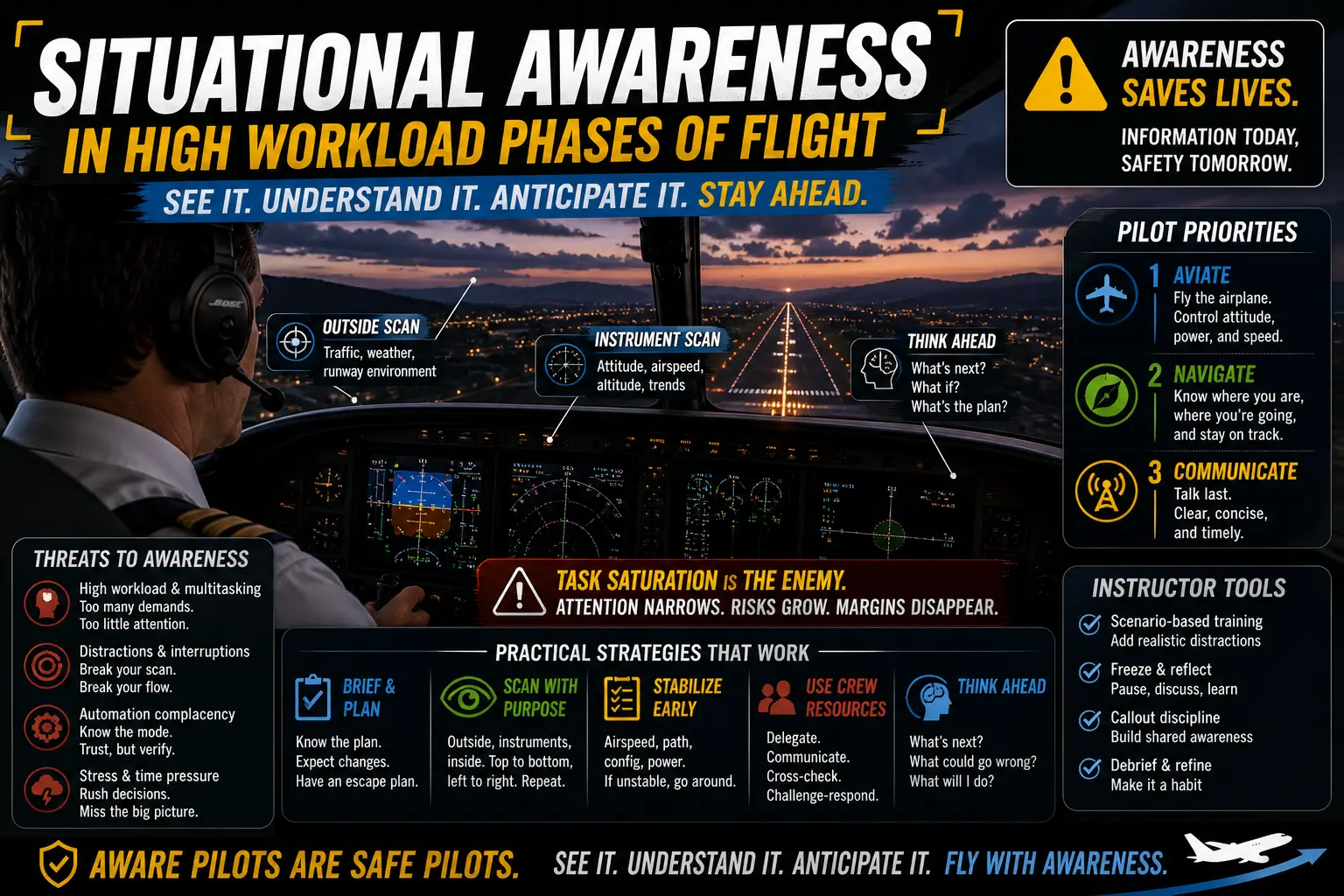
Situational awareness is the pilot's understanding of the aircraft, the environment, and how both will evolve over time. In high workload phases of flight such as takeoff, initial climb, approach, and landing, maintaining situational awareness becomes more difficult and more critical. Effective awareness reduces the chance of errors, improves decision making, and supports safe recovery from unexpected events.
This article explains why situational awareness degrades under task saturation, practical prioritization strategies pilots can use, and instructor techniques that build awareness in students and crews. The goal is to provide usable guidance you can apply in training flights, everyday operations, and recurrent practice without relying on memorized checklists alone.
Core idea: What situational awareness really means in flight
Situational awareness has three practical layers: perception, comprehension, and projection. Perception is noticing relevant information such as airspeed, altitude, engine indications, traffic, and weather. Comprehension is interpreting what those cues mean for aircraft state and trajectory. Projection is forecasting how the situation will develop if no action is taken or if a particular action is taken.
Under low workload these layers operate smoothly. Under high workload attention narrows, some cues are missed, and mental models may become incomplete or incorrect. The pilot who cannot perceive or properly interpret critical cues loses the ability to project and make timely decisions. Recognizing how attention shifts under pressure is the first step toward practical strategies that preserve awareness.
Why this matters in real-world aviation
High workload phases concentrate many tasks into short time windows: configuring the aircraft, monitoring performance, communicating with ATC, scanning for traffic, managing automation, and handling weather. When multiple tasks compete for attention, even experienced pilots can become task-saturated. This increases vulnerability to missed callouts, unstabilized approaches, navigation errors, and incorrect responses to malfunctions.
Beyond immediate handling, degraded situational awareness affects decision making. Poor projection can lead to delayed go-arounds, incorrect diversion choices, or inappropriate automation modes. For instructors, operators, and safety managers, training that improves awareness in realistic high-workload contexts reduces error chains and supports safer outcomes.
How pilots should understand situational awareness practically
Think of situational awareness as an active process, not a static trait. It requires deliberate habits and systems that compensate for human limits under stress. Useful mental models include the aviate-navigate-communicate priority, explicit scan patterns, and simple mnemonic cues that prompt timely actions.
Automation is a force multiplier when used correctly and a trap when misunderstood. Reliance on automation without monitoring can erode awareness because the pilot's attention shifts outward from systems. Balanced use means delegating repetitive tasks to automation while retaining active crosschecks and an understanding of the automation's current mode and limitations.
Task saturation risks and how they develop
Task saturation happens when cognitive demands exceed available attention and working memory. Common triggers in flight include unexpected system warnings, rapidly changing weather, a busy radio environment, or an unstable approach. Saturation typically follows a predictable pattern: attention narrows to the most salient cue, peripheral processing decreases, and the pilot may begin to execute actions without verifying context.
Under saturation pilots often skip steps, misprioritize, or fixate on a single problem while other threats go unchecked. Recognizing early signs such as missed callouts, delayed responses, erratic scan patterns, or increased verbal disorganization helps crews intervene before safety margins erode.
Prioritization strategies to preserve awareness
Effective prioritization organizes attention and actions so the most critical threats are handled first. Use these practical strategies:
- Clear priorities: Follow aviate-navigate-communicate. Maintaining flying parameters comes first, then ensuring the aircraft is on the intended course, then handling communications and other tasks.
- Simplify tasks: When overloaded, revert to the simplest, safest configuration or mode that allows control and visibility. For example, fly straight and level to buy time for troubleshooting an electrical issue rather than continuing a complex approach.
- One task at a time: Assign tasks to crewmembers and avoid trying to multitask critical items. Announce intentions out loud to keep both pilots aligned.
- Abort early: If an approach becomes unstabilized, prioritize a go-around. This prevents further workload escalation and restores margins.
- Use the sterile cockpit: Reduce non-essential conversation and tasks during critical phases to minimize distractions.
Instructor techniques to build and test situational awareness
Instructors play a pivotal role in developing students who maintain awareness when it matters most. Effective instructional methods focus on deliberate practice, realistic scenarios, and graduated exposure to workload.
Key techniques include:
- Scenario-based training: Create realistic high-workload scenarios that integrate navigation, communications, and systems management so students practice maintaining a scan and making decisions under pressure.
- Interval challenges: Use periodic disruptions—such as minor avionics faults or changes in ATC instructions—so the student practices reprioritizing without overwhelming them. Debrief each event to surface decision points.
- Freeze and reflect: Pause a scenario at critical moments and ask the student to describe their perception, intent, and projection. This promotes metacognition and reveals gaps in their mental model.
- Callout discipline and challenge-response: Teach precise callouts and require verbal confirmation for configuration changes. Challenge-response helps maintain shared awareness in multi-crew environments.
- Automation management training: Focus on mode awareness. Teach students to verbalize current automation mode and expected behavior during transitions.
- Use of distractions in a graded way: Train with controlled distractions so students learn to recover focus and reestablish a correct scan pattern.
Common mistakes and misunderstandings
Several repeated errors undermine situational awareness in training and operations:
Assuming automation will catch everything. Automation extends capability but does not replace crosschecks or mode awareness. Pilots who fail to verify automation mode can be surprised by unexpected behavior.
Fixation on a single problem. Focusing exclusively on a minor malfunction while ignoring aircraft attitude or energy can create cascading hazards.
Poor communication and ambiguous callouts. When crew members are not explicit, assumptions fill the gap and shared awareness breaks down.
Insufficient scenario realism. Training that isolates skills fails to prepare pilots for the simultaneous demands of real flights. Integrating tasks better reproduces operational workload and builds robust habits.
Practical example: Managing an unstabilized approach in IMC
Imagine you are flying an instrument approach in low clouds. During final approach you notice that airspeed is slightly high, the descent rate is increasing, and the approach lights are not visible. Simultaneously, ATC issues a frequency change and a passenger reports a sudden smell of smoke.
Prioritize: aviate first. Establish a stable attitude and power setting to control airspeed and descent. Next, navigate by verifying your position relative to the final approach path. Communicate third: declare the situation to ATC and request a go-around or vectors as needed. Delegate tasks: one pilot flies and stabilizes the aircraft, while the other confirms configuration, monitors instruments, and communicates. If uncertainty remains about the approach stability, execute a go-around to reset workload and re-plan.
Best practices for pilots
Adopt habits that make awareness routine rather than reactive. A short list of practical actions:
- Establish and practice a reliable scan pattern matched to each phase of flight.
- Brief expected external changes and what actions you will take if they occur.
- Practice verbalizing automation mode and any mode changes.
- Use simple mnemonics to trigger stabilization checks at key altitudes and distances.
- Debrief scenarios promptly to reinforce mental models and correct misunderstandings.
Frequently Asked Questions
How can I tell when task saturation is becoming dangerous?
Warning signs include missed callouts, delayed control inputs, a narrowing scan focused on a single instrument or cue, and increased verbal confusion. When these appear, simplify tasks immediately: establish basic flying parameters and either delegate or defer lower-priority tasks.
Should I always disengage automation during high workload?
No. Automation can reduce workload if you understand its current mode and likely behavior. If mode confusion is present or automation is acting unexpectedly, hand-fly or select a simpler automation mode until the situation is stabilized.
What instructor technique most quickly improves situational awareness?
Scenario-based training that simulates realistic, integrated workload tends to be most effective. When combined with timely freeze-and-reflect pauses and structured debriefs, this approach builds both competence and metacognitive skills.
How do I practice awareness in single-pilot operations?
Use disciplined scan patterns, brief expected tasks before critical phases, and carry out verbal self-checks such as announcing mode changes or configuration steps out loud. When possible, practice with an instructor or at a simulator to rehearse responses to distractions.
Can checklists alone ensure situational awareness?
Checklists support procedural compliance but do not guarantee awareness. Combine checklists with active scanning, verbal callouts, and periodic mental models of the flight path to maintain a complete picture.
Key Takeaways
- Practical takeaway: In high workload phases, prioritize aviate-navigate-communicate and simplify tasks to preserve control and decision time.
- Safety takeaway: Early recognition of task saturation and prompt actions such as a go-around reduce the risk of cascading errors.
- Training takeaway: Use scenario-based training, freeze-and-reflect, and callout discipline to build robust situational awareness skills.