
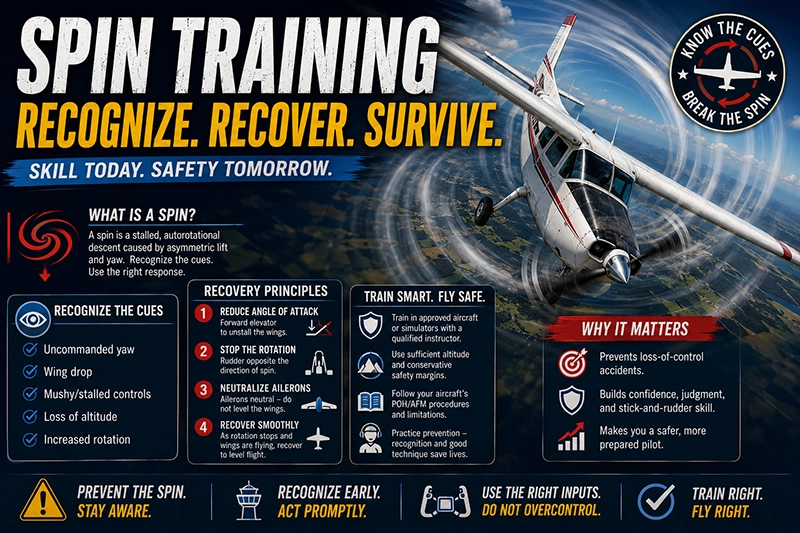
Spin training is a focused form of aerodynamic and upset recovery instruction that teaches pilots how to recognize, avoid, and recover from an aerodynamic spin. For pilots and instructors, understanding spins is essential because spins are an extreme expression of aerodynamic stall combined with yawing motion, and can lead to loss of control if not recognized and corrected promptly.
This article explains why spin training matters, what pilots need to know about the aerodynamics involved, how spin training fits into practical flight operations, common misunderstandings that increase risk, and how to design safer personal and instructional practices. The goal is to give pilots, flight instructors, and aviation professionals a readable, technically sound foundation for making training and safety decisions about spins and spin recovery.
What a Spin Is and Why It Happens
A spin is a stabilized, autorotational descent that follows an asymmetric stalled condition of the airplane. In practical terms, a spin combines a stalled wing with a yawing rotation so that the airplane rotates about its vertical axis while descending rapidly. The key aerodynamic elements are an angle of attack above the critical angle, a difference in lift and drag between the two wings, and sustained yaw that prevents the stalled flow from reattaching.
Stalls occur when the wing exceeds its critical angle of attack and can no longer produce sufficient lift. When one wing stalls more deeply than the other and the airplane is yawing, the stalled wing typically drops and the airplane can roll and yaw into a spin. Factors that influence spin entry and behavior include control inputs, power setting, airplane configuration, mass distribution, and atmospheric conditions.
Why Spin Training Matters in Real-World Aviation
Spin training matters because it addresses the full chain of events that can produce an aerodynamic upset: recognition of an impending stall, control coordination, appropriate control inputs to break the stall and stop rotation, and sound judgment about where and when to practice these maneuvers. Loss of control in flight remains a primary safety concern across general aviation. Training that improves a pilot’s ability to prevent stalls from developing into spins and recognize spin characteristics early directly reduces that risk.
In real-world operations, situations that can lead toward spins include distraction on approach, steep turn at low altitude, improper speed or configuration management during maneuvers, and uncoordinated flight in turbulence or wind shear. Spin training gives pilots the practical experience and mental models to identify precursors and apply appropriate corrective actions—both to prevent a spin and to recover when prevention fails.
How Pilots Should Understand Spin Training
Spin training is not just practicing a prescribed set of control movements. It is a layered approach that combines aerodynamic knowledge, stick-and-rudder skill, risk management, and familiarity with aircraft-specific handling. Useful ways to frame spin training include:
- Recognition: Learning the aerodynamic cues that a stall is becoming asymmetric—such as uncommanded yaw, rolling tendency, or a sudden change in control feel—and recognizing the difference between a deep stall and an incipient spin.
- Aerodynamic cause and effect: Understanding how angle of attack, yaw, and differential lift cause rotation and how changes in elevator, rudder, and aileron affect those variables.
- Recovery principles: Familiarity with the general sequence of actions that reduce angle of attack, stop rotation, and allow the wing to regain lift, while also knowing to follow the airplane’s specific approved procedures when provided by the pilot operating handbook or manufacturer.
- Risk management: Knowing where and when to practice maneuvers, using appropriate altitudes, staying within aircraft certification status, and training with an instructor in an approved airplane or simulator.
Practical understanding also means appreciating limitations. Many small airplanes are not certified for intentional spins. When an airplane is not approved for spins, the POH or AFM may explicitly prohibit intentional spin entries. Intentional spin training should be conducted only in aircraft and training programs that allow it, with qualified instructors and appropriate safety measures.
Technical Explanation: What Pilots Need to Know Aerodynamically
To recover from or prevent a spin, pilots must understand how the primary flight controls and power settings affect lift, drag, and yaw. Important points include:
- Angle of attack drives stall behavior. Reducing angle of attack is essential to regaining attached flow. Pitch control and elevator input are therefore central to recovery.
- Rudder controls yaw and rotation. During a spin, rudder opposite to the direction of rotation is used to stop the yawing motion. Coordination between rudder and elevator is crucial because uncoordinated aileron use can deepen the stall on one wing and worsen rotation.
- Aileron inputs have complex effects. Using aileron to try to level the wings during a spin can aggravate the stalled condition. In many recovery procedures, ailerons are neutralized to avoid adverse effects.
- Power affects the spin’s characteristics. High power may increase rotation rate or deepen the stall in some configurations, while reducing power can help reduce propeller effects and aid recovery. The appropriate power setting depends on the aircraft and manufacturer guidance.
These aerodynamic relationships are the basis for standardized recovery principles taught in training. However, pilots must always cross-check those principles with the specific aircraft flight manual or training syllabus for the airplane they fly.
Common Mistakes or Misunderstandings
Several common errors and misconceptions increase the risk that a stall will progress to a dangerous spin or that recovery attempts will be ineffective. Recognizing these gaps is essential to reducing risk.
1. Late recognition. Pilots sometimes do not recognize an impending asymmetric stall because they misinterpret cues or are fixated on other tasks. Delayed recognition reduces the available altitude for recovery and increases the likelihood of an accident.
2. Misuse of aileron. Applying aileron to “level the wings” during a spin can worsen the asymmetric stall. This is especially true if the pilot uses aileron toward the direction of rotation or applies excessive aileron input.
3. Over-reliance on a single mnemonic without considering aircraft-specific procedures. Mnemonics are useful memory aids but may not reflect every airplane’s recommended technique. Some airplanes have specific recovery steps published in their flight manuals.
4. Practicing spins at too low an altitude or in an aircraft not approved for spins. Safe spin recovery requires sufficient altitude to recognize the condition and execute recovery. Practicing in an unsupported aircraft increases structural and control-load risks.
5. Inadequate training in coordination. Spin entry and recovery are highly sensitive to coordination between rudder and elevator. Pilots who have limited experience with coordinated slow flight and stalls can find spin dynamics disorienting.
Practical Example: Recognizing and Responding to an Incipient Spin
Imagine a single-engine training flight where the pilot is demonstrating a steep turn to show angle-of-bank management. During the turn, the pilot allows airspeed to decay while adding back pressure to maintain altitude. A gust momentarily increases angle of attack, and the airplane begins to yaw and roll uncommanded. The instructor notices uncoordinated flight and a pronounced rolling tendency toward the inside of the turn.
In this scenario, early recognition comes from observing the uncommanded yaw, a rolling tendency that does not respond to aileron, and a mushy or stalled feel on the controls. The immediate priorities are to reduce angle of attack to reattach airflow and to manage yaw so the aircraft stops rotating. Practically, the pilot should reduce back elevator pressure to lower the angle of attack and coordinate rudder inputs to counter the yaw. If the airplane’s manufacturer provides a specific recovery sequence, follow that procedure while the instructor manages the situation.
This example emphasizes three points: the need for precise control feel and situational awareness, the importance of early corrective action, and the value of training that pairs recognition with appropriate control technique. Practicing stalls and recognition cues in a supervised environment builds the experience necessary to take those corrective actions smoothly.
Best Practices for Pilots and Instructors
Best practices for spin training balance technical instruction, aircraft selection, and conservative decision-making. Consider these practical actions:
- Train with a qualified instructor. Spin and upset recovery training should be conducted with an instructor who is current and experienced in teaching stall recognition and spin recovery in the specific aircraft or approved simulator used.
- Use approved aircraft or simulators. Only practice intentional spin entries in aircraft certified and equipped for that purpose, or in simulators that accurately model spin dynamics.
- Prioritize recognition and prevention. Spend significant training time on the aerodynamic cues of approaching stalls, coordinated control, and avoiding the conditions that cause spins, not just on the recovery sequence.
- Set conservative personal minimums. Maintain adequate altitude margins when practicing stalls and maneuvers, and avoid experimenting with unusual attitudes or configurations outside an approved training program.
- Keep currency. Regular, recurrent practice of slow flight, stalls, and coordinated control builds the “stick-and-rudder” skill that makes recovery responses instinctive.
- Follow aircraft-specific guidance. Always consult the aircraft flight manual or pilot operating handbook for limitations and recommended recovery procedures. Some aircraft have unique spin characteristics or restrictions.
- Include scenario-based training. Integrate stall and spin recognition into scenarios that mirror real-world tasks such as maneuvering at low speeds, student distractions on approach, or recovery from turbulence-induced upsets.
Training Design Considerations
When designing spin training, flight schools and instructors should consider phased learning that moves from recognition to recovery under increasing complexity. Typical phases include:
- Fundamentals: Teach angle of attack concepts, stall buffet and aerodynamic cues, and coordinated flight basics.
- Recognized stalls: Practice approaching and full stalls in coordinated and uncoordinated conditions to see how cues differ.
- Incipient spin awareness: Demonstrate how asymmetric stalls can develop into spins and practice early corrective actions without intentionally entering a full spin.
- Supervised spin entries and recoveries: Where appropriate and authorized, practice intentional spin entries and recoveries in aircraft approved for spins or in simulators, always following approved procedures.
- Integration: Apply lessons to operational scenarios such as go-arounds, steep turns, and low-level maneuvering to build decision-making under pressure.
Instructors should document training objectives, limitations, and student progress. Safety oversight includes pre-briefing risk mitigation, using safety altitudes, and establishing go/no-go criteria.
Regulatory and Certification Notes for Instructors
Spin training interacts with aircraft certification and training regulations. Many airplanes, especially some trainers and older models, have specific certification statements that restrict intentional spins. Instructors must know whether the training aircraft is approved for spins and comply with the airplane's operating limitations. If the aircraft is not approved for spins, pilots should not perform intentional spins in that airplane but can still practice recognition and prevention techniques, and use approved simulators or spin-capable aircraft for recovery practice.
Additionally, programs that offer upset prevention and recovery training (UPRT) often use a combination of classroom, simulator, and in-aircraft instruction to meet training goals. Pilots and operators should select training providers that use recognized syllabi and qualified instructors and that clearly state aircraft limitations and safety procedures.
Common Scenarios That Can Lead to Spins and How Training Helps
Understanding practical scenarios helps pilots apply spin training to daily flying. Typical situations include:
- Low-altitude maneuvering, where a minor loss of airspeed or an uncoordinated turn can quickly escalate into a stall and potential spin if not recognized.
- Distraction or task-saturation during approach or landing, when pilots may allow speed bleed-off and fail to coordinate controls while managing radios, checklists, or passengers.
- Abrupt control inputs or misinterpreted gusts when flying slow approaches, steep turns, or traffic pattern maneuvers.
- Unfamiliar aircraft handling or transitioning between aircraft types with different stall and spin characteristics.
Training that focuses on early recognition, conservative decision-making, and correct control coordination reduces the likelihood of these scenarios progressing into spins. Practicing in a structured progression builds intuition and reduces the time between recognition and corrective action.
Frequently Asked Questions
Is spin training required for the private pilot certificate?
Regulatory training requirements differ by certificate and country. Regardless of formal requirements, spin training provides skills that reduce the risk of loss-of-control events. Pilots should review applicable currency and training regulations and consider spin or upset recovery training as part of recurrent safety training.
Can I practice spins in any single-engine trainer like a Cessna 172?
Not necessarily. Many common trainers are not approved for intentional spins. Consult the airplane’s pilot operating handbook or the manufacturer’s guidance before attempting intentional spins. If the aircraft is not approved, focus on recognition and prevention techniques and use spin-capable aircraft or qualified simulators for full-entry training.
How much altitude do I need to practice spins safely?
The altitude required depends on the airplane, the student’s experience, and the type of spin training being performed. Establishing conservative minimum altitudes and safety margins is part of prudent training preparation. Trainers and operators typically define minimum safe altitudes for intentional spin entries in their syllabi and ensure students can recover to straight-and-level flight well above the ground.
Are simulators effective for spin training?
High-fidelity flight simulators are valuable for practicing recognition, procedural steps, and decision-making in a no-risk environment. However, simulators may not replicate all of the tactile cues and time delays of an actual spin. Combining simulator practice with supervised in-aircraft training in appropriate airplanes gives the most comprehensive preparation.
What should I do if my airplane unexpectedly enters a spin during solo flight?
Priority one is to recover using known, appropriate recovery principles while following the airplane’s operating handbook. If you are not trained or current in spin recovery in that airplane, the best immediate actions are to reduce angle of attack and stop any rotation with coordinated control inputs, and to follow emergency procedures in the POH. After recovery, land as soon as practical and inspect the airplane or have it inspected if structural loads were high.
Key Takeaways
Key Takeaways
- Include one clear practical takeaway.
- Include one safety or operational takeaway.
- Include one training, regulatory, or decision-making takeaway.
Practical takeaway: Spin training builds recognition and control skills that let pilots stop stalls from developing into more serious upsets. Safety takeaway: Practice spin-related maneuvers only within aircraft and programs authorized for intentional spins and maintain conservative altitude margins. Training and regulatory takeaway: Use approved syllabi, qualified instructors, and aircraft-specific procedures; consult the POH/AFM for limitations and recommended techniques.