
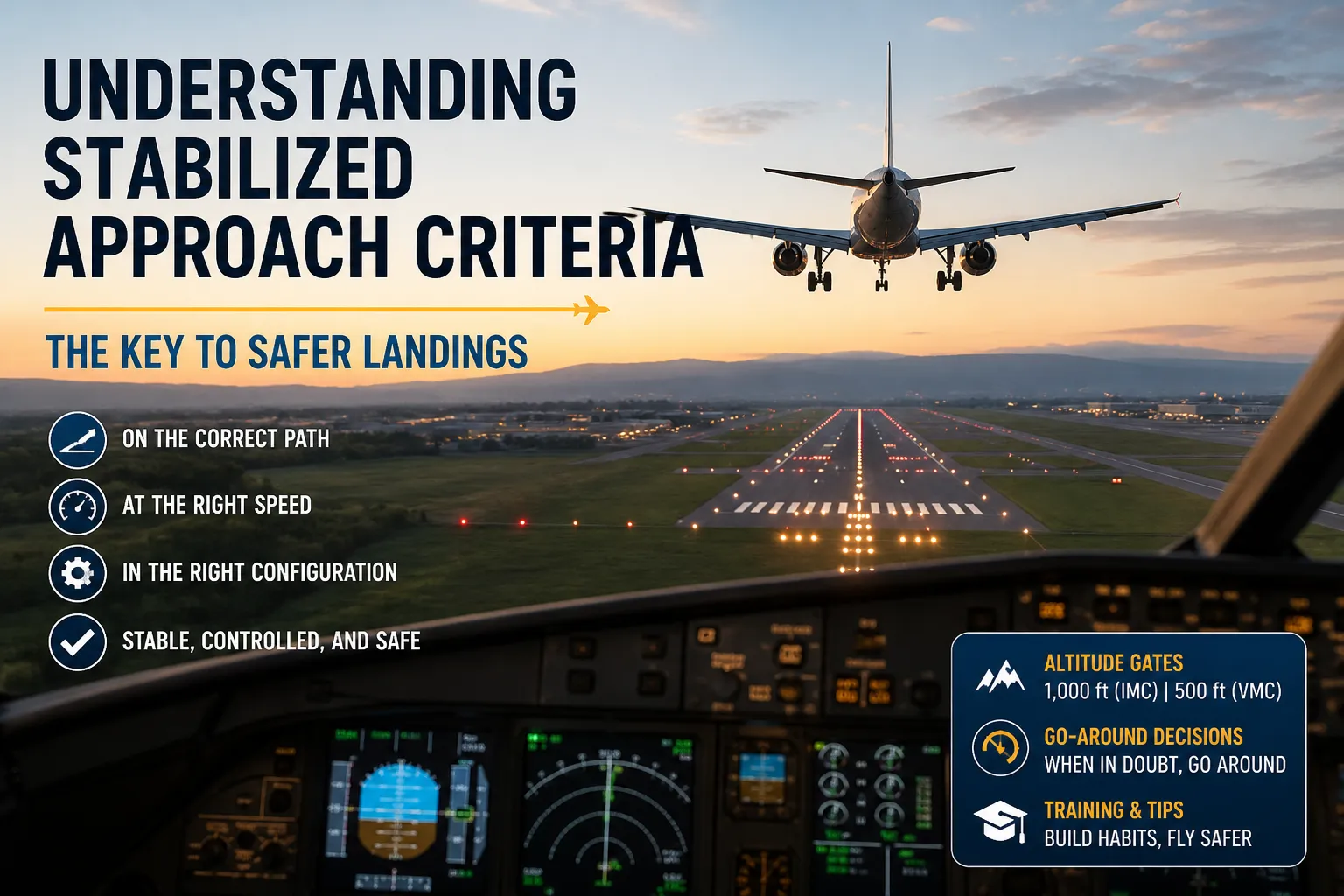
A stabilized approach is the backbone of a safe landing. Pilots and instructors use the stabilized approach concept to ensure the aircraft is on the correct path, properly configured, and controllable well before touchdown. The phrase stabilized approach appears in regulatory guidance, airline operating manuals, and international standards, but its practical value is universal: when an approach is stabilized, the pilot has time and margin to finish the landing safely; when it is not, the safest action is often a go-around.
This article explains what a stabilized approach means in operational terms, reviews standard criteria that operators and instructors commonly apply, discusses altitude gates and decision points, and covers go-around decision making. You will find practical training advice, common mistakes to watch for, realistic scenario examples, and an FAQ that answers likely pilot questions. The aim is to give pilots, instructors, and operations staff a clear, usable understanding of stabilized approach criteria and how to apply them every flight.
What is a stabilized approach?
At its core, a stabilized approach is an approach where key parameters are within acceptable limits so that the aircraft can be flown to a safe landing without excessive maneuvering, configuration changes, or power swings close to the runway. Different authorities and operators phrase the definition in various ways, but three elements are consistent: path, speed, and configuration.
Definitions from FAA, ICAO, and airlines
Regulators and airlines each provide guidance that defines stabilized approaches for their operations. These definitions typically require being on the correct glide path or visual slope, having airspeed close to the target approach speed, and being in the final landing configuration with an appropriate power setting. Airlines and operators often add explicit numeric tolerances and altitude gates that pilots must meet; training and company manuals document those specifics for each aircraft type and operation.
Why a stabilized approach matters
An unstable approach forces pilots into last-minute corrections: steep descent rates, large power changes, or late configuration work. Those corrections increase workload, reduce margins, and are a frequent precursor to runway excursions, hard landings, and other approach-and-landing incidents. Maintaining stabilization gives pilots time to identify deviations and take a safe, deliberate action, including a timely go-around when required.
Standard stabilized approach criteria
Although exact values vary by operator and aircraft type, stabilized approach criteria usually cover the same core parameters. In practice, operators translate these into specific numeric limits for airspeed, descent rate, configuration, and engine power based on aircraft performance, type certification data, and operational considerations.
Proper glide path
Being on the proper glide path means tracking the published glideslope, approach vertical path provided by visual guidance, or an established visual approach angle. If the aircraft is consistently above or below the desired path by an amount that would require large corrections near the runway, the approach is considered unstable. Visual cues and instrument guidance should align; substantial deviation typically requires correction well before the final approach gates.
Correct airspeed
The approach airspeed must be close to the airplane's target approach speed for the current landing weight and configuration. Operators commonly publish tolerances such as +10/–5 knots of target approach speed and descent rates generally below 1,000 feet per minute unless specifically briefed. If airspeed varies significantly or the pilot is forced to chase speed with aggressive power or pitch changes close to the runway, stability is compromised.
Landing configuration set
Landing configuration refers to flaps, landing gear, spoilers, and any other systems required for landing. A stabilized approach requires those items to be set and locked by the stabilization gate. Late extension of gear or flaps or in-progress configuration changes near the runway are a primary source of instability and increase pilot workload at a critical phase.
Descent rate limits
Descent rate is a critical stability parameter. A steady, controlled descent that keeps the airplane on the intended path is required; large, sustained descent rates close to the runway indicate instability. Many operators specify maximum allowed descent rates below a certain altitude, but the exact numeric limit depends on aircraft performance and workload considerations.
Power settings
Power must be appropriate to maintain the approach path and airspeed. Engine power that is fluctuating significantly or an approach made with near-idle thrust in conditions that require more energy to fly the profile is unstable. Proper power management keeps the airplane responsive and avoids excessive pitch or sink-rate corrections.
Altitude gates
Altitude gates are predetermined heights above ground level at which stabilization must be achieved. They are a practical tool instructors and operators use to enforce stabilized-approach discipline during approaches.
1,000 ft AGL (IMC)
For instrument meteorological conditions, many operators require a stabilized approach no later than 1,000 feet above ground level. By this gate, the aircraft should be on the correct flight path, at the appropriate speed, and in the landing configuration. If the approach is not stabilized at this point, the standard action is to initiate a go-around.
500 ft AGL (VMC)
When visual meteorological conditions prevail and pilots have the runway environment in sight, a common industry practice is to allow stabilization to be confirmed by 500 feet AGL. If the aircraft is still not stable by that altitude, a go-around is usually required. These lower-altitude gates account for the reduced workload and better visual references in VMC, but they still enforce a timely decision point.
What must be achieved by each point
By the applicable stabilization gate the aircraft should typically be established on the correct path, at target approach speed within the published or operator tolerance, and in the final landing configuration with power set to maintain energy. The approach should be flown with a stable descent rate and predictable control inputs. If any of these elements are not met, the pilot should fly a go-around and reestablish the approach under controlled conditions.
Go-around decision making
A decisive, timely go-around is an essential safety tool. The phrase no-fault go-around captures the idea that initiating a go-around is a safe, non-punitive decision made to protect the flight when stabilization criteria are not met.
“No-fault go-around” concept
A no-fault go-around encourages pilots to execute the maneuver without hesitation or fear of operational consequences. It recognizes that operational pressure should never outweigh safety. Operators that adopt this mindset and communicate it clearly during training and line operations tend to see better compliance and fewer approach-and-landing incidents.
Common pilot hesitation and why it is dangerous
Pilots may hesitate to go around for several reasons: perceived pressure to land on schedule, a belief they can salvage the approach, or concern about passenger reactions. Hesitation often leads to last-second aggressive corrections, higher workload, and reduced margin for recovery. A timely go-around preserves options and avoids the compounding hazards that come from trying to force an unstable approach to a landing.
Real-world scenarios
Unstable approaches appear in many forms. A few common examples illustrate how instability develops and why it matters.
Examples of unstable approaches
- Late configuration: Flaps or landing gear extended at low altitude, requiring large pitch or power changes to meet the profile.
- Speed decay or overspeed: Chasing airspeed corrections close to the runway, resulting in large power swings and pitch inputs.
- Excessive descent rate: Intercepting the glide path from above with a high descent rate that requires rapid reduction to near idle earlier than planned.
- Visual illusions: Approaches over featureless terrain or water can produce misperceptions of height and glide path, prompting inappropriate control inputs.
Accident case studies
Runway excursions, hard landings, and loss of control during landing have repeatedly been linked to unstable approaches in safety reports. Detailed lessons are available in accident and incident reports that examine the causal chain: unstable approach, delayed go-around, attempted salvage, and adverse outcome. Pilots should consult relevant safety publications and accident reports to study specific examples for their aircraft and operating environment.
Training tips
Good training creates muscle memory for stabilization and normalizes go-arounds. Instructors and training programs can apply several practical methods to teach stabilized approaches effectively.
How instructors can teach it effectively
- Teach explicit criteria: Use clear, documentable stabilization gates and numeric limits appropriate to the aircraft and operation.
- Use scenario-based training: Simulate distractions, abnormal configurations, and wind changes so students learn to recognize and respond to destabilizing cues.
- Enforce go-arounds during training: Make go-arounds the expected normative response when criteria are not met to reduce hesitation in real operations.
- Debrief with Use flight data, when available, or instructor observations to review energy state, speed, and configuration changes during approaches.
Common student mistakes
Students frequently make the same errors: delaying configuration changes, chasing airspeed with large pitch changes, failing to brief the go-around, and letting visual fixations take priority over instrument indications. Address these by reinforcing procedures, practicing energy management, and requiring clear callouts and briefings.
Practical Example
Imagine a single-pilot turboprop on an approach to a short runway in marginal VMC. The pilot is high on the glideslope and extends flaps late, then reduces power to capture the path. At 700 feet AGL the approach speed is 15 knots above target and the descent rate is fluctuating. The pilot considers continuing because the runway is in sight, but remembers the company stabilization gate of 500 feet in VMC. The pilot initiates a go-around, climbs away, reconfigures, and returns for a stabilized approach that meets criteria. The timely decision removes the need for large control inputs close to the ground and preserves safety margins.
Best Practices for Pilots
Applying the stabilized approach concept consistently reduces approach-and-landing risk. Practical habits to adopt include:
- Brief a go-around on every approach and make it a standard part of the approach callout flow.
- Use company or aircraft-specific stabilization gates; if none are prescribed, adopt conservative gates and standardize them for training.
- Monitor energy state proactively; anticipate configuration changes earlier than you think you need to.
- Practice go-arounds frequently so executing them becomes routine rather than a stressful emergency.
Frequently Asked Questions
What if I reach the runway threshold unstabilized but visual references look good?
Even with good visual references, an unstabilized aircraft near the runway increases risk. Industry practice is to go around rather than attempt to salvage a destabilized approach. A short, controlled go-around and reestablishment of stabilized conditions is safer than forcing a landing.
Are stabilized approach criteria the same for all aircraft?
No. While the conceptual elements are the same, numeric tolerances for speed, descent rate, and configuration timing vary by aircraft type and operator. Use the values specified in your aircraft operating manual or company procedures.
How should instructors grade a student who goes around for instability?
A no-fault go-around performed for valid stabilization reasons should be treated as a correct safety decision. Provide constructive debriefing on what led to instability and how to prevent it in the future.
Can automation help maintain stabilization?
Autopilots and flight director systems can maintain path and speed effectively when used appropriately, but automation cannot substitute for judgment. Pilots must monitor the automation and be prepared to disconnect and fly a go-around if automation cannot achieve or maintain stabilized conditions.
Key Takeaways
- Practical takeaway: Define and enforce stabilization gates and numeric tolerances appropriate to your aircraft and operation to create predictable decision points.
- Safety takeaway: A timely, no-fault go-around is often the safest response to an unstable approach; hesitation increases risk.
- Training takeaway: Teach stabilization as a normal part of approach discipline and practice go-arounds frequently so they become routine and unremarkable.