
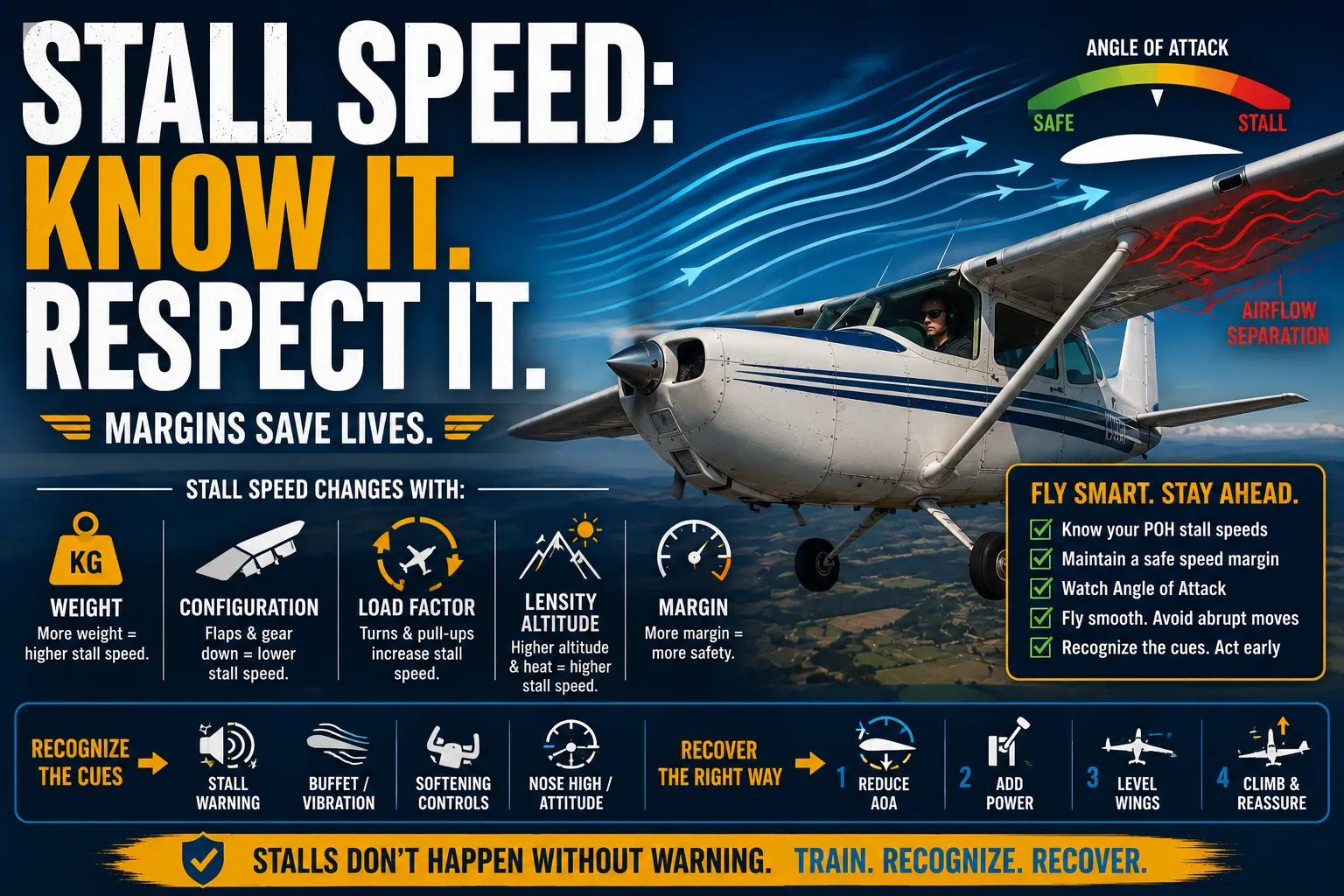
Stall speed is one of the most important performance numbers a pilot can understand. It is not a single fixed value but a set of speeds that describe when a wing will stop producing the lift needed to support an airplane. A clear understanding of stall speed helps pilots manage approach safety, maneuvering, and recovery from unexpected events.
This article explains what stall speed means in practical terms, how it changes with configuration and maneuvering, and why pilots should think in terms of angle of attack and margins rather than a single airspeed value. You will get clear explanations, operational takeaways, common mistakes to avoid, and a realistic training scenario to practice the concepts.
What stall speed really means
Stall speed is the indicated airspeed at which the wing reaches its critical angle of attack and cannot produce further lift. The critical angle of attack is the geometric angle between the wing chord line and the oncoming airflow where lift falls off sharply. The critical angle itself is a property of the wing and does not change with airspeed, weight, or configuration. What does change is the airspeed at which that angle is reached.
Several stall speeds are commonly used in pilots’ operating data because configuration matters. For example, flaps extended, gear down, and other lift-enhancing devices typically lower the speed at which a given angle of attack produces sufficient lift for level flight. Conversely, higher weight or added load factors increase the airspeed required to reach the critical angle.
Why this matters in real-world aviation
In flight training, airline operations, and everyday flying, stall speed is part of the safety margin pilots build into approach, climb, and maneuvering speeds. Many accidents happen when pilots allow their margin over stall speed to erode during slow flight, tight turns close to the ground, or when distracted during approach and landing. Understanding the variables that alter stall speed helps you manage those margins proactively.
Operationally, stall awareness influences landing and approach speed selection, go-around decisions, and how we teach and practice stall recovery. It also affects load and balance planning, as center of gravity and weight distribution influence handling and the effective stall behavior of the airplane.
How pilots should understand stall speed
Think about stall threat in three linked ways: angle of attack, indicated airspeed, and margin. Angle of attack tells you how close the wing is to its critical condition. Indicated airspeed tells you where the airplane sits relative to published stall speeds in a particular configuration. Margin is the buffer between your flying speed and the speed where a stall becomes imminent.
Always consult the airplane’s pilot operating handbook or flight manual for the published stall speeds for each configuration. Use those numbers as baseline reference points but remember that the stall can occur above or below those numbers depending on configuration, weight, bank angle, turbulence, or contamination of the wing.
Practical concepts to internalize:
- Critical angle of attack is constant for a wing; the airspeed at which it is reached changes with conditions.
- Flaps and high-lift devices change the speed at which a wing needs to fly to avoid a stall, not the fact that a stall is an angle-of-attack issue.
- Load factor (turning or abrupt maneuvers) increases effective stall speed. A steeper bank at a given indicated airspeed requires more lift, which increases the angle of attack required and raises the stall speed.
Common mistakes or misunderstandings
Many pilots treat stall speed as a single immutable figure. In practice, several common errors reduce safety margins:
- Relying solely on a remembered stall speed without checking the POH for configuration-specific values.
- Ignoring load factor during turns and maneuvers. Even moderate bank angles raise the stall speed noticeably.
- Confusing indicated airspeed with angle of attack. A given IAS may be safe in calm air but inadequate in a gusty environment or during a climbing turn.
- Not adjusting speeds for weight and density altitude. Higher gross weight and lower air density both change the airspeed at which the airplane reaches the critical angle of attack.
- Failing to recognize aerodynamic cues. Relying only on cockpit warnings or instruments can delay recognition of an impending stall.
Practical example
Imagine you are flying a light single-engine trainer on final approach. Your airplane’s landing-configuration stall speed listed in the flight manual is a baseline figure for the aircraft’s weight and configuration. On a calm day at sea level with a light load, flying approach at the recommended speed may provide an acceptable margin. Now add a steady 15-knot headwind gusting to 25 knots, a slightly aft center of gravity, and a turn to final during the approach. The gusts can momentarily reduce your indicated airspeed; the turn increases load factor and therefore the airspeed at which the wing will stall; and the aft CG can change pitch stability. Those combined effects reduce your margin above the stall even though you are flying the same indicated approach speed.
In training, this scenario is useful: conduct a stabilized approach briefing, call for a specific target approach speed with a clear margin above the POH stall speed, and rehearse a go-around decision point. During the practice, deliberately add small pitch changes or bank angles to show how margin closes and how quick, coordinated control and power changes restore margin.
Best practices for pilots
Approach stall awareness and safe low-speed operation come from both knowledge and consistent habits. Practical habits to adopt include:
- Know the published stall speeds for each configuration from the POH and apply them during planning.
- Use a clear margin above published stall speeds when selecting approach and maneuvering speeds; increase the margin in turbulence, gusty winds, or close to the airplane’s gross weight limits.
- Prioritize angle-of-attack awareness. When available, use AoA indicators or stabilizer trim references as a complement to airspeed information.
- Minimize abrupt control inputs at low speed; practice gentle, purposeful recovery techniques during dual instruction until muscle memory is reliable.
- Brief and rehearse go-around or escape options during approach and maneuvering near the ground so that decision-making is not delayed if margins erode.
Frequently Asked Questions
What is the difference between stall speed and critical angle of attack?
Stall speed is the indicated airspeed at which the wing reaches its critical angle of attack in a given configuration. The critical angle of attack is the wing-specific angle where lift falls off sharply. The angle itself stays roughly the same; the airspeed at which it is reached changes with weight, load factor, and configuration.
Does weight change stall speed?
Yes. Increasing weight requires more lift to maintain level flight, which means the wing must operate at a higher angle of attack for a given airspeed. In practical terms, a heavier airplane will reach its critical angle at a higher indicated airspeed than a lighter one in the same configuration.
How do flaps affect stall speed?
Flaps and other high-lift devices change the lift curve of the wing and generally reduce the stall speed for landing configurations. However, flaps also change handling characteristics and may change the stall’s behavior. Always use the POH’s published stall speeds for the specific flap setting you are flying.
Can a stall happen at cruise speed?
A stall can occur at any airspeed if the angle of attack exceeds the wing’s critical value. In cruise, this is uncommon unless the pilot imposes a very high angle of attack through abrupt pitch changes or encounters extreme turbulence or wind shear. Don’t assume high indicated airspeed alone guarantees immunity from stalls; angle-of-attack remains the governing factor.
Is an angle-of-attack indicator better than airspeed to avoid stalls?
An AoA indicator provides direct feedback on how close the wing is to its critical angle and can be a valuable tool. However, it complements rather than replaces good speed management and reference to the POH. Not all light aircraft have AoA indicators installed, so familiarity with the airplane’s stall behavior and maintaining safe speed margins remains essential.
Key Takeaways
- Practical takeaway: Think in terms of angle of attack and maintain a clear airspeed margin above published stall speeds for the current configuration.
- Safety takeaway: Load factor, weight, configuration, and atmosphere combine to change the stall speed; adjust approach and maneuvering speeds accordingly and rehearse go-around decisions.
- Training and decision-making takeaway: Practice recognition and recovery in a structured training environment, use AoA cues when available, and always consult the POH for configuration-specific guidance.