
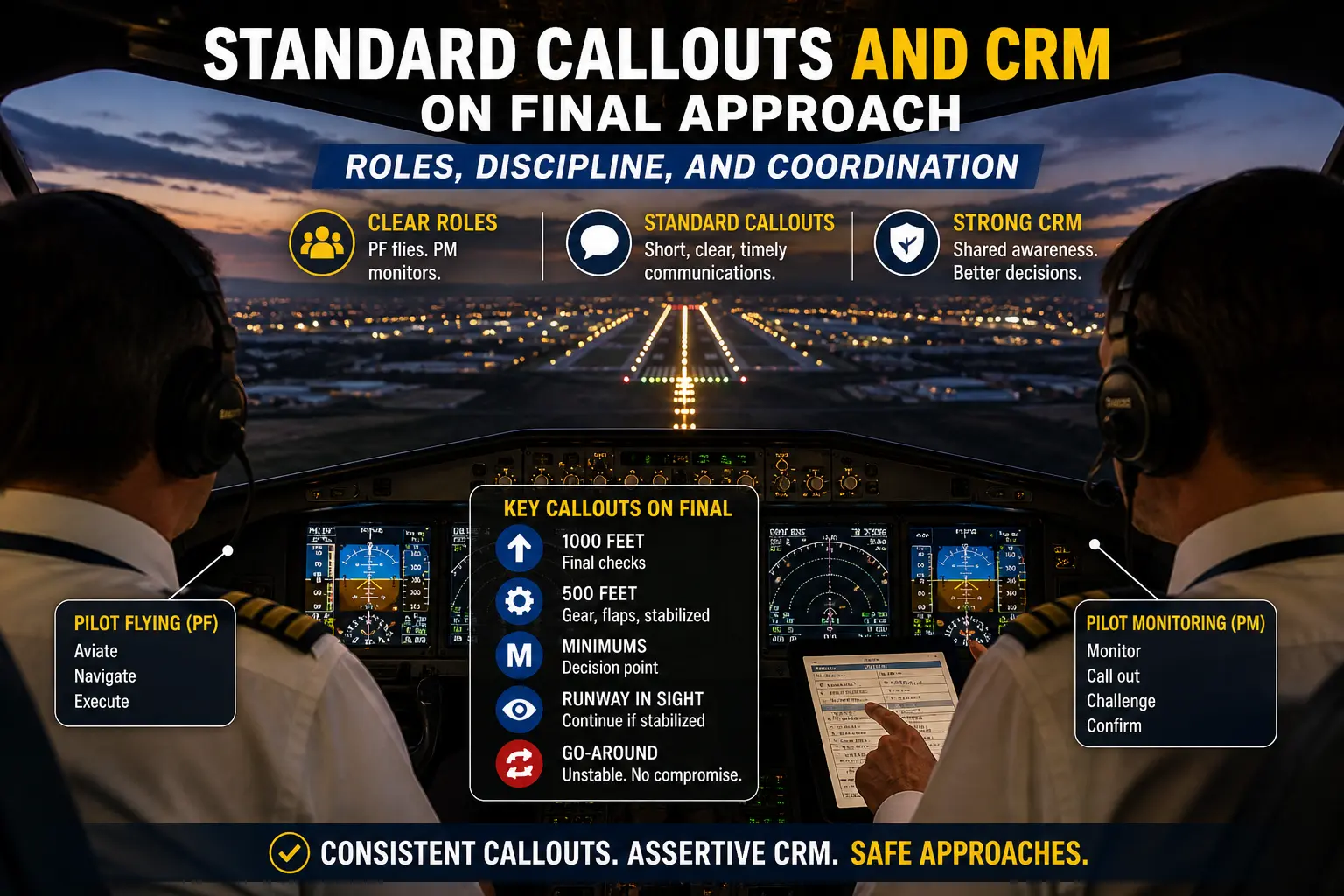
Standard callouts and CRM on final approach are essential tools for two-pilot operations and for any flight where a second set of eyes and hands improves safety. The phrase "standard callouts and CRM on final approach" refers to the predictable verbal cues and coordinated behaviors crews use to manage workload, maintain situational awareness, and detect deviations before they become threats. Pilots who master these elements reduce the risk of unstabilized approaches, runway excursions, and last-minute errors.
This article explains practical callout discipline, the pilot monitoring role, and crew coordination techniques during the high-workload phase of final approach. It describes how to apply standard callouts in realistic operations, how to avoid common misunderstandings, and how CRM practices support decision making when conditions change. Follow these principles alongside your company standard operating procedures and aircraft flight manual for safe, consistent approaches.
Clear main section: What are standard callouts and why they matter
Standard callouts are short, unambiguous verbal statements or confirmations made by the pilot monitoring (PM) or pilot flying (PF) at predefined times or when specific parameters change. They create shared situational awareness and provide early warning of deviations from planned flight path, speed, or configuration. Callouts reduce surprise by ensuring both crew members are verbally aligned on the aircraft state and the next expected actions.
Callouts are most effective when they are standardized across an operation. Standardization eliminates confusion about intent, reduces back-and-forth clarification, and speeds recognition of abnormalities. Effective callouts are concise, use plain aviation language, and include only the information needed to prompt action or confirm status.
Why this matters in real-world aviation
Final approach is a phase where altitude and speed margins narrow and the runway becomes the focal point. High workload, changing weather, ATC vectors, and visual illusions all increase the chance of error. In multi-crew operations, a disciplined approach to callouts and CRM distributes workload and uses both pilots’ cognitive resources to spot threats early.
Regulators and operators emphasize stabilized approach criteria and crew coordination because many approach and landing incidents involve loss of energy management, late configuration, or inappropriate continuation to landing. Standard callouts and good CRM help crews comply with stabilized-approach expectations, recognize when a go-around is necessary, and manage the aircraft safely when conditions are degraded.
How pilots should understand the pilot monitoring role and callout discipline
The pilot monitoring has several key responsibilities on final approach: monitor airspeed, vertical path, lateral alignment, configuration, and brief deviations to the pilot flying. Monitoring includes reading instruments, scanning outside references when appropriate, and making timely callouts when parameters approach predefined limits.
Callout discipline means three things: timing, phrasing, and follow-through. Timing ensures callouts occur at consistent checkpoints or when important thresholds are crossed. Phrasing keeps messages short and unambiguous. Follow-through demands a clear response from the pilot flying and, when required, an agreed remedy.
Common callout categories include configuration confirmations, altitude and descent profile checks, speed and sink rate alerts, runway or visual references, and procedural reminders such as missed approach briefings. These categories should map to an operator's SOPs and to the crew brief conducted before the approach.
Pilot monitoring examples and suggested callout structure
Below are practical example callouts presented as typical phrases crew might use during final approach. These are examples for training and discussion; crews must follow company SOPs and adapt wording as required by their operation.
- Approach brief complete - PF acknowledges: confirms plan and any unusual items.
- 1000 feet above airport - PM: a situational reminder to prepare final checks.
- 500 feet - PM: prompts final landing checks and review stabilized approach criteria.
- Minimums - PM: announces reaching the published decision altitude or minimum descent altitude.
- Runway in sight - PF: indicates visual contact and intention to continue if stabilized.
- Go-around - PF initiates or PM can call for go-around if safety margins are unacceptable.
Each callout should include a clear expectation. For example, when the PM calls "500 feet," the PF should respond with a short acknowledgement or with the current status if any CHECK item is not complete. If the aircraft is not stabilized, a short statement such as "unstabilized, going around" removes ambiguity.
Common mistakes or misunderstandings
Misunderstandings about callouts and CRM often arise from inconsistent phraseology, vague confirmations, or reluctance to speak up. Typical errors include:
- Using nonstandard or informal language that leaves the meaning open to interpretation.
- Delaying callouts until parameters are well outside safe margins, which reduces the time available to correct the situation.
- A passive PM who notices deviations but does not make a firm callout or recommendation.
- The PF treating the PM’s role as merely procedural and not engaging in mutual monitoring and cross-checking.
- Overly verbose callouts that increase workload rather than clarify it.
Address these by standardizing phrasing within your operation, training crews to expect direct and short communications, and reinforcing a safety culture where both pilots can call for a go-around without stigma.
Practical example: a two-pilot approach scenario
Imagine a two-pilot crew on an instrument approach in marginal visual conditions. The approach brief covered minima, runway condition, and a potential circle-to-land. The PF flies, and the PM monitors. At 1,000 feet above airport elevation, the PM calls "1000 to go, final checks." The PF acknowledges. As the aircraft descends, a gust increases indicated airspeed by several knots and the aircraft floats above the glide path. The PM calls "speed high, sink low," followed immediately by a succinct corrective action from the PF, such as reducing thrust slightly and applying minor pitch change.
At 500 feet, the PM calls "500, gear and flaps set?" The PF confirms. Approaching minimums, the PM calls "minimums." The PF states "runway in sight" and continues. If the PF had not obtained visual contact or if the aircraft remained outside stabilized parameters, the PM would be expected to call out the deviation and the PF to initiate a go-around without delay. This example shows how timely, specific callouts and clear role adherence keep the approach safe and manageable.
Best practices for pilots
Adopt these best practices to improve callout effectiveness and CRM on final:
- Agree on standard callouts during the pre-approach brief and practice them in training sessions to build automatic responses.
- Keep callouts short and actionable. If a problem is called out, add a recommended remediation when appropriate.
- Practice the assertive crew model: the PM makes timely calls and the PF acknowledges and acts; either pilot can call for a go-around when safety is compromised.
- Use readbacks and confirmations for critical items like autopilot disconnect, landing altitude, and runway in sight to ensure both pilots share the same mental model.
- Regularly review noise, visibility, and runway-surface threats in crew briefings so callouts reflect the environment and not just numeric thresholds.
Frequently Asked Questions
How specific should callout phrasing be?
Callouts should be specific enough to convey the parameter and the expected action, but concise to avoid adding workload. Use agreed-upon words that clearly indicate the situation, for example "unstabilized, going around" instead of uncertain language.
3Who is responsible for calling a go-around?
Either pilot can initiate a go-around. Standard CRM practice encourages the PF to fly and make decisions, but the PM must call for a go-around without hesitation if safety margins are compromised and the PF does not respond promptly.
Should callouts be identical across all aircraft types?
While the principles are the same, specific callout wording and the exact triggers may vary by operator and aircraft type. Follow your operator SOPs and aircraft checklists, and use training to align phrasing within your crew.
How do I train crews to improve callout discipline?
Use simulator scenarios that focus on communication and monitoring, include degraded-visibility and automation-failure profiles, and conduct debriefs that analyze the timing and clarity of callouts. Emphasize short, decisive language and practice assertive communications.
What if the PM and PF disagree on a decision on final?
CRM principles call for open, respectful challenge followed by escalation if needed. If a disagreement persists and safety is in question, default to the most conservative action, typically a go-around, until the situation can be resolved.
Key Takeaways
- Practical takeaway: Use brief, standardized callouts timed to checkpoints so both pilots share a clear mental picture on final approach.
- Safety takeaway: Timely monitoring and assertive communication enable early corrections or a prompt go-around before safety margins are lost.
- Training/decision-making takeaway: Practice callout discipline and CRM in the simulator and reinforce company SOPs to ensure consistent responses under pressure.